|
Published:
June 13, 2016

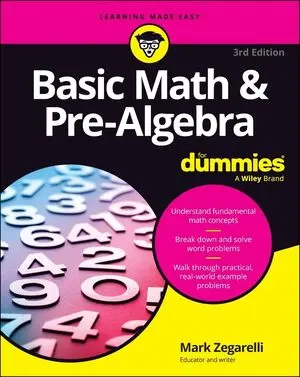
Basic Math & Pre-Algebra For Dummies

Overview

Basic Math & Pre-Algebra For Dummies, 2nd Edition (9781119293637) was previously published as Basic Math & Pre-Algebra For Dummies, 2nd Edition (9781118791981). While this version features a new Dummies cover and design, the content is the same as the prior release and should not be considered a new or updated product.


Tips for simplifying tricky basic math and pre-algebra operations

Whether you're a student preparing to take algebra or a parent who wants or needs to brush up on basic math, this fun, friendly guide has the tools you need to get in gear. From positive, negative, and whole numbers to fractions, decimals, and percents, you'll build necessary math skills to tackle more advanced topics, such as imaginary numbers, variables, and algebraic equations.

  • Explanations and practical examples that mirror today's teaching methods
  • Relevant cultural vernacular and references
  • Standard For Dummiesmaterials that match the current standard and design

Basic Math & Pre-Algebra For Dummies takes the intimidation out of tricky operations and helps you get ready for algebra!

Read More

About The Author

Mark Zegarelli is the author of many successful For Dummies titles on math, logic, and test prep topics. He holds degrees in both English and math from Rutgers University and is the founder of SimpleStep Learning, an educational website (https://simplestep.co).

Sample Chapters

basic math & pre-algebra for dummies

CHEAT SHEET

A little understanding can go a long way toward helping master math. Some math concepts may seem complicated at first, but after you work with them for a little bit, you may wonder what all the fuss is about.You'll find easy-to-understand explanations and clear examples in these articles that cover basic math concepts — like order of operations; the commutative, associative, and distributive properties; radicals, exponents, and absolute values — that you may remember (or not) from your early math and pre-algebra classes.

HAVE THIS BOOK?

Articles from
the book

The ten little math demons listed here plague all sorts of otherwise smart, capable folks like you. The good news is that they're not as big and scary as you may think, and they can be dispelled more easily than you may have dared believe. Knowing the multiplication table A sketchy knowledge of multiplication can really hold back an otherwise good math student.
Each of the sets of numbers listed here serves a different purpose, some familiar (such as accounting and carpentry), some scientific (such as electronics and physics), and a few purely mathematical. Counting on counting (or natural) numbers The counting numbers — also called the natural numbers — are probably the first numbers you ever encountered.
Math itself is one big concept, and it's chock full of so many smaller mathematical concepts that no one person can possibly understand them all — even with a good dose of studying. Yet certain concepts are so important that they make the Math Hall of Fame: Sets and set theory A set is a collection of objects.
Two common myths about word problems are that word problems are always hard and word problems are only for school — after that, you don't need them. Both of these ideas are untrue. Word problems aren't always hard Word problems don't have to be hard. For example, here's a word problem that you may have run into in first grade: Adam had 4 apples.
When you boil them down, nearly all percent problems are like one of the three types shown in the following table. In each case, the problem gives you two of the three pieces of information, and your job is to figure out the remaining piece. The Three Main Types of Percent Problems Problem Type What to Find Example Type #1 The ending number 50% of 2 is what?
The number line grows in both the positive and negative directions and fills in with a lot of numbers in between. Here is a quick tour of how numbers fit together as a set of nested systems, one inside the other.A set of numbers is really just a group of numbers. You can use the number line to deal with four important sets of numbers: Counting numbers (also called natural numbers): The set of numbers beginning 1, 2, 3, 4 .
In math, factors and multiples are two important connected concepts. Multiplication and division are inverse operations. You may have noticed that, in math, you tend to run into the same ideas over and over again. For example, mathematicians have six different ways to talk about this relationship. For example, the following equation is true: So this equation using the inverse operation is also true: The following three statements all focus on the relationship between 5 and 20 from the perspective of multiplication: 5 multiplied by some number is 20.
The great secret to adding and subtracting negative numbers is to turn every problem into a series of ups and downs on the number line. When you know how to do this, you find that all these problems are quite simple.Don't worry about memorizing every little bit of this procedure. Instead, just follow along so you get a sense of how negative numbers fit onto the number line.
A term in an algebraic expression is any chunk of symbols set off from the rest of the expression by either addition or subtraction. As algebraic expressions get more complex, they begin to string themselves out in more terms. Here are some examples: Expression Number of Terms Terms 5x One 5x –5x + 2 Two –5x and 2 x2y + z/3 – xyz + 8 Four x2y, z/3, –xyz, and 8 No matter how complicated an algebraic expression gets, you can always separate it out into one or more terms.
Evaluate exponents from left to right before you begin evaluating Big Four operations (adding, subtracting, multiplying, and dividing). The trick here is to turn the expression into a Big Four expression and then use the other basic order of operations rules. The Three Types of Big Four Expressions Expression Example Rule Contains only addition and subtraction 12 + 7 - 6 - 3 + 8 Evaluate left to right.
Some expressions contain only addition and subtraction. When this is the case, the rule for evaluating the expression is simple. When an expression contains only addition and subtraction, evaluate it step by step from left to right. The Three Types of Big Four Expressions Expression Example Rule Contains only addition and subtraction 12 + 7 – 6 – 3 + 8 Evaluate left to right.
Often an expression contains at least one addition or subtraction operator and at least one multiplication or division operator. These expressions are mixed-operator expressions. To evaluate them, you need some stronger medicine. The Three Types of Big Four Expressions Expression Example Rule Contains only addition and subtraction 12 + 7 – 6 – 3 + 8 Evaluate left to right.
A little understanding can go a long way toward helping master math. Some math concepts may seem complicated at first, but after you work with them for a little bit, you may wonder what all the fuss is about.You'll find easy-to-understand explanations and clear examples in these articles that cover basic math concepts — like order of operations; the commutative, associative, and distributive properties; radicals, exponents, and absolute values — that you may remember (or not) from your early math and pre-algebra classes.
Sometimes you can check divisibility by adding up all or some of the digits in a number. The sum of a number's digits is called its digital root. Finding the digital root of a number is easy, and it's handy to know. To find the digital root of a number, just add up the digits and repeat this process until you get a one-digit number.
A polygon is any shape whose sides are all straight. Every polygon has three or more sides (if it had fewer than three, it wouldn't really be a shape at all). Following are a few of the most common polygons. Triangles The most basic shape with straight sides is the triangle, a three-sided polygon. You find out all about triangles when you study trigonometry.
Fractions, decimals, and percents are the three most common ways to give a mathematical description of parts of a whole object. Fractions are common in baking and carpentry when you're using English measurement units (such as cups, gallons, feet, and inches). Decimals are used with dollars and cents, the metric system, and in scientific notation.
The English system of measurements is most commonly used in the United States. In contrast, the metric system is used throughout most of the rest of the world. Converting measurements between the English and metric systems is a common everyday reason to know math. This article gives you some precise metric-to-English conversions, as well as some easy-to-remember conversions that are good enough for most situations.
Numbers starting with a 1 and followed by only 0s (such 10, 100, 1,000, 10,000, and so forth) are called powers of ten, and they're easy to represent as exponents. Powers of ten are the result of multiplying 10 times itself any number of times. To represent a number that's a power of 10 as an exponential number, count the zeros and raise 10 to that exponent.
What about percentages more than 100%? Well, sometimes percentages like these don't make sense. For example, you can't spend more than 100% of your time playing basketball, no matter how much you love the sport; 100% is all the time you have, and there ain't no more. 100% means "100 out of 100" — in other words, everything.
Data — the information used in statistics — can be either qualitative or quantitative. Qualitative data divides a data set (the pool of data that you've gathered) into discrete chunks based on a specific attribute. For example, in a class of students, qualitative data can include Each child's gender His or her favorite color Whether he or she owns at least one pet How he or she gets to and from school You can identify qualitative data by noticing that it links an attribute — that is, a quality — to each member of the data set.
Two-digit numbers that are divisible by 11 are hard to miss because they simply repeat the same digit twice. Here are all the numbers less than 100 that are divisible by 11: 11 22 33 44 55 66 77 88 99 For numbers between 100 and 200, use this rule: Every three-digit number whose first and third digits add up to its second digit is divisible by 11.
You use decimals all the time when you count money. And a great way to begin thinking about decimals is as dollars and cents. For example, you know that $0.50 is half of a dollar, so this information tells you: 0.5 = 1/2. Notice that, in the decimal 0.5, the zero at the end is dropped. This practice is common with decimals.
Some expressions contain only multiplication and division. When this is the case, the rule for evaluating the expression is pretty straightforward. When an expression contains only multiplication and division, evaluate it step by step from left to right. The Three Types of Big Four Expressions Expression Example Rule Contains only addition and subtraction 12 + 7 – 6 – 3 + 8 Evaluate left to right.
When arithmetic expressions get complex, use the order of operations (also called the order of precedence) to simplify them. Complex math problems require you to perform a combination of operations — addition, subtraction, multiplication, and division — to find the solution. The order of operations simply tells you what operations to do first, second, third, and so on.
Fractions have their own special vocabulary and a few important properties that are worth knowing right from the start. When you know them, you find working with fractions a lot easier. Telling the numerator from the denominator The top number in a fraction is called the numerator, and the bottom number is called the denominator.
Converting a decimal to a fraction is pretty simple. The only tricky part comes in when you have to reduce the fraction or change it to a mixed number. Doing a basic decimal-to-fraction conversion Here's how to convert a decimal to a fraction: Draw a line (fraction bar) under the decimal and place a 1 underneath it.
The ten digits in the number system allow you to count from 0 to 9. All higher numbers are produced using place value. Place value assigns a digit a greater or lesser value, depending on where it appears in a number. Each place in a number is ten times greater than the place to its immediate right. To understand how a whole number gets its value, suppose you write the number 45,019 all the way to the right, one digit per cell, and add up the numbers you get.
Division is different from addition, subtraction, and multiplication in that having a remainder is possible. A remainder is simply a portion left over from the division. For example, suppose you're a parent on a picnic with your three children. You've brought along 12 pretzel sticks as snacks, and want to split them fairly so that each child gets the same number (don't want to cause a fight, right?
Even though multiples tend to be larger numbers than factors, most students find them easier to work with. Finding all the factors is possible because factors of a number are always less than or equal to the number itself. So no matter how large a number is, it always has a finite (limited) number of factors. Unlike factors, multiples of a number are greater than or equal to the number itself.
With decimals, this idea behind the place value of whole numbers is extended. First, a decimal point is placed to the right of the ones place in a whole number. Then more numbers are appended to the right of the decimal point. The following table shows how the whole number 4,672 breaks down in terms of place value.
The center of a circle is a point that's the same distance from any point on the circle itself. This distance is called the radius of the circle, or r for short. And, any line segment from one point on the circle through the center to another point on the circle is called a diameter, or d for short. The diameter As you can see, the diameter of any circle is made up of one radius plus another radius — that is, two radii (pronounced ray-dee-eye).
Two important skills in geometry — and real life — are finding the perimeter and calculating the area of shapes. A shape's perimeter is a measurement of the length of its sides. You use perimeter for measuring the distance around the edges of a room, building, or circular pathway. A shape's area is a measurement of how big it is inside.
You can measure the perimeter and area of all triangles. There also is a special feature of right triangles that allows you to measure them more easily. Finding the perimeter and area of a triangle Mathematicians have no special formula for finding the perimeter of a triangle — they just add up the lengths of the sides.
The main reason to know the multiplication table is so you can more easily multiply larger numbers. For example, suppose you want to multiply 53 x 7. Start by stacking these numbers on top of another, aligning the ones place. Draw a line underneath, and then multiply 3 by 7. Because 3 x 7 = 21, write down the ones digit (1) and carry the tens digit (2) to the tens column:Next, multiply 5 by 7.
You can multiply very quickly when you understand the concept of exponents. Here's an old question whose answer may surprise you: Suppose you took a job that paid you just 1 penny the first day, 2 pennies the second day, 4 pennies the third day, and so on, doubling the amount every day, like this: 1 2 4 8 16 32 64 128 256 512 .
Multiplying numbers that are in scientific notation is fairly simple because multiplying powers of ten is easy. Here's how to multiply two numbers that are in scientific notation: Multiply the two decimal parts of the numbers. Suppose you want to multiply the following: (4.3 x 10⁵)(2 x 10⁷) Multiplication is commutative, so you can change the order of the numbers without changing the result.
Here's a simple fact: When you cut a cake into two equal pieces, each piece is half of the cake. As a fraction, you write that as 1/2. In the figure, the shaded piece is half of the cake. Every fraction is made up of two numbers separated by a line, or a fraction bar. The line can be either diagonal or horizontal — so you can write this fraction in either of the following two ways: The number above the line is called the numerator.
Sometimes people confuse numbers and digits. The number system you're most familiar with — Hindu-Arabic numbers — has ten familiar digits: 0, 1, 2, 3, 4, 5, 6, 7, 8, and 9. For the record, here's the difference: A digit is a single numerical symbol, from 0 to 9. A number is a string of one or more digits. For example, 7 is both a digit and a number.
Fractions help you fill in a lot of the spaces on the number line that fall between the counting numbers. For example, the figure shows a close-up of a number line from 0 to 1.This number line may remind you of a ruler or a tape measure, with a lot of tiny fractions filled in. In fact, rulers and tape measures really are portable number lines that allow carpenters, engineers, and savvy do-it-yourselfers to measure the length of objects with precision.
Scientific notation is a standard way of writing very large and very small numbers so that they're easier to both compare and use in computations. To write in scientific notation, follow the formwhere N is a number between 1 and 10, but not 10 itself, and a is an integer (positive or negative number).You move the decimal point of a number until the new form is a number from 1 up to 10 (N), and then record the exponent (a) as the number of places the decimal point was moved.
You can tell whether a number is divisible by 2, 5, 10, 100, or 1,000 simply by looking at how the number ends — no calculations required. Divisible by 2 Every even number — that is, every number that ends in 2, 4, 6, 8, or 0 — is divisible by 2. For example, the following bold numbers are divisible by 2: Divisible by 5 Every number that ends in either 5 or 0 is divisible by 5.
You need to know how to tell prime numbers from composite numbers to break a number down into its prime factors. This tactic is important when you begin working with fractions. A prime number is divisible by exactly two positive whole numbers: 1 and the number itself. A composite number is divisible by at least three numbers.
The Big Four math operations — addition, subtraction, multiplication, and division — let you combine numbers and perform calculations. Certain operations possess properties that enable you to manipulate the numbers in the problem, which comes in handy, especially when you get into higher math like algebra. The important properties you need to know are the commutative property, the associative property, and the distributive property.
With fractions, the relationship between the numbers, not the actual numbers themselves, is most important. Understanding how to multiply and divide fractions can give you a deeper understanding of why you can increase or decrease the numbers within a fraction without changing the value of the whole fraction. When you multiply or divide any number by 1, the answer is the same number.
The percent circle is a simple visual aid that helps you make sense of percent problems so that you can solve them easily. The trick to using a percent circle is to write information into it. For example, this image shows how to record the information that 50% of 2 is 1. In the percent circle, the ending number is at the top, the percentage is at the left, and the starting number is at the right.
The word percent literally means "for 100," but in practice, it means closer to "out of 100." For example, suppose that a school has exactly 100 children — 50 girls and 50 boys. You can say that "50 out of 100" children are girls — or you can shorten it to simply "50 percent." Even shorter than that, you can use the symbol %, which means percent.
Multiplication and division with negative numbers is virtually the same as with positive numbers. The presence of one or more minus signs (–) doesn't change the numerical part of the answer. The only question is whether the sign is positive or negative. Just remember that when you multiply or divide two numbers, If the numbers have the same sign, the result is always positive.
There's no direct method for multiplying and dividing mixed numbers. The only way is to convert the mixed numbers to improper fractions and multiply or divide as usual. Here's how to multiply or divide mixed numbers. For example, suppose you want to multiply 1-3/5 by 2-1/3. Convert all mixed numbers to improper fractions.
Plane geometry is the study of figures on a two-dimensional surface — that is, on a plane. You can think of the plane as a piece of paper with no thickness at all. Technically, a plane doesn't end at the edge of the paper — it continues forever. Making some points A point is a location on a plane. It has no size or shape.
A ratio is a mathematical comparison of two numbers, based on division. For example, suppose you bring 2 scarves and 3 caps with you on a ski vacation. Here are a few ways to express the ratio of scarves to caps: The simplest way to work with a ratio is to turn it into a fraction. Be sure to keep the order the same: The first number goes on top of the fraction, and the second number goes on the bottom.
In algebra, simplifying and factoring expressions are opposite processes. Simplifying an expression often means removing a pair of parentheses; factoring an expression often means applying them. Suppose you begin with the expression 5x(2x2 – 3x + 7). To simplify this expression, you remove the parentheses by multiplying 5x by each of the three terms inside the parentheses: = 10x3 – 15x2 + 35x You can factor the resulting expression by replacing the parentheses: Simply divide each term by a factor of 5x: 5x(2x2 – 3x + 7) The two forms of this expression — 5x(2x2 – 3x + 7) and 10x2 – 15x2 + 35x — are equivalent.
The very mention of word problems — or story problems, as they're sometimes called — is enough to send a cold shiver of terror into the bones of the average math student. Generally, solving a word problem involves four easy steps: Read through the problem and set up a word equation — that is, an equation that contains words as well as numbers.
When people first find out about subtraction, they often hear that you can't take away more than you have. For example, if you have four pencils, you can take away one, two, three, or even all four of them, but you can't take away more than that.It isn't long, though, before you find out what any credit card holder knows only too well: You can, indeed, take away more than you have — the result is a negative number.
An equation is a mathematical statement that tells you that two things have the same value — in other words, it's a statement with an equals sign. The equation is one of the most important concepts in mathematics because it allows you to boil down a bunch of complicated information into a single number. Mathematical equations come in a lot of varieties: arithmetic equations, algebraic equations, differential equations, partial differential equations, Diophantine equations, and many more.
Exponents (also called powers) are shorthand for repeated multiplication. For example, 23 means to multiply 2 by itself three times. To do that, use the following notation:In this example, 2 is the base number and 3 is the exponent. You can read 23 as “2 to the third power” or “2 to the power of 3” (or even “2 cubed,” which has to do with the formula for finding the value of a cube).
The things contained in a set are called elements (also known as members). Consider these two sets: {Empire State Building, Eiffel Tower, Roman Colosseum} and {Albert Einstein's intelligence, Marilyn Monroe's talent, Joe DiMaggio's athletic ability, Sen. Joseph McCarthy's ruthlessness}.The Eiffel Tower is an element of A, and Marilyn Monroe's talent is an element of B.
Every whole number greater than 1 has a prime factorization — that is, the list of prime numbers (including repeats) that equal that number when multiplied together. For example, here are the prime factorizations of 14, 20, and 300: 14 = 2 × 7 20 = 2 × 2 × 5 300 = 2 × 2 × 2 × 3 × 5 Factor trees are a useful tool for finding the prime factorization of a number.
Probability is the mathematics of deciding how likely an event is to occur. You can calculate the probability of an event by using the following formula: For example, when you roll a single six-sided die, you can get six total outcomes: 1, 2, 3, 4, 5, or 6. Every time you add a die, the number of total outcomes is multiplied by 6.
When you understand how scientific notation works, you're in a better position to understand why it works. Suppose you're working with the number 4,500. First of all, you can multiply any number by 1 without changing it, so here's a valid equation: 4,500 = 4,500 x 1 Because 4,500 ends in a 0, it's divisible by 10.
In word problems, the word of almost always means multiplication. So whenever you see the word of following a fraction, decimal, or percent, you can usually replace it with a times sign. When you think about it, of means multiplication even when you're not talking about fractions. For example, when you point to an item in a store and say, "I'll take three of those," in a sense you're saying, "I'll take that one multiplied by three.
Exponents, radicals, and absolute value are mathematical operations that go beyond addition, subtraction, multiplication, and division. They are useful in more advanced math, such as algebra, but they also have real-world applications, especially in geometry and measurement.Exponents (powers) are repeated multiplication: When you raise a number to the power of an exponent, you multiply that number by itself the number of times indicated by the exponent.
https://cdn.prod.website-files.com/6630d85d73068bc09c7c436c/69195ee32d5c606051d9f433_4.%20All%20For%20You.mp3

Frequently Asked Questions

No items found.


