Managerial Economics For Dummies
Cover of Managerial Economics for Dummies with a hand drawing a supply and demand chart.
Explore Book
Buy NowSubscribe on Perlego
Managerial Economics For Dummies
Cover of Managerial Economics for Dummies with a hand drawing a supply and demand chart.Explore Book
Buy NowSubscribe on Perlego

Economists are often accused of treating firms too simply. By disregarding differences in organizational behavior, technology, or place, and by treating firms more simply as a kind of black box that takes inputs in and creates outputs from them, are economists painting a misleading picture that makes firms interchangeable and ignores important differences between them?

Economists are interested in how the profit motive affects what a firm would do, first and foremost. When they understand that, they can start to look at how firm behavior differs across different industries or markets.

The economist looking at a firm makes simplifications for two reasons:

  • You can't build a model without placing some restrictions on your model. If you rule nothing out, you rule anything in, and before you know it you've reenacted the Lewis Carroll story about the map so accurate that it has to be as big as the kingdom it maps.

  • You want to compare common features of firms, without focusing on all those details, so that you can zero in on the ones that are most important to building a model of a market.

About This Article

This article is from the book: 

About the book author:

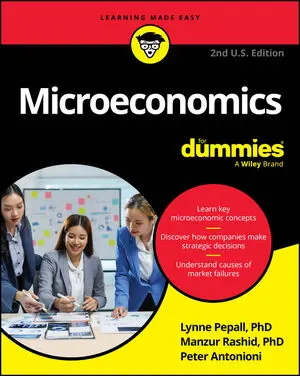
Lynne Pepall, PhD, is a professor of economics at Tufts University. She has taught microeconomics at both graduate and undergraduate levels since 1987.

Peter Antonioni is a senior teaching fellow in the Department of Management Science and Innovation at University College London, where he teaches strategy. His research interests are in the economic history of music production. He is the co-author of Economics for Dummies, Microeconomics for Dummies and Macroeconomicis for Dummies.

Manzur Rashid, PhD, has taught economics at University College London and Cambridge University. He read economics at Trinity College, Cambridge, where he graduated with a double first and was elected to junior, senior, and research scholarships. He completed his doctoral studies in economic theory at UCL, where he specialized in game theory, bounded rationality, and industrial organization, under the supervision of Martin Cripps. He is the co-author of Microeconomics For Dummies and Macroeconomics For Dummies, U.S. Edition.

got more questions?

frequently asked quetions

No items found.
