

 Main Menu
Book & Article Categories
- Main Menu
Book & Article Categories
- Main Menu
Collections
Explore all collections

Articles & Books From Manzur Rashid

Master the big picture of economics with clear explanations. Macroeconomics For Dummies, 2nd U.S. Edition brings the world of economic theory down to earth with accessible explanations that anyone can follow. This comprehensive guide tackles the intimidating subject of macroeconomics – the study of entire economies – and breaks it down into digestible, practical lessons that show how economic forces shape your daily life.
Cheat Sheet / Updated 07-17-2026
Macroeconomics is the study of the economy as a whole. What follows are summaries of some key information about how the economy works, including the basics of fiscal and monetary policy, the key summary statistics that macroeconomists examine in order to assess the health of an economy, and how the economy behaves in the short- and long-term.
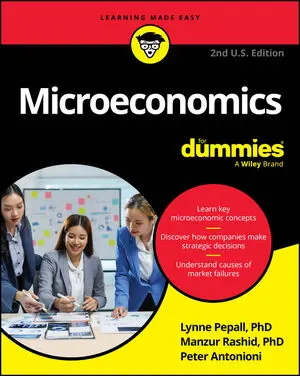
Find easy-to-follow coverage of microeconomics basics. Microeconomics For Dummies, 2nd U.S. Edition demystifies the complex world of microeconomics, offering down-to-earth explanations and real-world applications that make microeconomics make sense to everyone. This guide tackles a question that drives much of the world around us: how do people and firms make economic decisions every day?
Cheat Sheet / Updated 04-20-2026
Although micro means small, microeconomics covers a wide set of topics. These include how consumers and businesses make choices and how those choices interact through the forces of supply and demand in the marketplace; when market outcomes might be considered good and why monopoly power and information problems can make those outcomes less good; problems of risk and insurance; and the gains from international trade.
Article / Updated 12-13-2022
Over the last 50 years, the U.S. economy has grown at an average annual rate of about 2.8 percent. Roughly 1.1 percent has come from population growth: the country typically adds more workers each year. But the majority of it comes from the fact that it gets more productive each year — to the tune of about 1.7 percent annually.
Cheat Sheet / Updated 03-22-2022
Macroeconomics is the study of the economy as a whole. What follows are summaries of some key information about how the economy works, including the basics of fiscal and monetary policy, the key summary statistics that macroeconomists examine in order to assess the health of an economy, and how the economy behaves in the short- and long-term.
Cheat Sheet / Updated 02-28-2022
Microeconomics is that part of economics that looks at the world from the perspective of consumers and firms — asking how they make their decisions and how those decisions come together to make different kinds of markets. You do that by building models of different situations that explore the results of different types of conditions.
Article / Updated 04-11-2017
Economies run on people, firms, and governments requiring and buying things. A need exists (demand) that firms fulfill (supply). Students of microeconomics spend time learning about the behavior of supply and demand in individual markets. Students of macroeconomics are interested in the economy as a whole, so the emphasis is on aggregate (that is, total) demand for goods and services and aggregate (total) supply.
Article / Updated 10-31-2016
Economics is often split into microeconomics and macroeconomics. Microeconomics is the study of individual and firm behavior, and macroeconomics is the study of the economy as a whole. Decades ago they were very different fields with different ways of doing things:
Microeconomics stressed the importance of modeling individuals and firms as optimizing agents.
Article / Updated 10-31-2016
In case you didn't know, the profit motive is powerful. Think about it. Hundreds of millions of people have invested trillions of dollars in pension funds, IRAs, and other assets to provide for their retirement or their children's education or for other reasons. The large banks, mutual funds, and other investment advisors compete for this business by trying to offer their investors a better return than their rivals.

