

 Main Menu
Book & Article Categories
- Main Menu
Book & Article Categories
- Main Menu
Collections
Explore all collections
Articles & Books From Religion & Spirituality
Article / Updated 01-05-2026
The Christian season of Lent begins with Ash Wednesday and lasts for 40 days. In 2026, Ash Wednesday is on February 18. Catholics and members of some Protestant denominations are asked to do modest mortifications and acts of penance during Lent for the purification of the body and soul. Lent is a time of confession, fasting, abstinence, prayer, Bible and spiritual reading, and spiritual and corporal works of mercy.
Article / Updated 01-05-2026
On the Christian calendar, Lent is the 40-day period from Ash Wednesday to Easter. When it was first observed in the fourth century, its focus was on self-examination and self-denial in preparation for Easter, and Christians used fasting (abstaining from eating food) in the early years as a visible demonstration of this process.

An accessible and fascinating exploration of the Torah The Torah For Dummies, 2nd Edition is an easy-to-follow and insightful guide to the first five books of the Hebrew bible: Genesis, Exodus, Leviticus, Numbers, and Deuteronomy. This helpful resource walks you through the foundations of Jewish tradition, religion, and theology, explaining Judaism's rich and ancient history and how its interpreted by modern Jews.
Article / Updated 10-29-2025
For modern witches, observing special days throughout the year is a powerful way to connect with the cycles of nature, honor spiritual energies, and set intentions. These rituals, tied to both the sun's journey (Sabbats) and the moon's phases (Esbats), provide a framework for reflection, celebration, and magic.
Article / Updated 10-29-2025
Wondering whether your house is haunted? When strange things begin to happen in the average person’s home, they start looking for an explanation. The first thing to do is to try to see whether the strange noises and other occurrences that you believe are taking place have a natural explanation. Do you have window leaks that might cause cold drafts?
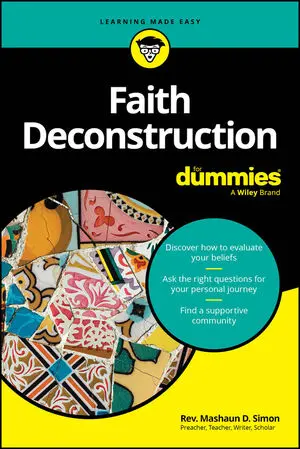
Get support and guidance as you navigate reexamining your faith and finding your own way to the truth Faith Deconstruction For Dummies helps you through the process of thinking critically about your beliefs by unlearning, processing, and considering new ways of thinking. This unbiased book walks you through your options as you begin the faith deconstruction process, and it provides advice and suggestions to assist you on your journey.
Cheat Sheet / Updated 10-27-2025
Faith deconstruction is the process by which you evaluate and think critically about your faith beliefs. For some, deconstructing your faith requires a total revamp of your beliefs. For others, your faith deconstruction will result in abandoning some of what you once believed, but not a complete abandonment. All-in-all, faith deconstruction is an opportunity to strengthen your faith, your relationship to yourself, and to God/gods.
Article / Updated 10-26-2025
Scientology is a set of religious beliefs created by science fiction writer L. Ron Hubbard. Hubbard wrote a self-help book that explored the relationship between body and mind called Dianetics in 1950. In 1952, he expanded upon the success of Dianetics by creating Scientology. Hubbard then incorporated the Church of Scientology in 1953.
Article / Updated 10-24-2025
According to Exodus in the Old Testament, God issued his own set of laws, the Ten Commandments, to Moses on Mount Sinai. These 10 Commandments are listed here in order, and you can read on or click the links to learn more about each commandment and its meaning.Ten CommandmentsI am the Lord thy God, thou shalt not have any gods before Me.
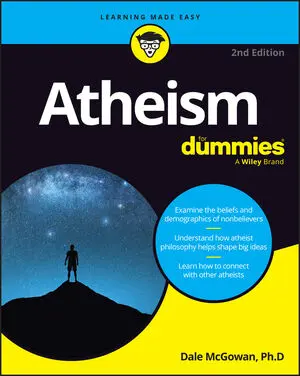
An unintimidating guide to Atheism and secular philosophy Atheism For Dummies, 2nd Edition takes an unbiased look into the philosophical worldview of the lack of belief in gods. This approachable book showcases how atheism is a spectrum, from showing the secular values and lifestyles that resonate with many atheists to also showing how atheism can connect to other philosophical views such agnosticism, secular humanism, and more.

