
The mid-2020s for telecommunications service providers (telcos) have been defined by significant technology advancements, business realities, and economic trends that have put significant pressure on their businesses.
Advancements in networking technology, including the global rollout of 5G and 5G Advanced service, have left telcos with a burgeoning network infrastructure, and the need to meet even stricter service-level agreements (SLAs) for service assurance. At the same time, markets are saturated and subscriber acquisition costs are rising, so telcos are shifting from acquisition to retention and customer lifetime value (CLTV) optimization as their new means of revenue growth. Finally, constricting margins and reduced profitability mean telcos must deliver an exceptional customer experience while drastically reducing the cost of service delivery.
As a result of this confluence of factors, telcos are under more pressure than ever to make progress on automated and autonomous network operations. Generative and agentic AI have the potential to transform the network, but telcos struggle to deploy AI for operational use
Three principles for network automation success
By focusing on the following best practices, telcos can successfully deploy AI in the network and introduce automation and autonomy into their operations.
Getting your data foundation in order
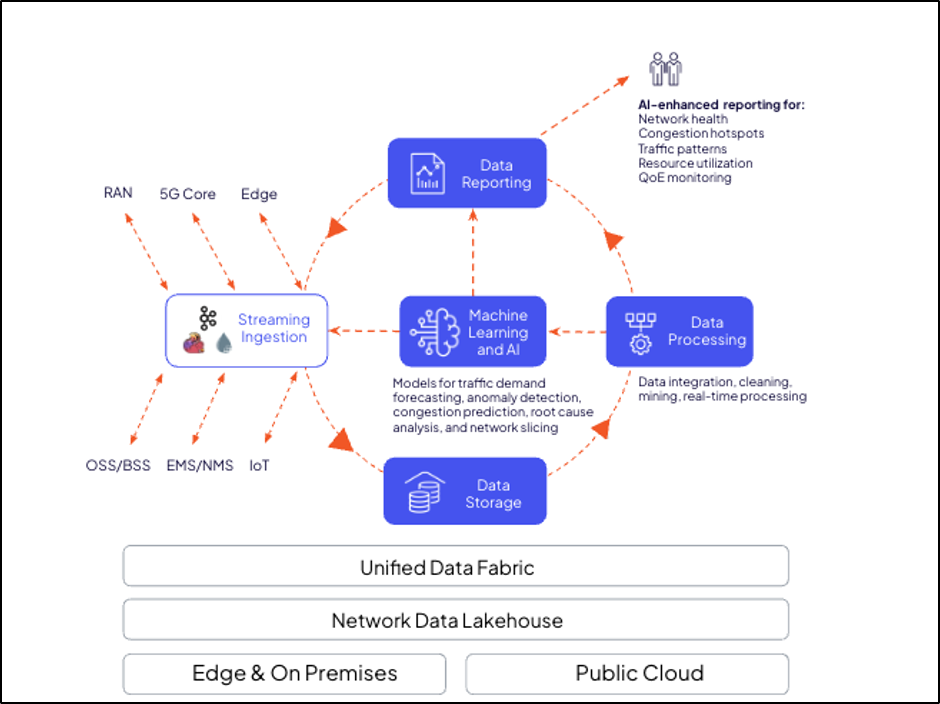
Network data is massive, and it continues to grow. One telco in the United States ingests six petabytes of network data per day. To put that into perspective, if a single event record is around 200KB of data, that means 33 billion things are happening every single day! Telcos need a data platform capable of ingesting, storing, and processing massive volumes of structured and unstructured data and making it available for analytics and AI.
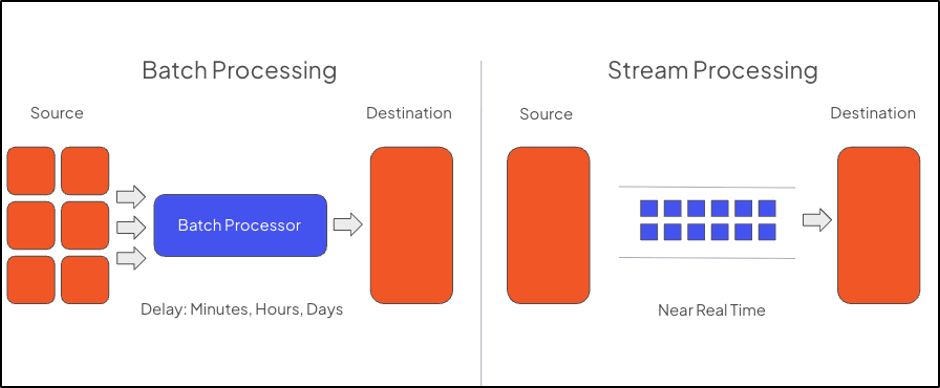
For network operations, telcos also need to orient data management around real-time ingestion, processing, and analysis of data with ultra-low latency. Batch processing was fine when analytics was primarily concerned with what happened in the past. But automating operations with AI requires streaming data and taking action as close to the source as possible.
Finally, as a highly regulated industry, security and governance is critical. Telcos must implement a unified data fabric, which ensures consistent security and governance with full lineage and access controls so data and AI are traceable, auditable, and explainable from end to end.
Deploying AI at the edge
One of the most persistent challenges for telcos deploying AI is that the majority of their network data lives on premises, and AI development and AI inference traditionally occurs in the cloud. The physical distance between the cloud environment and the network introduces latency that can impact performance and, ultimately, the customer experience.
To successfully leverage AI for network operations, it must be embedded directly into the network itself. An edge-to-AI architecture leverages streaming ingestion, processing, and analysis, including AI inference, at the edge, and sends data back to the core for model development and training. Models are pushed back to the edge to work against network data in real time.
Providing context for AI accuracy and consistency
We know two things about generative and agentic AI at this point. First, they hallucinate at a significant rate. Second, they are probabilistic, not deterministic. Given the same prompt multiple times, users can generally expect multiple different responses. For operational use cases requiring accuracy and consistency, these two characteristics make it incredibly difficult to trust AI to act autonomously.
Context is the key to improving the accuracy and consistency of AI outputs, and a number of different methods deliver that context. Models can be improved using fine-tuning, which is the process of showing the model many examples of what an acceptable output looks like. Retrieval-augmented generation (RAG), especially streaming RAG, gives models immediate context from which to generate a response or an action. Both methods are useful for different operational use cases, but in a highly regulated industry like telco, they both rely on an important capability: private AI.
Private AI is a deployment strategy that takes advantage of on-premises or private cloud AI services, and it ensures that models have the full organizational context in a secure and governed way. It makes all of the data available for development, training, and inference behind the organization’s firewall, so sensitive data is never exposed to the public internet.
The time to automate with AI is now
Facing significant headwinds, telcos have never been more motivated to make progress with AI. By building a foundation of trusted data and the capabilities to work with that data to provide real-time network intelligence, by deploying intelligence at the network’s edge with an edge-to-AI architecture, and by providing the context for AI to make accurate and consistent decisions, telcos can harness the transformative power of AI for network operations and build toward network automation and autonomy.
To learn more, read Automating Telco Networks with AI For Dummies, Cloudera Special Edition.
About This Article
This article can be found in the category:
Hot off the press
Explore Related content