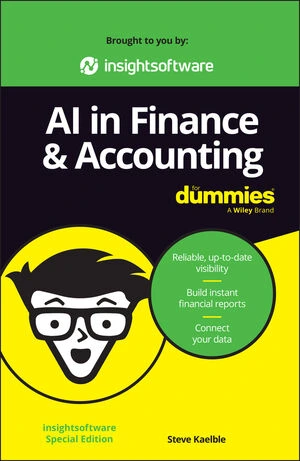

In this article you will learn:
- How AI can enhance your finance and accounting
- What risks AI can bring and how you can plan for them
- Whether you should build your own AI tools or seek out a vendor's
- Where to download a free For Dummies guide for more information
It’s positively dizzying how quickly artificial intelligence (AI) has moved from the realm of science fiction to the point where it’s nearly an everyday fact of life. AI now seamlessly powers and improves even such routine activities as online searches, navigation, television schedule browsing, grocery list planning, photo snapping, social media scrolling, email composing, and much more.
AI is revolutionizing not just daily living, of course, but also work, in virtually every industry. An insightsoftware survey of finance professionals found that nearly six in ten believe AI is increasingly important or even essential in their line of work. You can bet that with every passing month, that percentage will increase.
But as important as folks in finance believe AI is or will be, the same survey found that only four in ten feel confident in using it. That’s a significant gap between the way things are now and the way things can be, but it’s not entirely surprising. After all, truly embracing AI requires a fundamental change in organizational culture. That shift also necessitates a lot of education, so users fully understand not just the benefits and the exciting use cases, but also the AI-related risks they need to avoid or mitigate.
What can AI do for you?
The first step in getting from today to an AI-enhanced tomorrow in finance and accounting is understanding just what AI can do for your enterprise. It’s not taking over human oversight or actions, but giving your finance humans amazing superpowers. Here are some very high-level thoughts:
- Putting AI into your AP and AR: AI can streamline accounts payable and receivable by reading invoices, extracting all the pertinent data, connecting invoices with purchase orders, flagging exceptions, watching for pricing deviations, and avoiding duplicate payments. AI can also optimize collections by projecting cash flows, predicting potential slow-paying customers, and figuring out which outreach strategies work best for different troublesome customers.
- Helping with reporting and analysis: No more manual work in pulling together all the various source data for report generation. AI can look for variances and exceptions and worrisome trends, and keep dashboards up-to-date in real time. It can do the cross-checking and blank-filling needed for regulatory compliance reporting. It can even write narratives.
- Streamlining close management: Ask AI to be sure ledger balances match up with bank statements and accruals. It’ll spot discrepancies and figure out why they happened. It can validate journal entries, check for compliance with accounting policies, and ensure that all appears to be in line with historical trends. And it’ll handle the close checklists and progress tracking.
- Pondering the planning: AI helps you move from periodic forecasting and budgeting to continuous planning and predictive modeling. Automated variance reporting lets you know of anomalies now, not after the end of the month. Forecasts adjust as new data arrives. And dynamic risk scenario modeling comes up with simulations for any possibility that the future might bring.
- Streamlining auditing: Here’s another now-and-then activity that AI can turn into continuous monitoring and alerting. It always is watching transactions and logs, learning what’s normal so it can spot what isn’t. The sooner you notice outliers or potential fraud, the more likely that you can prevent instead of react to trouble.
What risks should you consider?
All that should sound pretty tantalizing, but you no doubt have heard about risks that new technologies such as AI can bring. That’s no reason to avoid progress — you just need to understand risks and plan for them.
- Data risks: AI both runs on data and impacts data. Data risk includes relying on poor-quality, old, or inconsistent data, which can lead to faulty conclusions and outputs. And data risk also includes the possibility of accidentally revealing sensitive or protected information.
- Model risks: The work of AI is done by models trained on data, and questionable data can lead to model biases or inaccuracies.
- Operational risks: AI models must integrate with data pipelines and application programming interfaces. System failures or integration gaps can interfere with the magic.
- Compliance risks: As a finance person, you know how vital it is to faithfully live up to all of the regulatory requirements governing your financial data. Your AI environment must also follow the rules.
These risks are not deal-breakers, not at all. You just need to ensure you know all that can go awry, and build strong governance to prevent or mitigate any issues.
AI-powered vendor, or DIY?
As powerful as AI can be, it’s also remarkably easy to dive in without a ton of information technology expertise. Enterprising employees on your team may already be doing so. Should you build your own proprietary system?
That’s not always a great idea. Studies have found that internal builds tend to succeed only about half as often as acquiring AI tools from specialized vendors and thus building partnerships with experts. Vendor-provided tools can deliver faster ROI and reduce the burden on your own staff, whether it’s the finance gurus or the techies.
In any case, you need some of that internal talent as you establish AI governance and optimize workflows. And taking the vendor approach does more than just leave the heavier lifting to someone else. You also reduce the security and governance risks associated with shadow AI, which is what it’s called when your well-intentioned people dive in with custom scripts, unapproved third-party tools, or homegrown models, all operating without sufficient oversight.
Seek a vendor with expertise to deliver the AI capabilities you crave. You also need a full review of security architecture, audit trail functionality, data governance practices and capabilities, and all of the elements of solid risk management.
As you move forward, keep in mind the time-honored wisdom that says taking things gradually can pay off in the long run. Start your implementation with a focus on processes that are comparatively low risk and high impact — processes that have high volumes and clear rules, and not a lot of regulatory exposure. Invoice data extraction is a possibility, or automated variance explanations, perhaps simple reconciliations.
Beginning a bit more gradually helps you build confidence, internal expertise, and trust levels among frontline finance employees and leaders alike. You can then scale successful pilots and implementations, with proper controls and governance.
Want to learn more?
Then, keep the journey going by reaching out to insightsoftware to find AI-powered solutions for finance, accounting, and operations.
About This Article
This article can be found in the category:
Hot off the press
Explore Related content