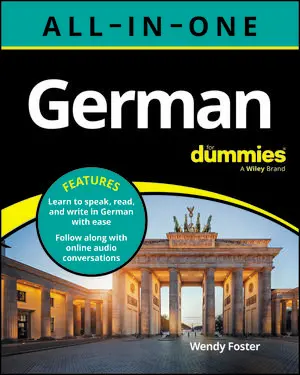
German All-in-One For Dummies, with CD

Overview

Learn to speak German? Easy.

German All-in-One For Dummies conveniently combines titles from the German Dummies library into one handy guide that covers all of the bases of the German language. For those looking to master fluency in this popular language, this book and CD combo are an efficient and logical choice.

German All-in-One For Dummies brings together content from German For Dummies, 2nd Edition, German For Dummies Audio Set, German Phrases For Dummies, Intermediate German For Dummies, and German Essentials For Dummies. ??Plus, it includes a new CD that allows for even more opportunities to practice speaking the language, as well as additional content on grammar and usage to empower you to use and speak German like a native.

  • Offers instruction and practice exercises for both speaking and writing German
  • Helps you prepare to demonstrate proficiency in conversational German

If you want to improve your German, whether it's for work, travel, or enjoyment, German All-in-One For Dummies has you covered.

Read More

About The Author

Wendy Foster teaches Business English, German, French, and intercultural communication skills. She also does editing for online German education programs. Wendy received her degree in German studies at the Sprachen-und-Dolmetscher-Institut in Munich and later her MA in French at Middlebury College in Paris.

Paulina Christensen has been working as a writer, editor, and translator for more than 10 years. She has developed, written, and edited numerous German-language textbooks and teachers' handbooks for Berlitz International. Dr. Christensen recieved her MA and PhD from Dusseldorf University, Germany.

Anne Fox has been working as a translator, editor, and writer for more than 12 years. She studied at Interpreter's School, Zurich, Switzerland, and holds a degree in translation. Most recently she has been developing, writing, and editing student textbooks and teacher handbooks for Berlitz.

Sample Chapters

german all-in-one for dummies, with cd

CHEAT SHEET

All languages have ways of showing what role a noun plays in a sentence. In English, a noun’s position in the sentence tells you how it’s being used. In German, the endings on the adjectives and articles that accompany the noun, which are based on case, tell you the noun’s function in the sentence. Here’s a quick overview of the German cases and the relationship they have with nouns, articles, and pronouns.

HAVE THIS BOOK?

Articles from
the book

When you’re in a German-speaking country, you’re bound to find yourself in a number of situations where you need to ask a lot of questions as you find your way around — for example, where the nearest bank is or how long the train will be delayed — or you may simply need to ask someone to speak more slowly. You many find the following vocabulary useful in various situations.
Speaking a foreign language correctly is all about mastering the basics of pronunciation. The key to mastering pronunciation is to start small by figuring out how the individual letters sound. Then you can expand to syllables, words, and finally, sentences. The rest is practice, practice, practice. Understanding stress in German This type of stress doesn’t have anything to do with meeting deadlines or having a BMW tailgate you at 110 miles per hour on the Autobahn.
In German, vowels (a, e, i, o, and u) can generally be pronounced in two ways — as short or long vowel sounds. The short vowel sounds are “clipped,” meaning they’re pronounced shorter than their English equivalents. Long vowel sounds are “steady-state” or “pure,” meaning the sound quality doesn’t change even though it’s a long sound.
Getting your hellos and goodbyes straight in German is a matter of keeping in mind how well you know someone. If you’re on formal terms — in other words, if you’re addressing one or more people with Sie (zee) (you, formal) — then you have one set of expressions. When you’re on du (dooh) (you, informal) terms of address, you go with conversational expressions.
This section provides you with useful German vocabulary so you can describe the activities you do at home both during the week and on the weekends. It also explains what you need to know about being a guest at someone else’s home. The time you spend at home is an important part of your life that defines who you are.
Chances are you’ll encounter German numbers in all kinds of situations: when you’re trying to decipher prices, for example, or street numbers, departure times, exchange rates, and so on. Knowing German numbers makes counting anything easy. Cardinal numbers have nothing to do with religious numbers colored red or a songbird that can sing numbers.
When you talk about yourself to a new acquaintance, you often answer many of the same key questions: What kind of job do you do? Where do you work? Are you self-employed? Are you a student? Where do you live? Because you’ll encounter these topics often, you need to be prepared. The following sections provide you with the information you need.
Meeting and greeting often require introductions. Your friends may want you to meet someone they know, or you may have to introduce your significant other to your colleague at a formal occasion. This section gives you the lowdown on how to do so. Introducing your friends Commonplace, everyday introductions are easy to make.
Not surprisingly, German numbers have a few of their own oddities that keep native English speakers on their toes. Here are some of the most common spelling and pronunciation changes related to numbers that you need to be familiar with: When you use the number eins to describe one thing in a sentence, it changes spelling because, in these situations, eins is working as an adjective, and it’s the equivalent of using a or an.
Ordinal numbers are the kinds of numbers that show what order things come in. You need ordinal numbers when you’re talking about das Datum (dâs dah-toom) (the date), die Feiertage (dee fay-er-tah-ge) (the holidays), die Stockwerke in einem Hotel (dee shtok-ver-ke in ayn-em hoh-tel) (the floors in a hotel), and stuff like that.
The German language has a few consonant sounds that are either different or don’t occur in English. Fortunately, most of them are easy to pronounce. The German letter combination ch is the trickiest one for English speakers to pronounce. There’s absolutely no equivalent for it in English (that’s why it’s represented by a capital H), and you actually have to learn a new sound — a kind of gentle “dry” gargling sound — in order to say it.
Ahh, relief! The sounds of German consonants are easier to master than the German vowel sounds. In fact, they’re pronounced either almost the same as their English equivalents or like other English consonants. Of course, you’ll find a couple of oddities and exceptions, but don’t worry. The following sections explain what you need to know.
German has three extra vowels: ä, ö, and ü. The German word for those curious double dots over the vowels is Umlaut (oom-lout) (umlaut). Umlauts slightly alter the sound of the vowels a, o, and u, as outlined in this table. These sounds have no equivalent in English. Pronouncing Vowels with Umlauts German Letter Phonetic Symbol As in English German Example ä (long) ai say (“ay” in “say” with spread lips) nächste (naiH-ste) (next) ä (short) ê bet (clipped “e”) fällen (fêl-en) (to fell [a tree]) ö er her (without the “r” sound) schön (shern) (pretty) (remember: no “r” sound) ü ue lure (“ooh” with pursed lips) Tür (tuer) (door) To make your German vowels ä, ö, and ü sound a bit more authentic, try progressing through the ä, ö, and ü sounds, pronouncing the vowels as though you’re getting ready to kiss someone — in other words, round your lips and pucker up, baby!
You’re in Interlaken, in der Schweiz (in-têr-lâ-ken in dêr shvayts) (Interlaken, in Switzerland) and you want to know what time it is. You have four choices: Look at your own watch; look at the nearest clock tower (most are absolutely stunning) and find out just how accurate the Swiss are in keeping time (very!
Some German verbs that you use to describe your daily actions have an unusual construction. They’re the equivalent of reflexive verbs in English. Verbs in this group use a reflexive pronoun like myself or ourselves to emphasize the information about who is carrying out the action of the verb. When you say, “Cats wash themselves very thoroughly,” you’re using the reflexive pronoun themselves together with the verb wash to talk about what cats do.
The first part of your greeting in German is a basic hello. How you say hello depends on what time of day it is. The following list includes both the standard, formal expressions for saying hello and the more casual, informal expressions: Guten Morgen! (gooh-ten mor-gen!) (Good morning!) This is the standard, formal greeting you use in the morning (until about noon).
German has three words — der, die and das — for the definite article the. To make matters more confusing for someone learning German, these three definite articles change spelling according to the case of the noun that they appear with in a sentence. The same is true for the indefinite articles. Just as English has two indefinite articles — a and an — that you use with singular nouns, German also has two indefinite articles (in the nominative case): ein for masculine- and neuter-gender words and eine for feminine-gender words.
A far greater number of Germans live in apartments, either rented or owned, than do North Americans, and great value is placed on being able to own a single-family dwelling. Land and construction materials are very costly, so German living quarters tend to be smaller and more energy efficient than their North American counterparts.
You may find yourself describing people you know as your friends, even if you aren’t in close contact with them. In the German-speaking world, people have more distinct boundaries between those they consider as Freunde (froyn-de) (friends) and those they describe as Bekannte (bê-kân-te) (acquaintances). For many Germans, Freunde are part of a smaller, tighter knit circle than those you may include in your group of friends.
In most German hotels, das Frühstück (dâs frue-shtuek) (breakfast) is generally included in the room price of the hotel accommodation. In smaller towns, if you’re staying at a Pension (pên-see-ohn) (pension) or Frühstückspension (frue-shtueks-pên-see-ohn) (bed-and-breakfast) or at a smaller hotel, you can expect a traditional German breakfast, consisting of the following: Kaffee (kâf-ey) (coffee) Tee (tey) (tea) Fresh Brötchen, Brot, Butter and Marmelade (brert-Hen, broht, boot-er, [and] mâr-me-lah-de) (fresh rolls, bread, butter, and jam) weich gekochtes Ei (vayH ge-koH-tes ay) (soft-boiled egg) served in an egg cup Choice of Aufschnitt and Käse (ouf-shnit [and] kai-ze) (cold cuts and cheese) The larger hotels in cities generally offer a breakfast buffet that includes the preceding items, as well as the following: Cornflakes (cornflakes [as in English]) (cornflakes) Müsli (mues-lee) (muesli) frisches Obst (frish-es ohpst) (fresh fruit) Variety of Brot and Säfte (broht [and] zêf-te) (bread and juices) Note: If you can’t do without scrambled eggs or fried eggs, you may need to put in a special order.
Read the following German conversation with a grain of salt — and a smile. It gives you an idea of how many English words have slid into German. However, you're not likely to overhear this many examples of mixed language in a single conversation. In this scenario, two friends, Claudia and Jana, meet on the street.
All languages have ways of showing what role a noun plays in a sentence. In English, a noun’s position in the sentence tells you how it’s being used. In German, the endings on the adjectives and articles that accompany the noun, which are based on case, tell you the noun’s function in the sentence. Here’s a quick overview of the German cases and the relationship they have with nouns, articles, and pronouns.
Because German and English are both Germanic languages, quite a few words are either identical or similar in the two languages. Words that share a common source are called cognates. Another group of words common to German and English stem from Latin-based words that English speakers are familiar with. Many of these words have direct equivalents in German (for example, nouns that end in -tion).
The biggest difference between German personal pronouns and English personal pronouns is that you have to distinguish among three ways to say you: du, ihr, and Sie. Other personal pronouns, like ich and mich (I and me) or wir and uns (we and us), bear a closer resemblance to English. The genitive case isn’t represented among the personal pronouns because it indicates possession; the personal pronouns represent only people, not something those people possess.
Like every language, German contains some false friends — words that look very similar to English but have a completely different meaning. As you read the following list, you can see why you have to treat any new German word with kid gloves, especially if it looks like an English word, until you find out for sure what it means in English: After (ahf-ter): If you want to avoid embarrassment, remember the meaning of this word.
German speakers generally place great value on showing respect toward each other and strangers. The language itself allows the speaker to make a clear distinction between formal and informal ways of saying you. (Once upon a time, English did this, too, but English speakers dropped the thee and thou forms long ago.
Modal verbs help you convey your attitude or explain how you feel about an action in German. They usually accompany another verb and appear in the second position of a sentence. The verb they assist generally appears at the end of the clause. The following table shows each German modal verb in infinitive form along with the English translation, followed by a statement using the modal verb.
German grammar has some striking differences to English grammar. One difference that newcomers to German notice right away has to do with word gender. Basically, you have three genders in German — masculine, feminine, and neuter — and although English has the same three genders, they play a very different role in German grammar.
Many words, like the ones shown in this table, are spelled almost the same in German as in English and have the same meaning. The table also shows you a few common German spelling conventions: The English c is a k in most German words. The ou in English words like house or mouse is often equivalent to au in German words.
Just like English, German has many idioms, or expressions typical of a language and culture. When you translate these idioms word for word, they may sound obscure, silly, or just plain meaningless, so to use them appropriately, you need to find out what they really mean. Some expressions have an English equivalent that’s recognizable, so using them correctly isn’t too hard.
You should know that talking at great length about your family is a far less popular pastime in Germany than in the United States, perhaps because Germans place a lot of value on privacy. Even so, you need to know how to talk about family, just in case the topic ever comes up. In the United States, discussing family, die Familie (dee fâ-mee-lee-e), is a great way to get to know someone.
In grammar, cases indicate the role that nouns and pronouns play in a sentence. Case is important in German because four types of words — nouns, pronouns, articles, and adjectives — go through spelling changes according to the case they represent in a sentence. German has four cases: nominative, accusative, dative, and genitive.
In English and German, you purposely arrange words in a certain order to communicate clearly. After all, putting words together in an unusual or inappropriate word order can cause confusion or, even worse, a breakdown in communication. So you do yourself a huge favor in getting your message across by following German word order.
A few German words have been adopted by the English language and have retained their meaning, such as Kindergarten (kin-der-gâr-ten), Angst (ânkst), kaputt (kâ-poot), Ersatz (êr-zats), Sauerkraut (zou-er-krout), Zeitgeist (tsayt-gayst), and Wanderlust (vân-der-loost). However, the number of these German words is minimal compared to the number of English words that have made their way into the German language.
https://cdn.prod.website-files.com/6630d85d73068bc09c7c436c/69195ee32d5c606051d9f433_4.%20All%20For%20You.mp3

Frequently Asked Questions

No items found.