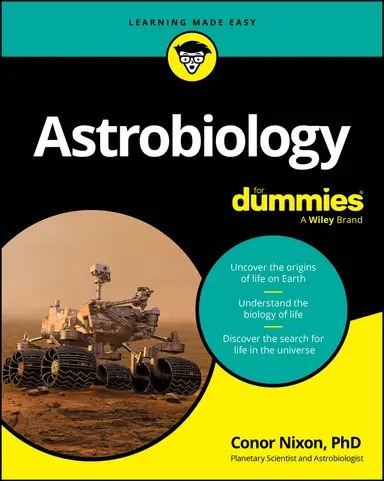
Astrobiology For Dummies
Astrobiology For Dummies book cover
Explore Book
Buy NowSubscribe on Perlego
Astrobiology For Dummies
Astrobiology For Dummies book coverExplore Book
Buy NowSubscribe on Perlego

As you navigate your way through this book and through your learning journey in astrobiology, you’ll encounter a fascinating but perhaps at times also overwhelming amount of new terms, facts, dates, and events. This handy-dandy Cheat Sheet should prove helpful as a reference tool when you need to remember what happened first, the invention of the telescope or discovery of DNA? And what in the world is an extremophile?

Astrobiology timeline

These first two lists are a useful guide to the major happenings in the history of astrobiology. The terms bya and mya mean billion years ago and million years ago, respectively, and all dates before 1 bya are somewhat uncertain.

Early Earth events

Date Early Earth Event
4.6 bya The solar system begins to form from the protosolar cloud (or nebula).
4.5 bya The Earth and inner planets form.
4.45 bya A Mars-sized planetesimal (Theia) collides with Earth, forming the Moon from the debris.
4.0 to 3.8 bya Likely earliest date for life (LUCA).
3.8 to 3.5 bya Oceans stabilize. The earliest evidence of life from fossils, including cyanobacteria, dates from here.
3.2 to 2.9 bya Oxygenic photosynthesis appears in prokaryotes.
About 2.4 bya The Great Oxygenation Event occurs, a massive rise in atmospheric oxygen.
2.1 to 1.8 bya The first eukaryotes appear: complex cells with distinct nuclei and mitochondria.
1.6 to 1.5 bya Algae appear, photosynthetic eukaryotes.
1.4 to 0.9 bya Fungi diverge from animals.
600 mya First multicellular animals (metazoans)
539 mya Vast numbers of new species of life appear in the “Cambrian Explosion,” including trilobites.
450 mya Earliest fish.
400 mya Earliest sharks and trees.
252 mya The Permian mass extinction wipes out 80% of marine species and 70% of land vertebrates.
230 mya Dinosaurs and mammals appear.
140 mya Flowers appear.
66 mya Dinosaurs go extinct in the KT mass extinction event as an asteroid strikes the Earth.
20 to 15 mya Great apes (Hominidae) appear.
14 to 8 mya Ape families diverge into orangutans, gorillas, and chimpanzee-humans.
8 to 7 mya Last common ancestor of chimpanzees and humans.
2.4 mya Earliest humans: homo habilis, the “tool user.”
1.9 mya Humans walk fully upright: homo erectus
0.3 mya Modern humans: homo sapiens, “the thinker.”

Human events and discoveries in astrobiology

Date Human Events and Discoveries
1543 Copernicus’s book: De revolutionibus orbium coelestium proposing a heliocentric model of the universe is published.
1584 Giordano Bruno speculates on the existence of exoplanets and extraterrestrial life and is later executed for heresy in Rome in 1600.
1590 Invention of the microscope in the Netherlands.
1608 The telescope invented in the Netherlands
1676 Discovery of bacteria by van Leeuwenhoek.
1755 Discovery of amoebae.
1803 Well-documented L’Aigle meteorite fall in France finally convinces skeptical scientists that rocks can really fall out of the sky.
1831 Discovery of the cell nucleus by Robert Brown.
1857 Mitochondria discovered by von Köliker.
1859 Darwin’s book On the Origin of Species is published.
1869 DNA (“nuclein”) discovered.
1908 The Tunguska Event becomes the largest known meteor fireball explosion in human history.
1947 The Roswell Incident becomes a notorious and long-running focus for alien landing believers.
1953 Double helix structure of DNA published.
1961 First human in space, Yuri Gagarin.
1961 Betty and Barney Hill claim to have been abducted by aliens in rural New Hampshire.
1965 First close-up pictures of Mars from Mariner 4.
1969 First human landing on the Moon.
1976 Viking 1 & 2 missions land on Mars to search for life.
1977 Voyager 1 & 2 spacecraft launched to the outer planets.
1984 The Martian meteorite ALH84001 is found in Antarctica.
2010 Hayabusa mission becomes the first successful asteroid sample return.
2015 New Horizons spacecraft reaches Pluto.
2017 Discovery of 1I/’Oumuamua, the first interstellar object (asteroid or comet).

Astrobiology terms made simple

Like any other scientific field, astrobiology comes with its own jargon. You may wonder why this is necessary, why don’t scientists just use plain language? Because it quickly becomes very long-winded to say “a group of organisms that share a common ancestor” rather than “clade” over and over when writing a research paper. So, jargon is useful, but it can also be off-putting. I’m providing here a list of the most common astrobiology terms that you may encounter— refer back as often as needed.

Term Definition
abiogenesis The process of life emerging from nonliving chemical.
abiotic Something that is decidedly nonliving, such as a rock or a simple chemical.
archaeon (pl. archaea) A type of prokaryotic microbe common everywhere on Earth, including many extremophiles.
bacterium (pl. bacteria) A type of prokaryotic microbe common everywhere on Earth. Some are harmful to humans causing disease, some helpful, most mind their own business.
biosignature A signature or sign that life is present somewhere: from an unexpected atmospheric gas to a trail of footprints.
chemotroph An organism (often an extremophile) that lives off chemical energy.
chondrule Mineral grains found in some meteorites: such rocks are known as chondrites.
cytoplasm The liquid inside a cell.
differentiation The process by which the original constituents of a planet, moon, or asteroid separate, forming distinct layers. Can also be seen in meteorites.
DNA Deoxyribonucleic acid: a strand of chemicals made of units (nucleobases) that encodes the recipe for the lifeform.
eukaryote A single or multicelled creature that has a distinct, enclosed nucleus containing its DNA, including creatures from tiny amoebas to blue whales.
evolution The idea that species of plants, animals, and microbes do not stay the same forever, but gradually change into new species by natural selection.
exoplanet A planet around another star (not the Sun).
extremophile An organism that is able to thrive in an extreme — such as very hot, cold, acidic or salty — environment.
falls and finds Meteorites that are collected after a witnessed fall to Earth, versus an unwitnessed discovery, which is known as a find.
Goldilocks zone An informal term for a habitable zone.
habitable zone (HZ) The range of distance from a star where liquid water could be expected on the surface of a planet.
LUCA The “last universal common ancestor,” the inferred original lifeform, and progenitor of all later life on Earth.
microbe A very small organism only visible under a microscope; usually unicellular creatures.
Miller-Urey (experiment) A famous experiment that attempted to replicate the formation of complex molecules needed for life from simple gases (ammonia, methane, hydrogen).
Mitochondrion (pl. mitochondria) The energy-producing unit in a eukaryotic cell, thought to have arisen long ago when an archaeon ingested a bacterium.
natural selection Charles Darwin’s explanation for the process of evolution, where some species flourish and others die out due to their fitness for survival.
panspermia The idea that life was seeded on Earth from space, e.g., by chemicals from a meteorite.
photoautotroph A fancy word for an organism that makes its own (auto) food (troph) from sunlight (photo) — e.g., a tree or algae. The process is known as photosynthesis.
planetesimal An early rocky body that was a building block of the planets; left over planetesimals became asteroids.
prebiotic Usually “prebiotic chemical,” meaning a chemical that was used to build life in abiogenesis, or a simpler chemical used by life today to build more complex molecules.
prokaryote A single-celled creature that lacks a distinct nucleus, instead having free-floating DNA in its cytoplasm, including all bacteria and archaea.
protocell A simple spherical structure, often made of fatty lipids, which could later have evolved into a cell.
protosolar cloud (and disk) The cloud of gas that gave birth to the solar system, first collapsing to a spinning disk, and then coalescing into the Sun and planets.
protist A wide category of simple eukaryotic life forms, consisting mostly of single-celled organisms that are not animals, land plants or fungi.
RNA Ribonucleic acid: a temporary strand of genetic code copied from DNA in modern cells but may have once existed before DNA.
SETI The search for extra-terrestrial intelligence.
spectroscopy A common scientific technique of splitting light into its component colors, helping to identify the material being studied.
volatile A solid or liquid substance that can readily convert to gaseous form on heating (e.g., water).

Useful astrobiology websites

After (or maybe during) reading Astrobiology For Dummies, you may realize that you want to know more about a certain topic, or about astrobiology in general. Here are some useful websites:

About This Article

This article is from the book: 

About the book author:

Conor Nixon, PhD, is a planetary scientist with 30 years of experience studying the outer solar system. He has held positions at the University of Maryland and NASA, is an author on more than 200 papers, and a veteran science communicator. He is the author of Astrobiology For Dummies.

got more questions?

Frequently Asked Questions

No items found.