|
Published:
June 26, 2017

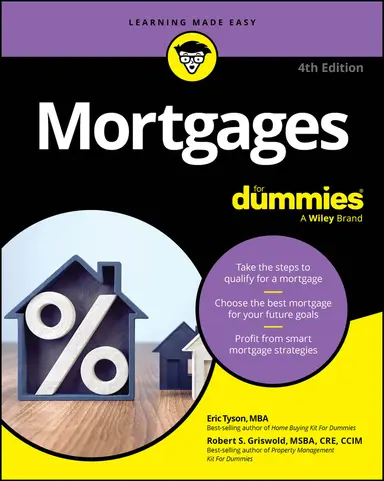
Mortgage Management For Dummies

Overview

Quickly make sense of mortgages

Taking out a mortgage to purchase real estate is a huge decision, one that could affect your family's finances for years to come. This easy-to-follow guide explains how to secure the best and lowest-cost mortgage for your unique situation. Whether you select a 15- or 30-year mortgage, you'll get all the tips and tricks you

need to pay it off faster—shortening your payment schedule and saving your hard-earned cash.

  • Fine-tune your finances
  • Qualify for a mortgage
  • Secure the best loan
  • Find your best lender
  • Refinance your mortgage
  • Pay down your loan quicker
  • Must-knows about foreclosure
  • Top mortgage no-nos
Read More

About The Author

Eric Tyson, MBA, is a financial counselor and the bestselling author of Investing For Dummies, Personal Finance For Dummies, and Home Buying Kit For Dummies.

Robert S. Griswold, MSBA, is a successful real estate investor, hands-on property manager, and the author of Property Management Kit For Dummies.

Sample Chapters

mortgage management for dummies

CHEAT SHEET

If you own or want to own real estate, you need to understand mortgages. Unfortunately for most of us, the mortgage field is jammed with jargon and fraught with fiscal pitfalls. For typical homeowners, the monthly mortgage payment is either their largest or, after income taxes, second largest expense. When you’re shopping for a mortgage, you could easily waste many hours and suffer financial losses by not getting the best loan you can.

HAVE THIS BOOK?

Articles from
the book

Before you get a mortgage, be sure you understand your personal financial situation. The amount of money a banker is willing to lend you isn't necessarily the amount you can "afford" to borrow given your financial goals and current situation. Maximize your chances for getting the mortgage you want the first time you apply by understanding how lenders evaluate your creditworthiness.
What are the advantages of a 15-year versus a 30-year mortgage? After you decide which type of mortgage — fixed or adjustable — you desire, you have one more major choice to make. Do you prefer a 15-year or a 30-year loan term? (You may run across some odd-length mortgages — such as 20- and 40-year mortgages; however, the issues remain the same as when comparing 15-year to 30-year mortgages.
Why do we pay property taxes? That’s something most homeowners ponder at one point or another. As you’re already painfully aware if you’re a homeowner now, you must pay property taxes to your local government. The property taxes are generally paid to a division typically called the County or Town Tax Collector.
You’re probably not going to refinance the mortgage on your house because you suddenly developed an insatiable urge to generate enormous loan fees for your friendly neighborhood lending institution. Here are three far more sensible reasons to refinance your mortgage: To cut costs: “A penny saved is a penny earned,” is every bit as true today as it was in Ben Franklin’s time, but why stop with a few lousy pennies?
What is an adjustable rate mortgage? Adjustable-rate mortgages (ARMs) have an interest rate that varies over time. On a typical ARM, the interest rate adjusts every 6 or 12 months, but it may change as frequently as monthly. Popular ARMs include hybrid loans where the initial interest rate is locked in for the first three, five, seven, or ten years and then adjusts after that (see the sidebar “Fixed-rate periods on hybrid-ARMs”).
With all the stress associated with mortgages, it’s a good idea to pause, recognize, and give thanks for the tax benefits of homeownership. You might be asking, “can I write off property taxes?” The short answer to the property tax deduction mystery is yes. The federal tax authorities at the Internal Revenue Service (IRS) and most state governments allow you to deduct, within certain limits, mortgage interest and property taxes when you file your annual income tax return.
A cash-out refinance differs from the cost-cutting and the restructuring refinances in one important aspect — instead of replacing your current loan with another one for the same amount of money, you pull extra cash out of the property when you refinance it. You can do a cash-out refinance in two ways: Get a new first mortgage.
This delicious tidbit of information can save you big bucks: Conventional mortgages that fall within Fannie Mae’s and Freddie Mac’s loan limits are referred to as conforming loans. Mortgages that exceed the maximum permissible loan amounts are called jumbo loans or nonconforming loans.When Congress passed the Economic Stimulus Act of 2008 (The Act), it also created a brand-new type of mortgage neatly notched between a conforming loan and a jumbo loan.
What is debt-to-income ratio? When you apply for a mortgage, your lender will take a hard look at your finances to determine your debt-to-income ratio. Lenders aren’t as concerned about short-term loans that you’ll pay off in fewer than ten months. They will, however, add 5 percent of any unpaid revolving credit charges to your monthly debt load.
What is a fixed mortgage? As you may have surmised from the name, fixed-rate mortgages have interest rates that are fixed (that is, the rate doesn’t change) for the entire life of the loan, which is typically 15 or 30 years. With a fixed-rate mortgage, the interest rate stays the same, and the amount of your monthly mortgage payment doesn’t change.
Watch your step, please. Be careful. We’re about to enter a hardhat zone. This balloon loan is covered with a fine coat of dust — construction dust.Like other balloon loans, construction financing is extremely diverse. No one standard loan instrument exists that all lenders use to finance construction projects.
What is a reverse mortgage? A reverse mortgage is a loan against your home that you don’t have to repay as long as you live there. In a regular, or so-called forward mortgage, your monthly loan repayments make your debt go down over time until you’ve paid it all off. Meanwhile, your equity is rising as you repay your mortgage and as your property value appreciates.
Because lenders check your credit score, you may want to see the same score that they see. It’s easy to check your FICO score and to find out specific things that you can do to raise it. Getting your credit score The websites for many banks, financial services sites, and credit reporting agencies offer FICO scores for a fee, as does Fair Isaac’s myFICO site.
“You can run, but you can’t hide” aptly describes the futility of trying to duck creditors. Many potential homeowners admit defeat before even applying because they fear the task of figuring out how to get a mortgage with bad credit.If you have pecuniary problems with the butcher, the baker, or the candlestick maker, woe be it to you if you’re ever slow and sloppy when paying your bills.
The FICO score evaluates five main categories of information. Some, as you’d expect, are more important than others. It’s important to note the following about your fico score: A score considers all these categories of information, not just one or two. The importance of any factor depends on the overall information in your credit report.
Yes, thousands of mortgage lenders are out there. However, not anywhere near that many mortgage lenders are good lenders or the best lenders for you. So, it’s tough to know how to choose a mortgage lender. Although you are encouraged to find the lowest-cost lenders, take caution: If someone offers you a deal that’s much better than any other lender’s, be skeptical.
If you believe you want to choose mortgage payoff faster than is required, this information is for you. If you’re certain that you want to pay down your mortgage balance quicker, it can be as simple. Here’s a few tips that show how to pay off your mortgage faster: Making an extra mortgage payment: If the stars align or you find yourself with extra funds, you can make an extra mortgage payment.
The mortgage application process is complicated. For a mortgage lender to make a proper assessment of your current financial situation and process your mortgage application, the lender needs details. Lots of them! Thus, mortgage lenders or brokers ask you to sign a form authorizing and permitting them to make inquiries of your employer, the financial institutions that you do business with, the Internal Revenue Service, and so on.
Mortgage interest can seem complicated. Loan amortization, loan principal, loan term, negative amortization—yikes! So much to think about. Let’s take a look at some mortgage loan basics.Money isn’t magical. It’s a commodity or consumer product like HDTVs and toasters. Lending institutions such as banks, savings and loan associations (S &Ls), and credit unions get their raw material (money) in the form of deposits from millions of people just like you.
When you apply for a mortgage, your lender will complete the underwriting process. The mortgage loan underwriting process is intimidating, but lenders have pretty good reasons for undertaking the process. Suppose your best friend hits you up for a loan. If your pal wants to borrow five or ten bucks until payday, that’s no big deal.
If you own or want to own real estate, you need to understand mortgages. Unfortunately for most of us, the mortgage field is jammed with jargon and fraught with fiscal pitfalls. For typical homeowners, the monthly mortgage payment is either their largest or, after income taxes, second largest expense. When you’re shopping for a mortgage, you could easily waste many hours and suffer financial losses by not getting the best loan you can.
To calculate your monthly mortgage payment, simply multiply the relevant number from the table below by the size of your mortgage expressed in (divided by) thousands of dollars. For example, on a 30-year mortgage of $125,000 at 7.5 percent, you multiply 125 by 7.00 (from the table) to come up with an $875 monthly payment.
The mortgage process can seem overwhelming. You’re probably asking yourself, “do I need a mortgage preapproval or a mortgage prequalification? And what the heck is the difference?” To find out the winner in the mortgage preapproval vs prequalification debate, keep reading.Everyone knows that time is money, so let’s start with a timesaving tip.
Most lenders will agree to mortgage rate locks. This means they will hold firm on interest rates and other terms they quote to you (usually for a 30-day period). For a nominal fee or slight interest rate increase, lenders will typically commit to hold rates and other terms firm for up to 60 to 90 days without any upfront lock fees.
Is mortgage insurance tax deductible? If you’re a high-income earner, are subject to the Federal Alternative Minimum Tax (AMT), or have low levels of itemized deductions, be warned that some of the itemized deductions from your mortgage interest may not effectively be tax deductible and may result in less tax savings than you think.
If you talk with others or read articles or books about prepaying your mortgage, you’ll come across those who think that paying off your mortgage early is the world’s greatest money-saving device. You’ll also find that some people consider it the most colossal mistake a mortgage holder can make. The reality is often somewhere between these two extremes.
Some lenders punish borrowers severely for repaying all or part of their conventional loan’s remaining principal balance before its due date. As punishment, they impose a charge known as a prepayment penalty. Prepayment penalties aren’t permitted on FHA, VA, USDA, and FmHA mortgages.How much money are we talking about?
What is PMI? PMI stands for private mortgage insurance. Private mortgage insurance protects lenders from losses they may incur due to the dreaded double whammy of default and foreclosure. Uncle Sam provides the mortgage insurance on government loans (FHA, VA, USDA, and FmHA). Private insurance companies provide private mortgage insurance (PMI) on all other loans.
As you budget for a given home purchase, don’t forget to budget for the inevitable laundry list of one-time closing costs. How much are closing costs on a house? In a typical home purchase, mortgage closing costs amount to about 2 to 5 percent of the purchase price of the property. Thus, you shouldn’t ignore them when you figure the amount of money you need to close the deal.
When seeking a mortgage, you might consider a government home loan. Through either insuring or guaranteeing home loans by an agency of the federal government, Uncle Sam is a major player in the residential mortgage market. Such government mortgage loans are called, you guessed it, government loans. The remaining residential mortgages originated in the United States are referred to as conventional loans.
Equity is the difference between what your house is worth in today’s real estate market and how much you currently owe on it. For example, if your home’s present appraised value is $225,000 and your outstanding mortgage balance is $75,000, you have $150,000 of home equity. Lucky you.There’s only one tiny problem with all that equity in your home — its utter lack of liquidity.
What are point on a mortgage, you ask? The interest rate on a mortgage is and should always be quoted together with the points on the loan. The points on a mortgage used to purchase a home are tax deductible in the year in which you incur them, whereas on a refinance, the points are gradually tax deductible over the life of the refinanced mortgage loan.
When you own a home with a mortgage, your mortgage lender will insist as a condition of funding your loan that you have adequate homeowners insurance, which includes both casualty and liability coverage. The cost of your insurance policy is largely derived from the estimated cost of rebuilding your home. Although land has value, it doesn’t need to be insured, because it wouldn’t be destroyed in a fire.
Before you go filling out the application for a mortgage, you might want to consider your indebtedness. Death is nature’s Draconian way of telling us to slow down. Having your mortgage application rejected because you’re in hock up to your hip-huggers is the lender’s gentle suggestion that you’d be wise to put your financial house in order.
What is a balloon loan? Before you can understand balloon loans, you need to have a grasp on loan amortization. Loan amortization refers to the process of repaying a debt by making periodic installment payments until the loan term is completed or you sell or refinance, whichever comes first. Speaking of firsts, be advised that first mortgages are almost always fully amortized.
What is a bridge loan? Some believe it’s the answer to buying your second home. It’s highly unlikely that you’ll remain in your first home forever. Sooner or later birth, death, marriage, divorce, job transfers, retirement, or another monumental life change will probably force you to confront the eternal seller’s quandary — should you sell your present house before buying a new one or buy first and then sell?
What is a mortgage? Mortgage is a word lenders use to describe a formidable pile of legal documents you have to sign to get the money you need to buy or refinance real property. What’s real property? It’s dirt — plain old terra firma and any improvements (homes, garages, cabanas, swimming pools, tool sheds, barns, or other buildings) permanently attached to the land.
What happens if you find your dream home, but it is less than, well, livable? A remodeling loan might be just what you need.Maybe you find the perfect location, but the house needs significant work. How do you get a mortgage for that kind of property? You might consider a remodeling loan or renovation loan. A home renovation loan can provide the financing you need to buy the home and make the repairs.
https://cdn.prod.website-files.com/6630d85d73068bc09c7c436c/69195ee32d5c606051d9f433_4.%20All%20For%20You.mp3

Frequently Asked Questions

No items found.


