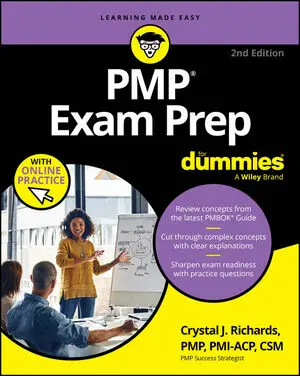
PMP Exam Prep For Dummies Procurement Cheat Sheet


Procurement on the PMP exam comes down to three core decisions: whether to make or buy, which documents to use, and which contract type fits the situation. This cheat sheet breaks down each decision clearly—covering contract types, source selection criteria, and what every project manager needs to understand about a contract, even when procurement owns it.
For more help preparing for the PMP exam, check out the "PMP Exam Prep For Dummies Cheat Sheet."
The make or buy decision
Make (Internal):
- Core competency of the organization
- Confidential or proprietary work
- Sufficient internal capacity exists
- Lower long-term cost
- Greater control over quality and schedule
Buy (External):
- Not a core competency
- Specialized expertise required
- Internal capacity unavailable
- Lower cost when outsourced
- Risk transfer is desirable
PMBOK, Eighth Edition — Plan Sourcing Strategy: This process formalizes the make or buy decision early in planning. It replaces Plan Procurement Management, reflecting that procurement execution belongs to a dedicated procurement team, not the project manager.
Key procurement documents
RFI (Request for Information): Gather market information before committing to a procurement approach. No binding response expected.
RFQ (Request for Quotation): Price is the primary factor. Used for commodities or standard goods and services with well-defined specs.
RFP (Request for Proposal): Scope is complex or solutions vary. Sellers propose an approach and a price. Emphasis on evaluating vendors based on technical cap, experience, proposed solutions, and price.
Source selection criteria
Technical Capability: Expertise, tools, and experience to deliver.
Management Approach: How the seller manages work, risks, and the relationship.
Financial Capacity: Stability to sustain the contract through completion.
Price or Lifecycle Cost: Total cost of ownership, not just the bid price.
Past Performance: Track record on similar contracts and references.
Intellectual Property: Who owns deliverables, tools, or methods created.
Proprietary Rights: Existing rights or licenses that affect delivery.
Contract types
What every project manager needs to know, even when procurement owns the contract.
Risk spectrum:

Cost Reimbursable (CR): Buyer bears the most risk
When to Use: Scope is unclear or evolving. Used for R&D, complex projects, or early-stage work where requirements cannot be fully defined upfront.
Exam Tip: If the question says scope is unclear or evolving, think Cost Reimbursable.
Contract subtypes:
- CPFF (Cost Plus Fixed Fee): Seller reimbursed for all costs plus a fixed fee that does not change based on performance.
- CPIF (Cost Plus Incentive Fee): Seller reimbursed for costs plus an incentive fee tied to meeting predefined performance targets.
- CPAF (Cost Plus Award Fee): Seller reimbursed for costs plus an award fee based on the buyer's subjective assessment of performance.
Fixed Price (FP): Seller bears the most risk
When to Use: Scope is well-defined and stable. The seller commits to delivering for a set price regardless of actual costs incurred.
Exam Tip: If the scope is clearly defined, think Fixed Price. If the seller underestimates, they absorb the loss.
Contract subtypes:
- FFP (Firm Fixed Price): The most common type. One price with no adjustments. Maximum risk to seller.
- FPIF (Fixed Price Incentive Fee): Fixed price with an incentive structure. Seller earns a bonus for meeting or exceeding cost or schedule targets.
- FP-EPA (Fixed Price with Economic Price Adjustment): Fixed price with predefined adjustments tied to economic conditions (e.g., inflation index). Used for long-term contracts.
Time and Materials (T&M): Risk shared between buyer and seller
When to Use: Scope is partially defined. Often used for staff augmentation, consulting engagements, or when work needs to start before full scope is known. A defining feature is the inclusion of a not-to-exceed (NTE) clause. This contract type is also known as Time and Means.
Exam Tip: T&M is the hybrid. It has elements of both Fixed Price (set unit rates) and Cost Reimbursable (open-ended total cost) but with the inclusion of an NTE clause.
Contract features:
- T&M (with NTE): Buyer pays a fixed rate per hour or unit plus materials at cost. This adds a spending ceiling to protect the buyer. The seller cannot bill beyond the cap without a change order.
What project managers must understand in a contract
Statement of Work (SOW): Defines the specific work, deliverables, timeline, and acceptance criteria. The foundation of the contract.
Acceptance Criteria: Conditions that must be met for deliverables to be accepted. A PM must know these to validate scope.
Change Control Provisions: How changes to scope, schedule, or cost are requested, reviewed, and approved. Protects both parties.
Terms and Conditions: Payment terms, warranties, liabilities, dispute resolution, and termination clauses.
Roles and Responsibilities: Points of contact, decision authority, and escalation paths for both parties.
About This Article
This article can be found in the category:
Hot off the press
Explore Related content