|
Published:
September 29, 2025

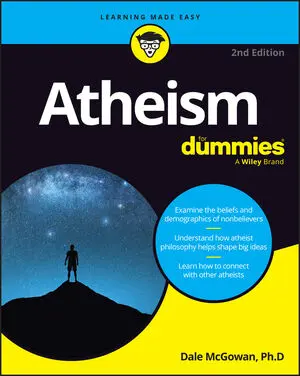
Atheism For Dummies

Overview

An unintimidating guide to Atheism and secular philosophy

Atheism For Dummies, 2nd Edition takes an unbiased look into the philosophical worldview of the lack of belief in gods. This approachable book showcases how atheism is a spectrum, from showing the secular values and lifestyles that resonate with many atheists to also showing how atheism can connect to other philosophical views such agnosticism, secular humanism, and more. Learn about the deep history of atheism, how atheism appears in popular culture, and how atheist philosophy and perspective can apply to topics like artificial intelligence and the climate crisis.

  • Explore what atheism is and isn't
  • Examine the beliefs of nonbelievers
  • Discover atheist perspective on important philosophical questions
  • Find out how the internet has shaped atheism and secular communities

If you're looking for a stronger understanding of religious nonbelief, Atheism For Dummies, 2nd Edition is the accessible guide for you.

Read More

About The Author

Dale McGowan, PhD, is the author of Parenting Beyond Belief and Raising Freethinkers and producer of podcasts on nonreligious par­enting, mortality, wonder, and the human story. His work has appeared in The Huffington Post and The Washington Post, and he co-founded the secular media company OnlySky.

Sample Chapters

atheism for dummies

CHEAT SHEET

Atheism is the simple but kind of startling idea that no god or gods exist. If you’re interested in exploring the topic, it helps to know some of the labels for different types and degrees of religious doubt, some of the most important thinkers in the history of atheism, and a few of the most fascinating spots on Earth for just saying no to God.

HAVE THIS BOOK?

Articles from
the book

The edgy and risky animated series South Park sprang from nontheistic heads — in this case, atheists Trey Parker and Matt Stone. For many people, believers and non-believers alike, shows like South Park play a valuable role in knocking the big questions down to manageable size. South Park goes after its targets relentlessly, sparing no one, including Parker and Stone’s fellow unbelievers: In one episode, a boy is fostered into a “strict agnostic” home in which a tyrannical father demands absolute uncertainty.
The history of atheism is filled with important figures — people who have thought outside of the religious box of their times and often used their eloquence and intellect to convince other to do so as well. Some have also distinguished themselves as moral or intellectual heroes in the great issues of their day.
Atheism is the simple but kind of startling idea that no god or gods exist. If you’re interested in exploring the topic, it helps to know some of the labels for different types and degrees of religious doubt, some of the most important thinkers in the history of atheism, and a few of the most fascinating spots on Earth for just saying no to God.
Most religious believers want to live in a world in which people behave ethically. Funny thing…so do most atheists. An ethical society is simply safer, less scary, easier, more satisfying to live in, and simply better, whether or not a person believes in God. That’s the kind of place everyone want their kids to live in.
Science fiction writer Isaac Asimov calls the Bible “the most potent force for atheism ever conceived” — and many atheists agree. But most people are only familiar with that carefully handpicked sampler of inspiring passages from the Bible. For each and every inspirational passage that finds its way into pulpits and needlepoint pillows, half a dozen immoral horrors stay pretty well hidden.
British atheist philosopher A.C. Grayling had an arresting thought about creating a Humanist Bible: How would world history have been different if the writers of the Bible used Greek and Roman philosophy instead of local religions as their sources? But they didn’t so Grayling did. The result is The Good Book: A Humanist Bible (Walker & Co.
From a country of atheist Lutherans to a province of atheist Catholics, there are some of interesting spots on the globe for religious disbelief. They also have different flavors of atheism. Atheism in Scandinavia Norway, Denmark, and Sweden are three of the four least religious countries on Earth, but you wouldn’t know that on the surface.
Some atheists also feel that religion has made no positive contributions to the world. Even atheist Bertrand Russell, a pretty levelheaded guy on most days, credits religion only with establishing the calendar, saying he can’t think of any other contributions. Most atheists, even those who feel religion is a bad influence overall, can usually think of a bit more than the calendar: Many great artists and composers are inspired by their belief.
Atheist philosophers didn’t really kill God, though Neitzche and Hardy have helped lay God to rest. And though philosophy has been pounding away at religious assumptions for centuries now, science ended up putting those assumptions on life support. An atheist philosopher, Friedrich Nietzsche (1844–1900), finally took the pulse of God and declared an end to the whole idea.
British philosopher and self-ascribed agnostic, Bertrand Russell (1872–1970) expressed an idea that is both simple and striking: He felt that all opinions, without exception, should be held conditionally (capable of being changed), not dogmatically (etched in stone). When people feel the evidence for a claim is strong, they can be confident in the claim, consider it true, and act accordingly, but they should always keep their minds open to new evidence or further thinking that might change their opinions.
How and whether to come out depends on many things, including whether an atheist is a dependent minor or self-sufficient adult. The thought of losing valued relationships or even being shunned completely by family and friends is painful and frightening. Whether you’re coming out as a nonbeliever or think you may have a family member who is, here are a few thoughts to remember: Coming out is a personal decision.
Many atheists say after they set side religious beliefs, the experience a similar set of feelings. They report most commonly, freedom and relief. Some atheists never really had religious beliefs in the first place. Their view was naturalistic from the beginning. For those atheists who did have supernatural beliefs, the stories of losing those beliefs are amazing in their variety.
Atheism is a big umbrella. There are about as many ways to disbelieve as there are ways to believe — different degrees, different emphases, and different expressions. It covers anyone who doesn’t believe in a supernatural god or gods. But under that umbrella are many shades and grades of disbelief and many people with different ways of approaching and expressing it.
Outraged by the role religion had played in keeping women in submission, many feminist leaders of the early Feminist movement identified as atheists and agnostics. Almost every traditional religion puts women in an inferior or even degraded role compared to men.Nearly all religions bar women from serving as clergy.
Most atheists will readily admit that a lot of religious believers are good people. From Martin Luther King, Jr. to the Dalai Lama to Mr. Rogers people have no trouble coming up with countless examples of people who do their religion proud. But many religious people to think that nonbelievers simply can’t be moral people.
Labels can be helpful. There are different labels and types of atheism, among them, implicit atheism and explicit atheism. These labels provide a quick and useful shorthand for understanding what a person does, or who she is, or even what he believes is true about the world. A quote from an 1861 speech by the pioneering feminist and atheist Ernestine Rose shows how many atheists think of atheism.
A lot of atheists and humanists today are pretty much allergic to religious language and ritual. But John Dewey, writing in the 1930s, was coming from a very different place. Few people can claim a greater influence on American culture than the philosopher John Dewey (1859–1952). In the course of a long career, Dewey practically reinvented the American system of education from the bottom up.
Ask a religious person or an atheist to identify his or her belief and you’re unlikely to hear many different answers. Several labels can easily apply to one person, each emphasizing a different aspect of belief or a different degree of detail. A few of the most common and useful descriptive terms or labels in and around atheism are Atheist: A person who’s of the opinion that no supernatural god or gods exist.
Just expressing an atheist opinion out loud was enough to set the wheels of British justice in motion in the 19th century. But Shelley went beyond that, arguing that atheism was a necessary position — the only one that could be reasonably held. Even as late as the 19th century, blasphemy was still an actual, arrestable crime in England.
The gender balance isn’t the only thing that’s shifting in the atheist landscape; in recent years, the movement has also gained a much greater presence of nonwhite nonbelievers. Religion has never just been about beliefs. It’s also about community and identity and a whole lot more. This is especially true in racial or cultural minority communities.
No matter what your perspective, the idea of religious atheism is probably a head-spinner at first. If someone said “religion,” the odds are pretty good that “God” is one of the first related words to pop into your head. Religion and God have been joined at the hip from the beginning. In fact, a person can be an atheist who also considers him or herself religious.
Atheism, humanism, and all the rest of the nontheistic isms show up in different ways around the world. What follows is a list of some of the most interesting places to watch for developments in religious disbelief. Earth: Current home to 1.1 billion nontheistic people. Ireland: Where those who call themselves “religious” dropped from 69 percent to 47 percent in seven years — the largest drop on Earth.
The title of The Little Book of Atheist Spirituality (Viking) by André Comte- Sponville often draws a chuckle. Some see a contradiction in “atheist spirituality,” whereas others assume the book is a lightweight, touchy-feely book that substitutes religion with the Age of Aquarius. Fortunately it’s much better than that — a thought-provoking, accessible little book that tackles all of those important intangibles that a human being runs into after she’s given up the gods and embraces atheism.
European atheism didn’t start clearing its throat until the mid-1600s. At that time, clandestina, or secret manuscripts appeared. Clandestina are anonymous books challenging the existence of God. Minor nobles and major thinkers of the time started to secretly pass clandestina to each other. Blasphemy was still extremely illegal, and saying God didn’t exist was as blasphemous as you could get.
The Cult of Reason was an attempt to organize a civic religion without gods, a kind of atheism, to replace Christianity during the French Revolution. Centered on humanity rather than divinity, the goal of the Cult of Reason was the perfection of mankind through the pursuit of truth and freedom. Like most radical social experiments, it was interesting and more than a little weird.
A lot of people think that atheism is a recent idea. But religious disbelief actually has a long and fascinating history. Just as a student of Christianity would want to know about a few rather significant things that happened 2,000 years ago, someone who wants a better understanding of atheism likewise needs to know what atheism has been up to for the past 30 centuries or so.
A movement called The New Atheism was born the moment religion flew planes into buildings on September 11, 2001. Though atheists had been around for centuries, the horror and clarity of that moment, and the very clear part played by religion, was the last straw and a call to action for countless nonreligious people.
There are many key moments in the Scientific Revolution that proved important for later developments in atheism. Without these key moments, atheism would have remained in the starting gate, munching its hay. But with these crucial changes of perspective, atheism was out of the gates and around the first turn. Atheism gained momentum with the start of the Scientific Revolution, marked by Copernicus’s theory of the sun-centered solar system , published in 1543.
Atheism and other kinds of religious doubt are chock-a-block with labels and terms. Some are more important than others; some are neutral or positive; others are used (even by atheists) as putdowns. The following list includes all of the major labels — good, bad, and ugly. Atheist: Doesn’t believe a god or gods exist.
https://cdn.prod.website-files.com/6630d85d73068bc09c7c436c/69195ee32d5c606051d9f433_4.%20All%20For%20You.mp3

Frequently Asked Questions

No items found.