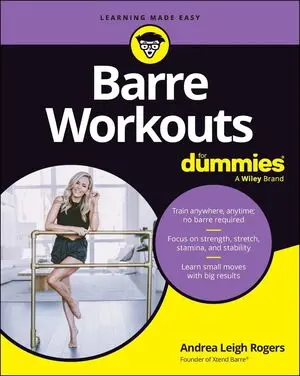
What Is a Barre Workout, and What Are the Fundamentals of Barre?


A barre workout is a low-impact, high-intensity exercise method that blends Pilates, yoga, and ballet-inspired moves to build strength, stamina, and flexibility.
Barre is a ballet-inspired workout that’s low-impact but seriously high-intensity. It blends the precision of Pilates, the flow of yoga, and the focused discipline of professional dance training into one routine. Don’t let the small movements fool you — one of the greatest barre workout benefits is that it challenges deep stabilizing muscles you didn’t even know you had. It improves your posture, tones your entire body, and sharpens your mind–body connection, all without a single jump or jarring impact.
Barre is more than a class or workout; it’s movement that strengthens you physically and mentally. It shows you what you are capable of and leaves you feeling empowered, energized, and motivated to take on life with a new level of intention.
Now, the barre itself — the wall-fixed, stationary handrail used for warmups in ballet-training and dance studios around the world — is where the name of this workout derives. But here’s the thing: Barre is most definitely not just for dancers. And you most definitely don’t need a wall-fixed barre to do it.
Barre may be performed in a studio or at home on an exercise mat, barefoot or in grip socks, and occasionally with light hand weights, resistance bands, or a Barre or Pilates ball. Workouts consist of a warm-up, then a series of targeted and challenging exercises that focus on the upper body and arms, the core, abductors, thighs, legs, and feet, and a delicious cooldown at the end to promote flexibility and mobility. With consistency, you’ll achieve lean muscle tone, incredible stamina, and feel nothing short of amazing.
How is Barre a ballet-inspired exercise?
Barre incorporates classic ballet positions and movements, modifying them for general fitness purposes to build endurance.
As Barre borrows from the art of ballet training via Pilates and yoga, you will learn classic ballet moves like pliés, arabesque, and battements (if this all sounds French to you, we cover how to do all these moves in Chapter 5 of Barre Workouts For Dummies), and improve your endurance using your own bodyweight via repetitions to challenge the body in targeted ways.
Why do small Barre moves deliver big results?
Small barre moves use high repetitions and isometric holds to fatigue muscles efficiently, leading to a stronger and more toned physique.
Many of my clients who are brand-new to Barre workouts are surprised by how quickly they see — and feel — the results. How can such small moves, seemingly simple techniques, and graceful positions deliver toned limbs, a stronger core, improved flexibility, and make their muscles shake like they’re bench-pressing 100 pounds? How can such a low-impact workout be so deeply effective at burning fat? And why are these hand weights so light?
“Barre . . . has a reputation for being deceptively hard — all those tiny movements can add up to a rigorous workout,” noted The New York Times in 2025.
The power of Barre is that, even though the moves can seem small and the weights are light, it’s truly a full-body workout. Through a series of targeted and compound movements, a Barre workout focuses on both individual muscles and muscle groups throughout the body. Barre also gives special focus to those smaller muscles that might not otherwise get activated, which tends to promote a more toned, stronger physique. Targeting those muscles — through isometric holds, changing positions, lots of repetitions, sometimes with light weights, a ball, or resistance bands — means those small moves deliver big results.
There is a reason dancers’ bodies are so startlingly strong relative to their body mass, and Barre workouts owe much to this much-loved tradition.
What are isometric holds?
Isometric exercises are static holds in specific positions for a set period, activating muscles without changing their length.
Think wall sits, glute bridges, and planks; in Barre workouts, this is seen in various exercises where we hold the position before or after the movement. These holds activate muscles or muscle groups without moving. Where a biceps curl lengthens (eccentric contraction) and shortens (concentric contraction) your biceps, an isometric exercise is a completely still, static contraction. A Barre workout combines both movement and still moments of isometric exercise to build strength and control.
What are the Barre workout fundamentals?
The main barre workout fundamentals are based on four core pillars: Strength, Stamina, Stretch, and Stability. Before you jump into your first plié, it helps to understand the core principles that make Barre so effective.
Think of a full Barre workout as incorporating four pillars, or the four S’s:
Strength
You build strength through resistance and targeted bodyweight exercises. You’ll be challenging and building strength through resistance, using your bodyweight (or occasionally light weights or resistance bands) in moves like Parallel Pliés, Fold-Overs, and C-Curve Abs. As with all strength-building, your strength will grow when combined with a healthful diet and enough protein (and enough calories in general), good hydration, and skillful sleep.
Stamina
Barre improves your muscular endurance over time. You’ll be challenging and improving your stamina, and you’ll be able to measure this in your ability to hold positions for longer and with better form, increasing the number of repetitions you’re able to do before fatigue, and in the ability and desire to take on longer and more intense workouts. It’s a subtle power that grows and is useful in every area of your life.
Stretch
Stretching promotes flexibility and speeds up recovery. Much like yoga and Pilates, Barre workouts contain a stretch component — it’s baked into many of the exercises — that supports general mobility, flexibility, and muscle health, and helps prevent muscle tightness (which, if ignored, can cause injury).
Stability
Core stability keeps your body balanced and aligned during complex movements. Your ability to maintain a stable center — particularly in your core and pelvis — will start to improve, as a complex network of muscles learn to activate instinctively. Exercises like second cardio, battements, and passé presses, where you move your limbs away from your core, challenge your ability to maintain stability — and it’s this challenge that truly improves it. Outside your Barre workouts, your overall balance will improve, which is especially important as we age.
Ready to learn more about Barre? Check out the "Barre Workouts For Dummies Cheat Sheet" or get the book.
Frequently asked questions
Q: Can beginners do a barre workout?
A: Yes, barre workouts are highly adaptable for beginners. Because the movements are low-impact and easily modified, anyone can start building strength and stamina regardless of their current fitness level.
Q: How often should you do a barre workout to see benefits?
A: For the best barre workout benefits, aim for two to four sessions a week. Consistency allows your muscles to adapt to the isometric holds and high repetitions, improving your overall muscle tone and posture.
Q: Do you need a physical barre to do a barre workout at home?
A: No, you do not need a wall-mounted barre for a home workout. You can easily substitute a sturdy chair, the back of a couch, or a kitchen counter for balance and support.
About This Article
This article can be found in the category:
Hot off the press
Explore Related content