


Quantum computing is quickly becoming a modern reality that redefines how organizations must think about security, risk, and long-term data protection. Quantum computing represents a fundamental shift from the deterministic, binary logic of classical machines. Instead of relying on bits that are limited to representing data as ones and zeros, quantum systems draw on principles of quantum mechanics — including qubits, superposition, and entanglement — to process information and unlock breakthroughs in drug discovery, materials engineering, climate modeling, logistics optimization, and advanced research, among others.
But the same capabilities that make quantum computing so transformative also make it deeply disruptive. When machines can solve problems that were once considered computationally impossible, the foundations of today’s cybersecurity — especially public‑key cryptography — become vulnerable. Algorithms such as Rivest-Shamir-Adleman (RSA), Diffie‑Hellman, and Elliptic‑Curve Cryptography rely on mathematical problems that classical computers can’t feasibly solve. Quantum machines running Shor’s algorithm, however, could make quick work of these algorithms, effectively breaking the trust model that modern encryption depends upon.
Harvest now, decrypt later: The threat is already here
Adversaries are already executing Harvest Now, Decrypt Later attacks in which encrypted data can be stolen and stored today, then decrypted when cryptographically relevant quantum computers (CRQCs) emerge. Data that seems safe right now may already be sitting in an adversary’s archive, waiting for quantum capabilities to unlock it. For organizations with long‑lived data — intellectual property, financial records, healthcare information, government communications — the threat is immediate, not theoretical.
Defending against the quantum threat With PQC
Post‑quantum cryptography (PQC) represents a strategic shift in how organizations safeguard their digital environments and networks, providing the next-generation security architecture necessary to withstand quantum threats. PQC algorithms replace vulnerable asymmetric cryptography while strengthening symmetric encryption and hashing.
Four U.S. National Institute of Standards and Technology (NIST)‑approved algorithms form the backbone of quantum‑safe security:
- Module-Lattice-Based Key-Encapsulation Mechanism (ML‑KEM) replaces Elliptic Curve Diffie-Hellman (ECDH) for secure key exchange. It ensures that session keys negotiated today remain protected even as quantum capabilities advance.
- Module-Lattice-Based Digital Signature Algorithm (ML‑DSA) is a quantum‑safe digital signature algorithm that prevents attackers from forging device identities, routing updates, or software images.
- Advanced Encryption Standard Galois/Counter Mode (AES‑GCM‑256) is a symmetric block cipher that remains resilient even when quantum attacks reduce effective key strength.
- Secure Hash Algorithm (SHA‑512) is a robust hashing function required for software and firmware integrity under the U.S. National Security Agency’s (NSA) Commercial National Security Algorithm (CNSA) Suite 2.0.
Together, these algorithms protect the four pillars of secure communication: key establishment, authentication, confidentiality, and integrity.
Exploring Cisco Full‑Stack PQC Resilient Infrastructure
To counter the quantum threat, leaders must immediately address a pressing strategic challenge: how to protect critical infrastructure against an adversary capable of breaking the cryptographic algorithms that secure today’s networks.
Cisco Full-Stack PQC Resilient Infrastructure delivers quantum‑safe protection from the moment a switch powers on to every packet it transmits across the network. A PQC‑anchored secure boot, rooted in the Trust Anchor Module (TAm), stores the cryptographic keys used to verify each stage of the boot sequence. Across the network, ML‑KEM strengthens key exchange for Internet Protocol Security (IPsec), Transport Layer Security (TLS), Secure Shell (SSH), and Media Access Control Security (MACsec), ensuring harvested data cannot be decrypted by future quantum systems.
Cisco’s broader roadmap aligns with global mandates, committing to quantum‑safe communications and hardware‑anchored trust by 2026. It guides customers through cryptoagility, phased migration, and PQC adoption across switching and routing platforms, supported by Cisco Research, Labs, and the Security and Trust Office for long‑term resilience.
How to get started
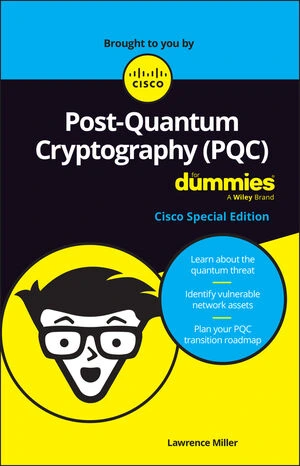
Standards and regulations typically lag technological innovation. The fact that major government mandates — from the U.S., UK, and EU to Australia, Brazil, Israel, South Korea, and others — are already being enacted, should be a clarion call for executives to act now. Visit Cisco.com and download a free copy of Post-Quantum Cryptography (PQC) For Dummies, Cisco Special Edition and get started today.
About This Article
This article can be found in the category:
Hot off the press
Explore Related content