



In this article, you discover
- How agentic AI poses a risk to IT security
- Why monitoring agentic activity should include analyzing behavioral intent
- How behavioral intent helps you spot worrisome agentic security activities
- How you can find out more about protecting your assets in the age of agentic AI
The vital role of security — protecting your enterprise’s applications and data — is certainly nothing new. But now that the paths connecting those apps and data sources with the rest of the world have multiplied, traditional security methods just don’t cut it.
Agentic artificial intelligence (AI) provides the latest twist. Activity was already arriving through application programming interfaces (APIs) and third-party integrations, but now you’ve got generative and agentic AI systems taking autonomous actions.
Those behaviors may pose new risks, but they also provide some of the best answers to those risks. These days your ideal yardstick for measuring agentic AI security is a meticulous focus on how agentic systems are behaving. Their actions are what speak louder than anything.
Watching behavioral intent
Traditional IT security — back in the day — looked like this: You just built a wall and your IT lived safely inside with the outsiders on the outside. When the practicality of the wall faded, it made sense to watch where the outsiders were coming from, including by tracking their IP addresses. But with agentic AI, that’s not good enough. Many outsiders are welcome, while some insiders may be stirring up trouble.
That’s why security efforts must analyze behavioral intent. That means monitoring all activity coming in by way of calls from other applications, traffic from web browsers, API requests, bot interactions, and AI-driven workflows involving generative and agentic systems.
The idea is to run those traffic observations through a behavioral intent engine to figure out not just what’s happening but what the intended purpose of that activity is. Doing so helps you detect and mitigate attacks, but just as important, it spotlights and corrects behavior that has good intentions but has started to drift off the road.
Cequence employs this kind of technology to analyze behavioral intent continually across web, mobile, and API traffic. Machine learning models basically fingerprint incoming requests to discern behavior, checking against normal operations as well as known attack traits. It’s the key to telling good bots from bad bots (or bots that are good-natured but misguided).
That’s why it’s essential to watch behavioral intent, analyze carefully and quickly, and automatically mitigate immediately if the circumstances require action.
Spotting worrisome behavior
Monitoring behavioral intent is how you tell good activities and bad behavior apart. Agentic AI is, of course, all about enabling autonomous behaviors in ways never before accomplished — actions are the whole point, but they have to be the right actions.
Bad behavior on the part of agentic AI could be an agent that is deleting records, or perhaps exfiltrating sensitive data by sending copies of records to an external email address. You need to find out that kind of thing is happening right away, in real time, so your security can automatically address the risk.
But well-intentioned, good bots can also be unintentionally guilty of errant behavior. They may be doing their best to complete a task that a human has given them, but they make faulty assumptions.
Maybe a bot decides on its own to make 100 record requests a second, rather than 100 a day. The bot wants to keep its human as up-to-date as possible, but it’s doing the right thing in the wrong way, overwhelming the system and vaulting over guardrails. Your security system needs to know about this behavior, too, and be able to fix it.
One thing that makes behavioral intent monitoring a challenge is the fact that risks can emerge over time, not always with a single action or request. What matters is the sequence of actions, including how tools are invoked, how APIs are changed, whether and how credentials are reused, and how data is moving from one system to another. Malicious actions such as prompt injection or goal hijacking can redirect agent behavior into risky actions, but it often happens only in subtle ways that don’t scream out that an attack is happening.
Behavioral intent monitoring requires really getting to know the sequences and patterns — knowing what’s right so the security platform can more easily tell what’s wrong. Good agents will usually follow predictable sequences, with consistent endpoints, logical workflows, and steady volumes. Compromised agents are likely to exhibit unusual activity. Maybe they’re probing unknown resources, or spiking downloads, or shifting from read to write operations.
Watching through a lens of behavioral intent establishes a baseline for what’s normal, in terms of goal sequences, data flows, and request patterns. That makes subtle drifts as detectable as obvious attacks, whether it’s malicious impersonations, accidental data leaks, over-permissioned workflows, or autonomous actions that are outside the defined limits.
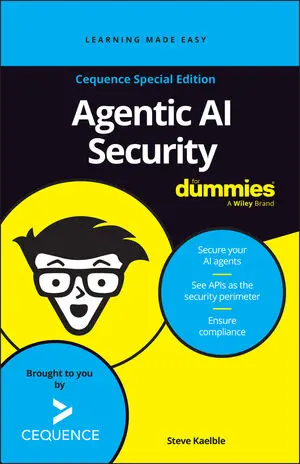
This article has given you the basics about what you can learn from AI agent behavior. If you want to know more, download the free e-book, Agentic AI Security For Dummies, Cequence Special Edition. It goes into much greater detail about how to secure your APIs and protect your assets in the age of agentic AI.
About This Article
This article can be found in the category:
Hot off the press
Explore Related content