Herbal Magic For Dummies Cheat Sheet


This cheat sheet includes information that you will come across time and time again as you practice herbal magic, as well as some helpful information to take you further into your studies. While herbal magic can be a form of personal expression once you get the hang of it, here are some of the foundational concepts to give you a head start!
Helpful items for herbal magic
One thing that all herbal practitioners can relate to is that they collect a lot of bottles, jars, and containers. This collection comes with the territory, but it doesn’t stop there. Herbal magic comes with a lot of tools of the trade, and this list covers some of the most important ones that you will want to have on hand to make your life easier.
- Mason jars
- Dropper bottles
- Coffee grinder
- Gloves
- Cheesecloth
- String or other natural cordage
- Small slow cooker
- Tools for stirring and scooping, such as pottery tools
- Rubbing alcohol (for sterilization)
- Face mask (when working with powdered ingredients)
The four elements
The four elements — Earth, Air, Water and Fire — are nature’s building blocks. You can find them all things in varying proportions and convey complex and abstract concepts as much as they represent physical elements.
The four elements are associated with other important categories, such as the signs of the zodiac and planets in the solar system. They are the foundation behind the humoral system of medicine, which categorizes illnesses based on the qualities of hot, cold, dry, and wet, allowing the herbal practitioner to select the appropriate herbs to treat the issue. Similar variations to this system, which began in Ancient Greece, can be found in other systems of herbal medicine, such as Traditional Chinese Medicine and Ayurvedic medicine.
The four element system also plays a role in how practitioners interpret an herb’s spiritual properties, with Spirit, the fifth element, being the unifying force behind the other four.
Working with moon phases
Working with the energy of the Moon can be a helpful way to synchronize with the naturally present energies of the cosmos for all kinds of manifestation, whether working with herbal magic or intentional visualization. An entire lunar cycle is 28.5 days and is made up of eight phases, which are shown in the figure.
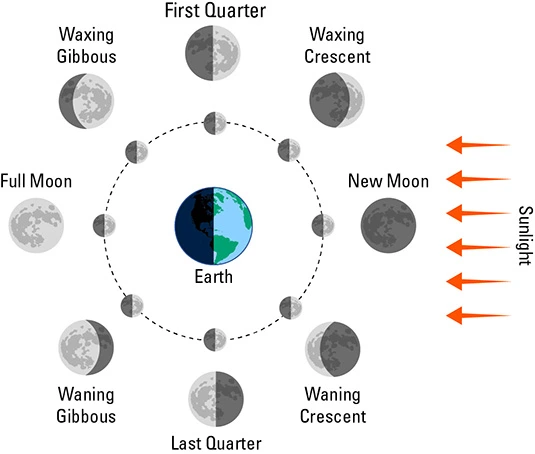
Dark moon (often referred to as new moon) is a three-day period in which the Moon is least visible in the sky, including the day before, the day of, and the day after. The dark moon is when the Moon’s energy is hidden, or goes within, and is a time to focus on rest, reflecting, meditation, divination, and dreamwork.
Increasing in light is the stage from the new moon (when the first sliver of light is visible at sunset) all the way up to the full moon, including the waxing crescent, first quarter, and waxing gibbous. This is the time to focus on starting new things, new beginnings, building energy, invitation, increase, attraction, and building.
Full moon is when the energy of the Moon is at its strongest and can be accessed for three days: the day before, the day of, and the day after the full moon. The night of the full moon is traditionally considered the most powerful time for magical workings, especially those focused on culmination, blessing, healing, sending energy, manifestation, and extra energy.
Decreasing in light is the stage of the lunar cycle that happens after the days of the full moon, when the lunar disk begins to grow smaller until it finally disappears from the sky. This is a time to focus on cleansing, removing unwanted influences, diminishing what is undesirable, banishing, setting boundaries, reducing debt, and protecting.
About This Article
This article can be found in the category:
Hot off the press
Explore Related content