Boxing For Dummies Cheat Sheet


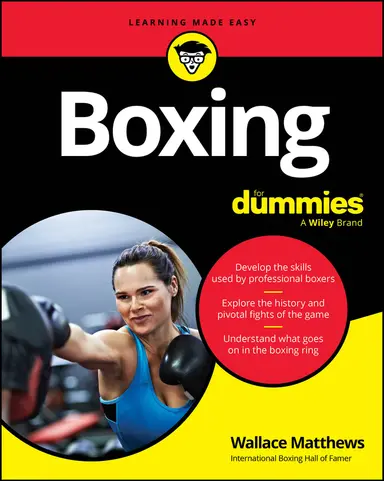
Curious about boxing? Whether you're lacing up gloves for your first workout or cheering ringside as a fan, this cheat sheet has you covered. You'll learn what gear you need, how to build a solid training routine, common rookie mistakes to avoid, and the lingo that'll make you sound like a seasoned boxing insider in no time.
Boxing is among the world’s oldest sports, believed to date back to the beginning of human history. It is a form of unarmed hand-to-hand combat that involves not only strength and endurance, but physical and mental discipline as well as technique. In recent years, boxing workouts have become one of the most popular forms of exercise for people of all age groups who are seeking to achieve a higher level of fitness while learning a complex new skill. Boxing training is a full-body workout that incorporates elements of strength training, aerobic training, and High-Intensity Interval Training (HIIT). It has been shown to benefit Parkinson’s disease sufferers, elderly people with balance and strength issues, and virtually anyone who wants to improve their overall conditioning. As of 2024, it was estimated that approximately nine million people engaged in some form of boxing training in the United States alone.
How to start a boxing workout regimen
Who should try a boxing workout? Virtually everyone. Boxing programs attract an equal number of men and women, ranging in ages from teenagers to octogenarians. They are attracted to the cardio benefits of a boxing workout, the way the routine reshapes their bodies and increases their strength, and how learning to punch correctly even increases their confidence. And for the vast majority of boxing fitness enthusiasts, there is no contact or exchanging of punches. It’s simply an intense, challenging workout that benefits them both physically and mentally.
What will you need?
Not a heck of a lot. A decent pair of boxing gloves of between 12 and 16 ounces, a pair of hand wraps, a good pair of athletic shoes, perhaps a jump rope, and standard workout clothes. Access to a heavy bag or speed bag is a plus but not absolutely necessary.
Will I get hurt?
As long as you’re not sparring, your only injuries are likely to be sore shoulders and skinned knuckles, and only in the beginning. The long-term benefits of a boxing workout — muscular shoulders, strong legs, a tight core, and improved cardiac fitness — far outweigh the little ouchies you will have after your first few workouts.
What exercises would I do?
A good boxing workout consists of a shoulder and leg warmup, followed by a round or two of rope-skipping, a round or two of shadowboxing (in which you practice your moves in front of a mirror against an imaginary opponent), then three rounds each on the speed bag and heavy bag. Work in ratios of three minutes of work to one minute of rest. Wrap up the workout with some dumbbell work to strengthen your shoulders, some core exercises such as crunches, planking, or Russian twists, and some stretching to cool down. The who thing should take approximately one hour. And, oh yes, three to five days of distance running before or after the workout will really help your stamina.
What might I do wrong?
Two biggest mistakes of boxing newbies? Muscling up on your punches, and dropping your hands during a round. Effective punching is all about technique — the coordinated movement of legs, hips, core, shoulders, and finally fists, which results in a smooth and fluid transfer of weight, much like hitting a baseball, a tennis ball, or a golf ball. And if you plan to get into the ring with another boxer, allowing your hands to drop to where they are no longer protecting your head is an absolute no-no!
How do I find a good boxing gym in my neighborhood?
The website usaboxingmetro.com has a list of registered boxing gyms in all 50 states.
How to become a more knowledgeable boxing fan
Well, there are a few things you need to know, beginning with how to score a fight. Fights are scored on the 10-point must system, meaning the boxer who wins a round gets 10 points and the one who loses the round gets 9 or lower depending on how one-sided the round was. Rounds are judged using four criteria: clean punching, effective aggression, ring generalship (the ability of a boxer to control the style of the fight and the tempo of the action), and defense.
You should also familiarize yourself with the best current boxers. The easiest way to do this is by reading the various boxing websites, watching the fights on television or in replay on the Internet, and by checking out the verified records of boxers who interest you on the boxing database boxrec.com.
You might also brush up on some boxing lingo so you can be conversant with the fight crowd. For instance:
- When discussing the weight of a fighter, never use the words one hundred and avoid using the weight class. That means when discussing a welterweight, say “He’s a 47.” When discussing a lightweight, “He’s a 35,” and so on. This will establish your bona fides as someone who knows the game.
- Walking down an opponent means forcing him backwards by pressure with the intention of trapping him on the ropes or in a corner.
- Tying up an opponent means preventing him from punching by clinching or wrapping your arms around him. Excessive clinching is a foul.
- Covering up means a fighter is raising his arms and gloves up in front of his face with the intention not of delivering punches, but blocking them. Also known as going into a clamshell, or in hockey, turtling up.
- A runner is a fighter who prefers not to stand his ground and fight. These fighters are often said to be on the bicycle.
- A bleeder is a fighter who cuts easily.
- A plodder is a fighter who is slow on his feet.
- A bricklayer is a fighter with a powerful punch. These fighters are sometimes said to be heavy-handed.
- A slapper is a boxer who tends to land his punches with the palm of his glove rather than his knuckles. An arm puncher is a boxer who throws his punches without the weight of his body behind them.
- A boxer with the ability to wipe out a points deficit with a single punch late in a fight is said to possess the equalizer. Likewise, a boxer who lacks a powerful punch is said to be feather-fisted.
It’s like learning a whole new language.
Who were the greatest boxers?
Well, Muhammad Ali, of course. Also Sugar Ray Robinson, Joe Louis, Jack Dempsey, Sugar Ray Leonard, Floyd Mayweather Jr., and many, many others. Among the women, Christy Martin, Claressa Shields, Katie Taylor, Amanda Serrano, Lucia Rijker, and again, many, many others.
What were some of the greatest boxing matches? Muhammad Ali–Joe Frazier 1 and 3, Joe Louis–Max Schmeling 2, Marvin Hagler–Thomas Hearns, and Jose Luis Castillo–Diego Corrales come immediately to mind. But here are hundreds and perhaps thousands of other great matches, and many are readily accessible on the Internet.
YouTube.com has thousands of videos of great, historical boxing matches as well as numerous instructional boxing workout videos to help you hone your new skills.
About This Article
This article can be found in the category:
Hot off the press
Explore Related content