

 Main Menu
Book & Article Categories
- Main Menu
Book & Article Categories
- Main Menu
Collections
Explore all collections
General Forensic Psychology: Expert Guides and Resources
Articles & Books From General Forensic Psychology
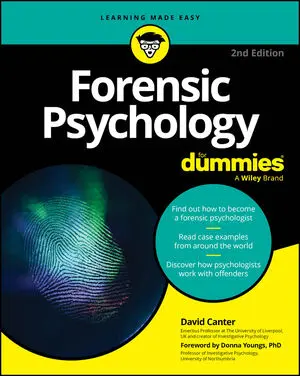
A clear introduction to the psychology of crime Forensic Psychology For Dummies uncovers how forensic psychologists help law enforcement crack major crime cases. This book walks you through the ins-and-outs of this field. It explains why people commit crime, how psychologists assist investigators by profiling offenders and creating interrogation strategies, as well as how some forensic psychiatrists work to treat and rehabilitate the convicted, the imprisoned, and those on supervised release.
Cheat Sheet / Updated 03-30-2026
Forensic psychology is a rapidly growing area of the professional application of psychological science to legal and criminal justice settings. Popular media overdramatize the work of forensic psychologists. They are confused with criminologists who study patterns of crime and justice. They emphasize the role of profilers who exist much more in fiction than in practice.
Cheat Sheet / Updated 03-15-2022
Forensic psychology is the application of psychological knowledge to the criminal justice system. Print out and pin up this Cheat Sheet to remind yourself of how forensic psychology is used within the justice system to assess offenders, identify criminal capacity in young people, and to characterize psychopaths.
Article / Updated 03-26-2016
Robert Hare's Psychopathy checklist is a tool commonly used in clinical practice to assess whether an individual is a psychopath. Here are Hare’s definitions of two types of psychopath: Selfish, callous psychopaths Glibly, but superficially charming Grandiose feeling of how important s/he is Patho
Article / Updated 03-26-2016
Criminality can often be linked back to an offender’s childhood. A child who exhibits three or more of the following behaviours is at risk of becoming seriously anti-social as an adult: Habitual lying Cruelty to animals Cruelty to people, especially vulnerable people Breaking into buildings or cars
Article / Updated 03-26-2016
Forensic Psychologists often assess offenders to determine whether they’re fit to plead their case in court, or are likely to be violent in the future. There are a number of important issues to be considered in this assessment and these are outlined here: Family background Any history of abuse? Offender ever removed from family?