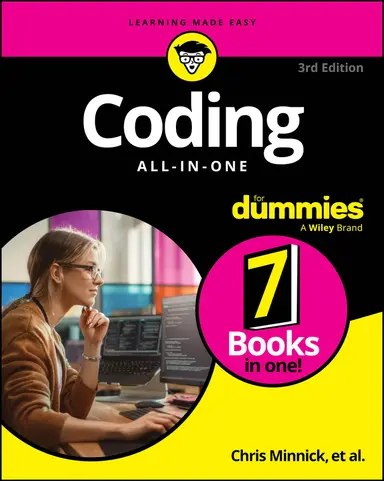
https://www.wiley.com/Coding+All+in+One+For+Dummies,+2nd+Edition-p-9781119889564

Overview

Learn to code from the basics to Python and beyond.

Coding is one of the most valuable skills you can pick up, whether you're switching careers, building a side project, or just curious about how software works. Coding All-in-One For Dummies gives you a friendly, accessible introduction to the languages and tools that power the web and more — including HTML, CSS, JavaScript, Python, and AI-powered coding platforms — all in one handy volume.

You'll go from understanding the basics of how code works to tackling data analysis with Python. Along the way, you'll get comfortable with web development fundamentals, explore how artificial intelligence tools can accelerate your coding projects, and build real skills you can apply right away in any industry.

Inside:

  • Get started with the fundamentals of coding and learn how computers interpret the instructions you write
  • Build web pages using HTML, CSS, and JavaScript, then level up with advanced web coding techniques
  • Explore how AI tools can help you write, debug, and improve your code faster than ever
  • Discover Python basics and see how this beginner-friendly language opens doors to data science and automation
  • Find practical examples and plain-English explanations that make even tricky programming concepts click

Whether you're a student, career changer, or professional looking to expand your technical skill set, this guide gives you everything you need to start coding with confidence. No experience required — just jump in and get going!

Read More

About The Author

Features content from the works of these expert authors: Chris Minnick, Paul McFedries, John Paul Mueller, Luca Massaron, John Shovic, and Alan Simpson.

coding all-in-one for dummies

CHEAT SHEET

Generative AI coding tools can boost your productivity—handling syntax reminders, testing, debugging, refactoring, and documentation—but only if you know how to prompt them well. This cheat sheet walks you through ten prompt engineering tips, a beginner-friendly coding vocabulary, handy AI and Python glossaries, and a curated list of free resources to keep you learning.

HAVE THIS BOOK?

Articles from
the book

The options for learning how to code never seem to end, and advanced degrees typically appeal to a particular group of people. While not necessary for either learning to code or obtaining a coding job, an advanced degree can help accelerate your learning and differentiate you from other job candidates. Here are the two types of advanced degree programs: Master’s degree: A technical degree that allows you to explore and specialize in a particular area of computer science such as artificial intelligence, security, database systems, or machine learning.
Both averaging and voting systems can also work fine when you use a mix of different machine learning algorithms. This is the averaging approach, and it’s widely used when you can’t reduce the estimate variance.As you try to learn from data, you have to try different solutions, thus modeling your data using different machine learning solutions.
Coding has an extensive vocabulary that to laymen can seem like impenetrable techno-babble. Whether you're reading coding-related article online or speaking to a developer at work, you may hear words that you have not heard before or that have a different meaning in a coding context. Here are some common vocabulary words to know: General web development terms: Server: A computer that hosts website code, and that "serves" website code when requested by a "client" computer.
Let’s say that you’ve taken training classes at work, found a coding mentor, and even solved your first problem by using code. Congratulations! So where do you go from here? Like a foreign language, if you stop coding, you’ll forget what you’ve learned. The most important thing is to keep coding and building your confidence and skills.
Practice your Python online using the Codecademy website. Codecademy is a free website created in 2011 to allow anyone to learn how to code right in the browser, without installing or downloading any software. Practice tags (and a few more) by following these steps: Go to Dummies.com Coding All-in-One page, and click the link to Codecademy.
Practice Bootstrap online using the Codecademy website. Codecademy is a free website created in 2011 to allow anyone to learn how to code right in the browser, without installing or downloading any software. Practice tags by following these steps: Go to the Dummies.com Coding All-in-One page, and click the link to Codecademy.
Like careers in medicine or law, a career in coding was often a long road. Much has changed in the industry, and today it's possible to get started without being accepted at a prestigious university or working for years on an advanced degree. In fact, you can probably go to work right away after learning the skills that employers require.
Generative AI coding tools can boost your productivity—handling syntax reminders, testing, debugging, refactoring, and documentation—but only if you know how to prompt them well. This cheat sheet walks you through ten prompt engineering tips, a beginner-friendly coding vocabulary, handy AI and Python glossaries, and a curated list of free resources to keep you learning.
What courses will you need to take in college to get a coding job? College CS courses offer a sweeping survey of entire computer systems from the hardware used to allocate memory to the high-level software that runs programs and the theories used to write that software. As a result, you gain a great sense of why computer systems behave as they do, which gives you the foundation to advance a technology or a programming language when the need arises.
Dates can present problems in data. For one thing, dates are stored as numeric values. However, the precise value of the number depends on the representation for the particular platform and could even depend on the users’ preferences. For example, Excel users can choose to start dates in 1900 or 1904. The numeric encoding for each is different, so the same date can have two numeric values depending on the starting date.
It's common to think that coding careers are reserved for the few technical wizards in the world. In fact, it's a regular job for regular folks. If you're persistent, conscientious, and curious, I'll bet you can do it. Don't sell yourself short by buying into ideas that just aren't true. You must be good at math to be a coder Developers who are building cutting-edge games, data scientists trying to create the next big machine-learning algorithm, or engineers working in the financial services industry likely need some proficiency in physics, statistics, or financial math.
Jobs in coding involve more than just sitting in front of a computer. There are other steps you must take in order to ensure that a project is seen through to the end. The purpose of the planning phase is to Understand the client goals. Some clients may want to be the first to enter an industry with an app, even if it means sacrificing quality.
There are many tools available to help coders do their best work. Before you start coding, do a few housekeeping items. First, ensure that you are doing all of the following: Using the Chrome browser: Download and install the latest version of Chrome, as it offers the most support for the latest HTML standards.
Machine learning depends a lot on the in-sample data. This portion of your data is important because you want to discover a point of view of the world, and as with all points of view, it can be wrong, distorted, or just merely partial. You also know that you need an out-of-sample example to check whether the learning process is working.
special formatting, you do have to consider how the text is stored and whether it contains special words within it. The multiple forms of encoding present on web pages can present interpretation problems that you need to consider as you work through the text.For example, the way the text is encoded can differ because of different operating systems, languages, and geographical areas.
Even though supervised learning is the most popular and frequently used of the three types, all machine learning algorithms respond to the same logic. The central idea is that you can represent reality using a mathematical function that the algorithm doesn’t know in advance but can guess after having seen some data.
In addition to pure layouts, Bootstrap can also create web page components found on almost every website. The idea here is the same as when working with layouts — instead of re-creating the wheel every time by designing your own button or toolbar, it would be better to use prebuilt code, which has already been tested across multiple browsers and devices.
Scatterplots are especially important for data science because they can show data patterns that aren’t obvious when viewed in other ways. You can see data groupings with relative ease and help the viewer understand when data belongs to a particular group. You can also show overlaps between groups and even demonstrate when certain data is outside the expected range.
Generally, you use absolute positioning only on named elements, rather than classes or general element types. For example, you will not want all the paragraphs on a page to have the same size and position, or you couldn’t see them all. Absolute positioning works on only one element at a time.However, you can build a layout with absolute positioning and some flexibility.
In general, browsers display links as blue underlined text. Originally, this default behavior minimized the confusion between content on the page and an interactive link. Today, almost every website styles links in its own way. Some websites don’t underline links; others retain the underlining but style links in colors other than blue; and so on.
Unstructured data files consist of a series of bits. The file doesn’t separate the bits from each other in any way. You can’t simply look into the file and see any structure because there isn’t any to see. Unstructured file formats rely on the file user to know how to interpret the data.For example, each pixel of a picture file could consist of three 32-bit fields.
When styling specific elements with CSS, it is helpful to visualize the HTML code as a family tree with parents, children, and siblings. In the following code example, the tree starts with the html element, which has two children head and body. The head has a child element called title. The body has h1, ul, and p elements as children.
To fully document your MatPlotLib graph, you usually have to resort to labels, annotations, and legends. Each of these elements has a different purpose, as follows: Label: Provides positive identification of a particular data element or grouping. The purpose is to make it easy for the viewer to know the name or kind of data illustrated.
You have a few alternatives to cross-validation in machine learning, all of which are derived from statistics. The first one to consider — but only if you have an in-sample made of few examples — is the leave-one-out cross-validation (LOOCV). It is analogous to k-folds cross-validation, with the only difference being that k, the number of folds, is exactly n, the number of examples.
When you use absolute positioning, you can determine exactly where things are placed, so it’s possible for them to overlap. By default, elements described later in HTML are positioned on top of elements described earlier. Handling depth in CSS You can use a special CSS attribute called z-index to change this default behavior.
You can easily compare examples from your data using calculations if you think of each of them as a vector. The following information describes how to measure similarity between vectors to perform tasks such as computing the distance between vectors for learning purposes. Understanding similarity In a vector form, you can see each variable in your examples as a series of coordinates, with each one pointing to a position in a different space dimension.
As human beings, understanding language is one of our first achievements, and associating words to their meaning seems natural. It’s also automatic to handle discourses that are ambiguous, unclear, or simply have a strong reference to the context of where we live or work (such as dialect, jargon, or terms family or associates understand).
You've filtered coding job postings, networked with dozens of people, created a great portfolio site, and finally landed one or more interviews. Use these tips to maximize the chances of turning the interview into an offer for employment: Prepare diligently: Review the company's website, blog posts, news releases, tweets, and any other social media to learn more about the company's culture, technologies, and past clients.
HTML, CSS, and JavaScript are the most common front-end coding languages. Following is a list of some online resources, references, and tutorials to help you continue practicing all three languages. W3Schools: Reference guides for HTML, CSS, and JavaScript HTML cheat sheet: Most commonly used HTML commands
Once you know what your app will do, you can focus on how your app will do it. After breaking down your app into steps, you go over each step to determine how to accomplish it. For more complicated apps, developers first decide which of these two methods is the best way to complete each step: Building code from scratch: This is the best option if the functionality in a particular step is unique or strategically important, an area of strength for the app, and existing solutions are expensive or nonexistent.
No matter if the machine learning problem is to guess a number or a class, the idea behind the learning strategy of the k-Nearest Neighbors (kNN) algorithm is always the same. The algorithm finds the most similar observations to the one you have to predict and from which you derive a good intuition of the possible answer by averaging the neighboring values, or by picking the most frequent answer class among them.
Given the neural network architecture, you can imagine how easily the algorithm could learn almost anything from data, especially if you added too many layers. In fact, the algorithm does so well that its predictions are often affected by a high estimate variance called overfitting. Overfitting causes the neural network to learn every detail of the training examples, which makes it possible to replicate them in the prediction phase.
As a busy professional with a full work schedule, you need a tangible project to work toward to keep you motivated while you find out how to code. Think of all the tasks you perform during the week — how many could be automated if you had the right tools and skills?The following sample tasks can be done more efficiently with some coding and could help you think of a goal of your own: Spreadsheet consolidation: You have 15 team members who submit timesheets to you using spreadsheets, and you create a consolidated weekly report by manually cutting and pasting entries from each spreadsheet.
Rating data has its limitations in machine learning. For recommender systems to work well, they need to know about you as well as other people, both like you and different from you. Acquiring rating data allows a recommender system to learn from the experiences of multiple customers. Rating data could derive from a judgment (such as rating a product using stars or numbers) or a fact (a binary 1/0 that simply states that you bought the product, saw a movie, or stopped browsing at a certain web page).
You will be able to code and complete some small apps by yourself, but the apps you build at work or use every day, like Google Maps or Instagram, are created by teams of people. Teams for a single product can vary in size, reaching to upward of 50 people, and each person plays a specific role across areas like design, development, product management, and testing.
With your research finished, it’s time to find the best solution. If multiple solutions exist for each step, you now need to choose one. To help you choose, weigh each of your multiple solutions across a variety of factors, such as these: Functionality: Will the code you write or the prebuilt solution you found do everything you need?
When coding your app, you will almost inevitably write code that does not behave as you intended. HTML and CSS are relatively forgiving, with the browser even going so far as to insert tags so the page renders properly. However, JavaScript isn’t so forgiving, and the smallest error, such as a missing quotation mark, can cause the page to not render properly.
One way of styling specific elements in CSS is to name your HTML elements. You name your code by using either the id or class attribute, and then style your code by referring to the id or class selector. Naming your code using the id attribute Use the id attribute to style one specific element on your web page.
https://cdn.prod.website-files.com/6630d85d73068bc09c7c436c/69195ee32d5c606051d9f433_4.%20All%20For%20You.mp3

Frequently Asked Questions

No items found.


