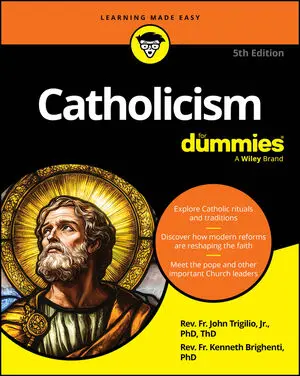
Catholicism For Dummies

Overview

Peer through the stained glass and get an inside look at Christianity's most popular religion

Catholicism can seem a bit mysterious to non-Catholics—and even Catholics. Embrace your curiosity and turn to Dummies for answers! Full of fascinating facts and written in a friendly style, Catholicism For Dummies explains the basics of Catholic beliefs like the importance of Sunday Mass; the seven sacraments; the purity of the Blessed Virgin Mary; heaven, hell, and purgatory; the Trinity; and so much more. You'll learn about the Catholic perspective on women as priests, saints as examples of how to live, and prayer as the basis of a relationship with God.

This easy-to-read resource offers an overview of a rich and diverse faith. You'll also discover:

  • The ins and outs of living as a Catholic and why followers of the faith observe traditions like attending Mass on certain days of the year, praying the rosary, and not eating meat on Fridays
  • Information on what the pope does, how he is selected, the history of the Vatican, and what it's like to be a priest in today's society
  • Details about the church's position on modern social issues, like poverty, abortion and the death penalty, same-sex marriage, and contraception

Whether you're a cradle Catholic or just curious about the world's second largest religion, Catholicism For Dummies has the answers you're seeking to a faith that's been around for thousands of years. Order your copy today.

Read More

About The Author

Rev. Fr. John Trigilio, Jr., PhD, ThD, is President of the Confraternity of Catholic Clergy and a member of the faculty at Mount St. Mary’s Seminary in Emmitsburg, Maryland.

Rev. Fr. Kenneth Brighenti, PhD, is co-host with Father Trigilio of a weekly television program on EWTN called Web of Faith. With Father Trigilio, he is the co-author of previous editions of Catholicism For Dummies.

Sample Chapters

catholicism for dummies

CHEAT SHEET

Catholicism shares many beliefs with other Christian faiths, as well as certain prayers, but Catholicism puts its own spin on things. For example, the Catholic version of the Lord's Prayer (or the Our Father) differs a bit from the Protestant version. Get a basic understanding of Catholic beliefs by reading the articles of Catholic faith.

HAVE THIS BOOK?

Articles from
the book

Here is a list of ten of the most famous Catholics, beginning with the most famous. But take heed: Just being baptized Catholic doesn't mean a person is a good Catholic. The Catholic Church believes that a good Catholic is one who regularly and faithfully practices his faith every day of his life. A person who dissents from official Catholic teaching on faith and morals, who never or only irregularly attends Mass, or who has a scandalous, immoral lifestyle is not considered a practicing — or a good — Catholic.
Catholics do not worship saints, but the saints are near and dear to Catholic hearts. Catholics respect and honor the saints and consider them to be the heroes of the Church. The Church emphasizes that they were ordinary people from ordinary families, and they were totally human. Here are some tidbits about the lives of 11 ordinary people who became popular saints.
The Catholic Church emphasizes that it's imperative to consider the four Gospels as actually forming one whole unit. The four Gospels aren't four separate Gospels but four versions of one Gospel. That's why each one is called The Gospel According to Matthew or The Gospel According to Mark, for example, and not Matthew's Gospel or Mark's Gospel.
Catholicism shares many beliefs with other Christian faiths, as well as certain prayers, but Catholicism puts its own spin on things. For example, the Catholic version of the Lord's Prayer (or the Our Father) differs a bit from the Protestant version. Get a basic understanding of Catholic beliefs by reading the articles of Catholic faith.
This article looks at the history of the Catholic Church from the time of Jesus through the fall of the Roman Empire beginning in ancient Rome. Non-Christian Rome (A.D. 33–312) Present-day Israel was known as Palestine at the time of Jesus, and even though it had a king (Herod), it was a puppet monarchy because the real civil power ruling the Holy Land was the Roman Empire.
One single vestige of unity survived both the moral and military decline of the Roman Empire, and that was the Catholic Church, which had one head (the pope in Rome), one set of laws (canon law), and the same seven sacraments all over the world. And unity existed between the pope and the bishops, between the priests/deacons and their respective bishop, and between the people of the parish and their pastor.
The New Testament contains four Gospels, books of the Bible that tell the life and words of Jesus. The four evangelists, Matthew, Mark, Luke, and John, each wrote one of the four Gospels, considered by Christians to be the most important of all biblical text, because these four books contain the words and deeds of Jesus when He walked this earth.
Like most religions, Catholicism has specific prayers that believers say at certain times or on certain occasions. The Our Father is part of the Catholic Mass, for example, and the Act of Contrition is said as part of the Sacrament of Penance. The Glory Be and Hail Mary are repeated as part of the Rosary, along with the Our Father: Our Father: Our Father, Who art in heaven, hallowed be Thy name; Thy kingdom come; Thy will be done on earth as it is in heaven.
Many were martyred during the Roman persecutions of Catholics. Martyr is actually a Greek word for witness. These faithful Christians tried to avoid persecution, but if hours of torture and a horrible death resulted from witnessing to the faith, they accepted it. St. Stephen was the first deacon of the Catholic Church and the first Christian martyr (also called the Proto-martyr).
Listen to the article:Download audio Rosary beads help Catholics count their prayers. More importantly, Catholics pray the holy Rosary as a means of entreaty to ask God for a special favor, such as helping a loved one recover from an illness, or to thank God for blessings received — a new baby, a new job, a new moon.
A form of Marian devotion, Catholics can visit a holy place where an apparition of Mary has occurred. Catholics believe that a shrine is a holy place, usually where an apparition or other miracle took place or where a saint lived, worked, or died. Shrines are often connected to or located inside of a chapel or church so the faithful can pray and worship God, especially through the Holy Sacrifice of the Mass, as a devotion.
Through the ages, more poems, hymns, statues, icons, paintings, treatises, and sermons have been produced on this one woman than any other in all human history. Yet Catholics' devotion to Mary, known as Marian devotion, has been criticized by non-Catholics as unbiblical or even idolatry. Catholics definitely don't worship Mary.
The Holy Eucharist is placed in an ornamental vessel called a monstrance (see the figure) and left on the altar for public adoration and worship. Catholics consider it a great privilege and blessing to be able to adore the Blessed Sacrament; some spend a holy hour in front of the Eucharist each week so they can privately and publicly pray and express their faith.
According to pious Catholic tradition, in the 13th century, Mary, the Mother of God, appeared to St. Dominic de Guzman, gave him a rosary, and asked that instead of praying the Psalms on beads or knots, the faithful pray the Hail Mary, Our Father, and the Glory Be.Fifteen decades made up the original Dominican Rosary, but it was later abbreviated.
Listen to the article:Download audio According to Exodus in the Old Testament, God issued his own set of laws, the Ten Commandments, to Moses on Mount Sinai.In Basic Beliefs of Catholicism, the Ten Commandments are considered divine law because God himself revealed them. And because they were spelled out specifically with no room for ambiguity, they’re also positive law.
The latter half of the 16th century through the middle of the 18th century brought even more changes to the world's way of thinking — and to the Catholic Church. Science and religion Some people believe that Galileo Galilei (1564–1642) was ahead of his time and that the Catholic Church held back science for centuries.
The 18th century witnessed the dawn of the Industrial Revolution in England. The American and French Revolutions also occurred during this time. Many new ideas and concepts were being introduced into philosophy, religion, and society, and these ideals were embodied in a movement called the Enlightenment. The age of revolution had begun.
Roughly at the same time as the First Vatican Council (1869–1870), which defined the doctrine of Papal Infallibility, the Italian unification process took shape under Victor Emmanuel, threatening the Papal States.Back in the 8th century, the Carolingian Frankish King Pepin the Short, who was the father of Charlemagne, had given the Papal States (Patrimonium Petri) to the pope for his secular rule.
Whereas Pope Innocent III (1198–1216) epitomized the zenith of papal power and influence, Pope Boniface VIII (1294–1303) personified one of the most complicated, mysterious, and at times contradictory pontificates of the Church.King Philip IV of France and Boniface became bitter enemies early on. Their relationship worsened over time, and in 1303, Philip sent mercenaries to arrest and bully Boniface into resigning.
In 1545, the Church called the general Council of Trent, which lasted more than 18 years due to wars and other interruptions, such as the death of a pope. During this age, known as the Counter Reformation, men and women who were considered outstanding in their holiness combated the attacks.Using the printing press now to its own advantage, the Church was able to counterattack its opponents, mass-producing its catechisms, canon law, the Catholic Bible, and the lives of the saints so that many new religious communities could evangelize through their schools and parishes.
During the late Middle Ages, the Catholic Church flourished — especially under Pope Innocent III. The Church was at its zenith both spiritually and politically. In fact, never again would these two spheres be united so strongly in the Church.Two new orders developed at this time: the Dominicans and Franciscans.
During the Middle Ages, Greek philosophy (as epitomized by Plato and Aristotle) was used to help develop a Christian one, which became partner with sacred theology. The Latin language was known and used — mostly in religious and legal contexts. The liberal arts and religious sciences were the main staples of university education, and Christendom was the term given to a unified Christian culture, religion, and empire that predominated Medieval Western and Central Europe.
If you want to know the basics of the Catholic faith, look no further than the articles of Catholic faith. This list of twelve articles mirrors the Apostles' Creed, a prayer that sets out Catholic tenets: Article 1: I believe in God, the Father Almighty, Creator of heaven and earth. This affirms that God exists, that he's a Triune God (one God in three persons, known as the Holy Trinity), and that he created the known universe.
The word church has many meanings. Most obviously, it can signify a building where sacred worship takes place. The Catholic Church is not one particular building even though the head of the Church (the pope) lives next to Saint Peter's Basilica (the largest church in the world) in Rome.People who use the church building — the body or assembly of believers — are also known as the church.
Gnosticism comes from the Greek work gnosis, for knowledge. From the first century b.c. to the fifth century a.d., Gnostics believed in secret knowledge, whereas the Jews and Christians were free and public about disclosing the truth divinely revealed by God.Gnostics believed that the material world was evil and the only way to salvation was through discovering the "secrets" of the universe.
Feels like kind of a big question, eh? The cut-to-the-chase answer is that Catholicism is a Christian religion (just as Protestantism and Eastern Orthodoxy). Catholics are members of the Roman Catholic Church (which means they follow the authority of the bishop of Rome, otherwise known as the pope), and they share various beliefs and ways of worship, as well as a distinct outlook on life.
Baptisms in the Catholic Church usually take place on Sundays, during the parish Mass or in the early afternoon after all the Masses are over. It all depends on the parish, the pastor, and the parents at the Baptism.Adults who were never baptized are an exception to this rule; they're highly encouraged to be baptized with other adults on Holy Saturday evening, during a service known as the Easter Vigil, because it's held on the night before Easter Sunday.
Catholicism maintains that Christ's body and blood are present in the consecrated host (the wafer of bread upon which the priest says the words of Jesus from the Last Supper: "This is my body") and in the consecrated wine (over which the priest says the words of Jesus: "This is the chalice of my blood").Holy Eucharist refers to the three aspects of Christ's body and blood — as sacrifice during the Consecration of the Mass, as Holy Communion, and as Blessed Sacrament.
The word Communion comes from Latin: Con means "with" and unio means "union." Communio means "union with." Catholics believe that Communion allows the believer to be united with Christ by sharing His body and blood. The priest and deacon, sometimes with the assistance of extraordinary ministers (nonclerics who have been given the authority to assist the priest), distribute Holy Communion to the faithful.
Every March 17th, thousands of people don their greenest garb, march in Irish pride parades, eat green clover-shaped cookies, and quaff frosty mugs of green beer in celebration of the Catholic Saint, St. Patrick's Day. But do you really know who St. Patrick was and why he is celebrated? ©Martin Mullen / Adobe StockPatrick was born in AD 387 just south of Hadrian’s Wall in Britain, which was part of the Roman Empire (that's right — he wasn't Irish!
The second pillar of faith in the Catholic religion is the seven sacraments — or in more general terms, divine worship of God as celebrated in the sacred liturgy. The ceremonies, rituals, and rites performed for the past 2,000+ years were developed by the Church to render worship of the Almighty, to teach the faith to the believers, and to give moral guidance on how to live that faith.
https://cdn.prod.website-files.com/6630d85d73068bc09c7c436c/69195ee32d5c606051d9f433_4.%20All%20For%20You.mp3

Frequently Asked Questions

No items found.