|
Published:
October 6, 2025

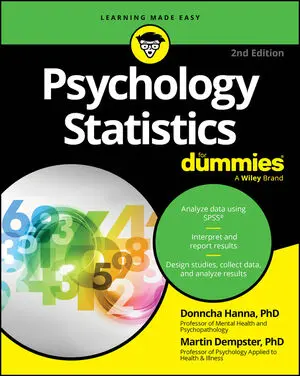
Psychology Statistics For Dummies

Overview

Untangle statistics and make correct, dependable conclusions

Psychology Statistics For Dummies, 2nd Edition makes statistics accessible to psychology students, covering all the content in a typical undergraduate psychology statistics class. Built on a foundation of jargon-free explanations and real-life examples, this book focuses on information and techniques that psychology students need to know (and nothing more). You'll learn to use the popular SPSS statistics software to calculate statistics and look for patterns in psychological data. And, this helpful guide offers a brief introduction to using the R programming language for statistical analysis—an increasingly important skill for the digital age. You'll also find hands-on practice exercises and examples using recent, real datasets.

  • Explore the use of statistical analysis in research for the psychology field
  • Master basic statistics concepts such as means, standard deviations, and correlations
  • Conduct data analysis using the SPSS software package
  • Get clear explanations of everything in your psychology statistics course, so you can pass with flying colors

This guide is perfect to use as a readable supplement to psychology textbooks and overall coursework. Students in other social and behavioral sciences can also benefit from this stellar primer on statistics.

Read More

About The Author

Donncha Hanna, PhD, is Professor of Mental Health and Psychopathology at Queen’s University, Belfast. He is a co-author of Research Methods in Psychology For Dummies.

Martin Dempster, PhD, is a health psychologist and statistician at Queen’s University, Belfast. He’s a co-author of Research Methods in Psychology For Dummies.

Sample Chapters

psychology statistics for dummies

CHEAT SHEET

You may be more interested in studying psychology than in crunching numbers, but knowing psychology statistics is essential if you’re going to make all that research data stack up, and have other people understand it. This Cheat Sheet helps you out with some basic concepts in psychology statistics.Determining the role of variables in psychology statisticsIn psychology statistics, research studies which involve collecting quantitative data (any data that can be counted or rendered as numbers) usually require you to collect and store data on a data sheet about several variables.

HAVE THIS BOOK?

Articles from
the book

When putting together the psychology statistics you need to report when you’re describing a variable in a report, you need to know which of the three measures of central tendency – the mode, median and mean – you should use. Be guided by the advantages and disadvantages of each measure. Weighing up the advantages and disadvantages of each measure leads you to the following conclusion: the most appropriate measure of central tendency for a variable depends on the level of measurement of the variable and the nature of the distribution of scores within that variable.
The measures of dispersion you use in psychology statistics show you the spread or variability of the variable you are measuring. The three main ones are the range, the interquartile range, and the standard deviation. Getting to know the range, interquartile range, and standard deviation The three most important measures of dispersion are defined as follows: The range is the difference between the highest score and the lowest score in a variable.
In psychology statistics, research studies which involve collecting quantitative data (any data that can be counted or rendered as numbers) usually require you to collect and store data on a data sheet about several variables. When you conduct your statistical analyses on this data, you need to know what role each variable played in your research design.
When working with psychology statistics you can classify variables according to their measurement properties. When you record variables on a data sheet, you usually record the values on the variables as numbers, because this makes statistical analysis easier. However, the numbers can have different measurement properties and these determine what types of analyses you can do with these numbers.
You may be more interested in studying psychology than in crunching numbers, but knowing psychology statistics is essential if you’re going to make all that research data stack up, and have other people understand it. This Cheat Sheet helps you out with some basic concepts in psychology statistics.Determining the role of variables in psychology statisticsIn psychology statistics, research studies which involve collecting quantitative data (any data that can be counted or rendered as numbers) usually require you to collect and store data on a data sheet about several variables.
https://cdn.prod.website-files.com/6630d85d73068bc09c7c436c/69195ee32d5c606051d9f433_4.%20All%20For%20You.mp3

Frequently Asked Questions

No items found.


