|
Published:
May 12, 2026

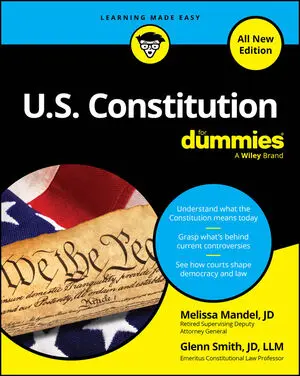
U.S. Constitution For Dummies, All New Edition

Overview

An up-to-date and easy-to-read walk through of how America’s Constitution actually works under the hood

Looking for an easy-to-read and crystal-clear guide to the document that shapes nearly everything about your relationship with the United States and its government? This brand-new, completely reimagined edition of the U.S. Constitution For Dummies explains the ins and outs of Congress, the executive branch, the presidency, and the Supreme Court. It provides legalese-free walkthroughs of how all those pieces fit together and how they affect your rights and responsibilities as an American.

You’ll explore everything from voting rights to the limits of executive power and how American states challenge laws passed by the federal government (and vice versa). You’ll discover how the Constitution influences the political process in the United States and how the nature of your constitutional guarantees and rights as a person are changing.

Inside the book:

  • Brand-new discussions of how the First Amendment interacts with social media and emerging technology
  • Up-to-the-minute explanations of how presidential power and accountability are affected by the Supreme Court’s recent decision on presidential criminal immunity
  • Explorations of recent changes in the constitutional treatment of reproductive and maternal healthcare
  • In depth explanations of how the Constitution safeguards you, from Miranda warnings, search and seizure rules, legal representation, and trial rights

Perfect for students, citizens, activists, professors, and anyone else with an interest in American governance, politics, law, and society, the U.S. Constitution For Dummies is a straightforward resource that skips the jargon and misinformation and offers accurate, up-to-date, and accessible info.

Read More

About The Author

Melissa Mandel is an award-winning prosecutor who has represented the State of California before the United States Supreme Court.

Glenn Smith is an emeritus professor and has taught constitutional law for four decades. He remains active as a visiting lecturer at UCSD and is an expert in statutory interpretation, privacy, free speech, and voter initiatives.

Sample Chapters

u.s. constitution for dummies

CHEAT SHEET

The US Constitution was written and signed by men who craved independence from Britain but who were nonetheless steeped in its history and ideals.The document starts with some basic precepts of English governance, but then adds some uniquely American twists — three branches of government that act to check and balance each other, for example.

HAVE THIS BOOK?

Articles from
the book

In Brown v. Board of Education, a unanimous Supreme Court outlawed racial segregation in public schools throughout the United States. In so doing, the Court declared 17 state laws unconstitutional, including some from northern states. The Court also overturned its own 1896 ruling in Plessy v. Ferguson that had approved the “separate but equal” formula, which had said that it was okay to provide separate facilities for the different races as long as those facilities were equal.
This highly controversial case is important for two reasons: first, because of its effect on elections, and secondly, because it struck down a major bipartisan Act of Congress, which had been essentially upheld by the Supreme Court itself.The conservative nonprofit organization Citizens United wanted to run TV commercials to promote its film Hillary: The Movie in the run-up to the 2008 Democratic presidential primary elections.
This case is the flip side of Nixon v. Fitzgerald. In that case, the high court ruled that the President is totally immune from civil suits for anything he does in his official capacity. In this later case, a unanimous high court held that the President is not immune from suit for anything that he did before he became president — and that such private lawsuits can go ahead even while the President is still in office.
This was a U.S. Supreme Court 5–4 decision upholding the constitutionality under the Eighth Amendment of lethal injection by a three-drug protocol including midazolam as an acceptable form of execution. The Court also, rather strangely, held that death-row prisoners could challenge their method of execution only if they came up with an alternative method!
These two affirmative action cases, both brought against the University of Michigan, were decided by the U.S. Supreme Court on the same day, with opposite outcomes. The Court upheld the use of race as an admissions factor while condemning the use of a quota system. So the affirmative action but non-quota-based admissions policy in force in the Law School was upheld, while the “points” system applied for undergraduate admissions was condemned.
Chief Justice Charles Evans Hughes famously remarked that, “We are under a Constitution, but the Constitution is what the judges say it is, and the judiciary is the safeguard of our liberty and our property under the Constitution.” The Chief Justice was right to point out that the meaning of the Constitution keeps changing as a result of judicial interpretation and reinterpretation, without any change in the words on paper.
Susette Kelo lost her lovely old house. The City of New London, Connecticut, had condemned her home and 114 other lots in a working-class neighborhood in the interests of “economic development.” However, the beneficiaries of this program weren’t the public at large, but Pfizer, the pharmaceutical giant, and a property development corporation — a private entity.
Marbury v. Madison established the U.S. Supreme Court’s right of judicial review — the power to strike down a law as unconstitutional. William Marbury was appointed a Justice of the Peace by outgoing President John Adams. But the new Secretary of State, James Madison, refused to deliver Marbury’s commission — the formal document of appointment.
This landmark 5–4 U.S. Supreme Court decision legalized same-sex marriage throughout the United States and its possessions and territories. It marked the culmination of a long battle fought out in a number of states, 37 of which, plus the District of Columbia, had legalized gay marriage prior to the ruling and 13 of which had banned it.
This case is remarkable for several reasons, not least because the U.S. Supreme Court decision was unanimous, ruling that trawling through the digital contents of a cellphone without a warrant is unconstitutional as a violation of the Fourth Amendment. The case arose out of an incident in 2009 in which David Leon Riley was pulled over in his Lexus by a San Diego police officer for expired registration tags.
The Supreme Court overturned Roe v. Wade on June 24, 2022, ending nearly 50 years of a woman's constitutional right to an abortion. The decision allows individual states the ability to set their own abortion laws, banning or restricting the procedure as they see fit.The nation was expecting the landmark decision due to a leaked draft of the Supreme Court's deliberations in the related case Dobbs v.
The US Constitution was written and signed by men who craved independence from Britain but who were nonetheless steeped in its history and ideals.The document starts with some basic precepts of English governance, but then adds some uniquely American twists — three branches of government that act to check and balance each other, for example.
The Constitution emerged from a meeting called the Philadelphia Convention, which took place in 1787. (That meeting has since come to be known also as the Constitutional Convention.) The Convention was held because the Articles of Confederation — the document that had been serving as the country’s first governing constitution — were considered to be weak and problematic.
https://cdn.prod.website-files.com/6630d85d73068bc09c7c436c/69195ee32d5c606051d9f433_4.%20All%20For%20You.mp3

Frequently Asked Questions

No items found.