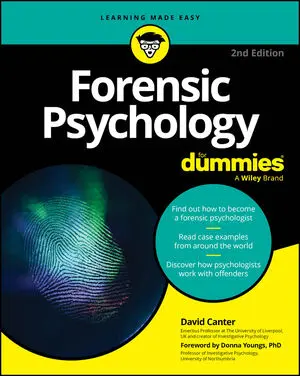
Forensic Psychology For Dummies Cheat Sheet


Forensic psychology is a rapidly growing area of the professional application of psychological science to legal and criminal justice settings. Popular media overdramatize the work of forensic psychologists. They are confused with criminologists who study patterns of crime and justice. They emphasize the role of profilers who exist much more in fiction than in practice. Real forensic psychology is grounded in rigorous assessment, ethical practice, and scientific methodology. Practitioners may assess a person’s competency to stand trial, evaluate risk of reoffending, provide expert testimony, conduct childcustody evaluations, or advise on jury selection. At its core, it aims to ensure that psychological insights contribute to fair, evidencebased legal outcomes.
Psychological aspects of criminality
In order to contribute to legal processes psychologists must understand the roots in a person’s, characteristic, attitudes, beliefs, familial and social experiences of their criminality. These are modified by the opportunities for crime and pressures from economic constraints and career opportunities.
Their inherited features (nature) interact with their social conditions (nurture). The two cannot be separated.
Criminals are varied, but some general characteristics are typical of the average criminal, no matter what the crime:
- They’re most often men (about 80 per cent for most crime types).
- They’re usually in their mid- to late teens.
- They come from dysfunctional family backgrounds.
- They have family or friends who’ve been convicted of crimes.
- They didn’t do well in school.
Investigative interviews protocols
Developing rapport is one of the most important features of a good interview:
- Explaining clearly what the interview is for how you’re carrying it out
- Listening carefully
- Showing respect
- Being nonconfrontational
- Acknowledging the respondent’s anxieties
The cognitive interview has been developed to enhance recall by victims and witnesses. It uses these strategies:
- Establishing rapport
- Listening actively
- Encouraging spontaneous recall
- Asking open-ended questions
- Pausing after responses
- Avoiding interruption
- Asking for detailed descriptions
- Encouraging the person to concentrate on the question
- Encouraging the use of imagery
- Re-creating the original context of the event
- Adopting the witness’ perspective
- Asking relevant questions
- Encouraging multiple retrieval attempts
What are some tests used by forensic psychologists?
- Rorschach inkblot test: Interpretation of accounts of what’s seen in ambiguous images to indicate aspects of their subconscious mind.
- Thematic Apperception Test (TAT): Interpretation of stories told about ambiguous pictures to indicate the underlying needs and motivations that characterize a person.
- Minnesota Multiphasic Personality Inventory (MMPI): A wide-ranging exploration of personality, by answering whether nearly 600 questions about yourself are true or false.
- Millon Clinical Multiaxial Inventory (MCMI): An assessment of mental illness developed using people in psychiatric hospitals who already have diagnoses for mental problems.
- Personality Assessment Inventory (PAI): Consists of 344 questions developed to assess a person’s problems in a way that can aid treatment planning; takes about an hour to complete.
- Wechsler Adult Intelligence Scale (WAIS): The standard test to measure intelligence. It has undergone many revisions and spawned many variants, including versions for special populations, such as children.
- Trail Making Tests A and B: A simple test to administer that assesses how quickly a person can carry out visual tasks such as joining up numbers in sequence; used to diagnose various forms of dementia.
- Luria-Nebraska Neurophysiological Battery: Consists of 269 items (that can take a couple of hours to complete) covering many aspects of brain functioning; used to assess the nature and extent of any brain damage.
About This Article
This article can be found in the category:
Hot off the press
Explore Related content