Ecology For Dummies Cheat Sheet


Human beings are part of an interconnected web of life that weaves through — and is dependent upon — the physical environment of planet Earth. The rapid growth of the human population is causing unprecedented effects on the ecosystems that sustain us. Cultivating a deep understanding of these ecosystems through the study of ecology can help us figure out how to live more sustainably on our planet. Here are a few to help you master the most important fundamentals in the science of ecology.
Energy flow through ecosystems
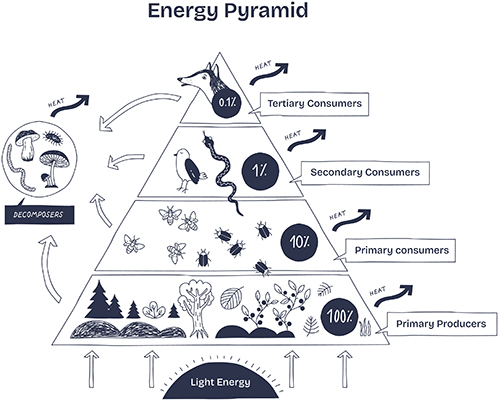
Most ecosystems rely on sunlight to provide the energy that makes life possible. Vast amounts of light energy travel from the sun to our planet every day, so much so that just one percent of that energy, captured by photosynthetic producers, powers almost all life on Earth (see Figure 1).
Organisms in each trophic level use some of the energy they receive for their own growth. Energy transfers in living things aren’t 100 percent efficient, so some energy transforms to heat with every transfer (this is due to the second law of thermodynamics). Heat energy can’t be used for cellular work, so the transfer to heat represents energy that is lost from each trophic level. The heat transfers to the atmosphere and ultimately makes its way to space.
Biogeochemical cycling
All living things are made of the same basic elements, mostly carbon, hydrogen, oxygen, nitrogen, phosphorus, and sulfur. Organisms must have a source of these elements, either directly from the environment or by eating others. As organisms grow and reproduce, they release some elements back to the environment as waste. Eventually, organisms die, and decomposers recycle the remaining material. The movement of matter through ecosystems is an amazing game of transformation as elements shift forms and combine in new ways.
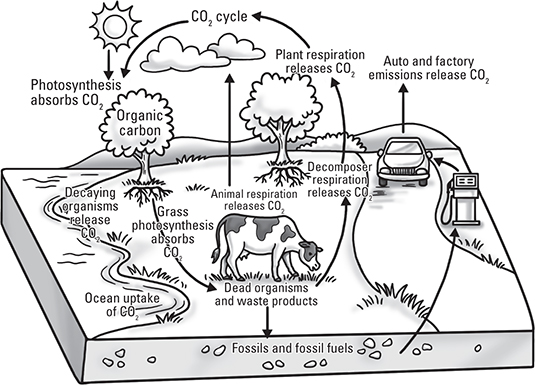
One of the most important cycles on Earth is the carbon cycle (see Figure 2), not just because it shows how carbon moves through living things but also because it has a big impact on our climate. Carbon forms the backbone of the molecules that build cells and thus all organisms. In fact, if you ignore water, carbon makes up almost 50 percent of the matter found in living things.
The primary processes of the carbon cycle are:
- Photosynthesis: Organisms take carbon in the form of carbon dioxide (CO2) from the environment, using energy from sunlight to convert CO2 and water (H2O) into food molecules like glucose (C6H12O6). They also make oxygen gas (O2) as waste. Carbon moves through the food web and is stored as organic molecules in the bodies of living things, which act as carbon sinks.
- Cellular respiration: Organisms use oxygen to break down carbon-containing food molecules for their stored energy, releasing CO2 back to the environment. They also produce H2O as waste. Respiration by plants, animals, and decomposers is a source of CO2 to the environment.
- Combustion: The burning of carbon-containing materials like fossil fuels is a source of CO2 to the environment.
- Ocean uptake: The ocean absorbs CO2 from the atmosphere, acting as a carbon sink. Scientists estimate that the ocean has absorbed 30 percent of the carbon released since the Industrial Revolution, greatly slowing the rate of climate change.
As living things oxidize and reduce molecules as part of their metabolism, they constantly release waste materials. But what is trash to one organism may be treasure to another. Organisms pick up these molecules, use them for their metabolism, and release them in a new form. Scientists map the transformation of elements through ecosystems, focusing on each of the macroelements one at a time.
Recycling elements via biogeochemical cycles
Community structure
Communities are groups of species living together in a particular area. Some types of species have particularly large impacts on community structure:
- Dominant species are the most common or largest species in a community. They often affect community structure by outcompeting other species for resources.
- Foundation species create or maintain the physical or chemical environment that other organisms depend on. Deep-sea corals grow upward off the ocean floor, creating coral reefs that provide habitats for many other organisms.
- Keystone species keep a community in balance by controlling populations of other species. Keystone species may not be large or abundant, but their loss leads to big changes and even the collapse of a community. Seastars in the Pacific Northwest are a keystone species in the intertidal. They prey on mussels, opening up space on intertidal rocks for many other species. Without seastars, the mussel population expands, and biodiversity is lost.
Disturbance causes an abrupt change in an ecosystem, altering the availability of resources and substrates. After a disturbance, communities reform via succession.
- Primary succession occurs on land that doesn’t have organic soil or plants, such as areas after a catastrophic disturbance or on newly developed land (like volcanic islands).
- Secondary succession occurs on land that has some organic components in the soil but where most plants have been removed by a disturbance.
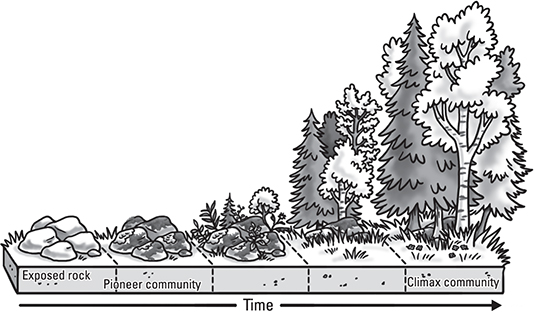
During succession, the community progresses from pioneer species to a climax community (see Figure 3):
- Pioneer species have the ability to survive as first colonists. They often change the environment in ways that facilitate colonization by additional species.
- The climax community is the stable community that forms at the end of succession. This community often inhibits colonization by additional species.
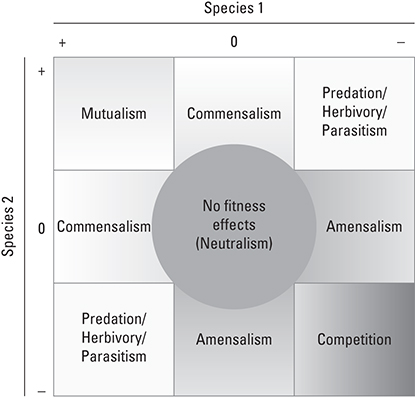
Types of ecological interactions
The interaction between species forms the basis for many processes in ecosystems, such as the food chain and the nutrient cycle. Inter-specific interactions occur between individuals of different species, while intra-specific interactions occur between individuals of the same species. In Figure 4, a (+) indicates a positive impact of the interaction, a (-) indicates a harmful impact, and a (0) indicates a neutral impact. When two organisms associate and interact with each other over a long period of time, they may form a symbiosis.
About This Article
This article can be found in the category:
Hot off the press
Explore Related content