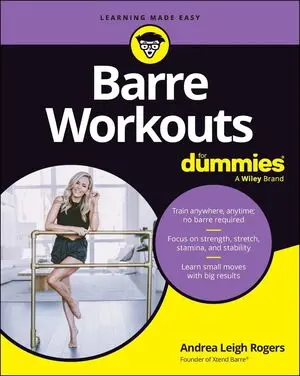
Barre Workouts For Dummies Cheat Sheet


In this cheat sheet, you'll learn:
- what the most important Barre movements are and why they matter
- what you'll need to get started with Barre
- how a Barre workout is structured
- how to choose the right Barre class, studio, or instructor
Barre is built on the idea that small moves = big results. The choreography may change class to class, but underneath it all is a handful of foundational exercises that do the real work. Many of these movements come directly from classical dance training and Pilates-inspired conditioning, where precision and efficiency take center stage. Dancers are true athletes, even if they make it look effortless, and Barre borrows from that same athletic foundation — but no tutu is required!
The most important Barre movements and why they matter
The following foundational movements are the subtle powerhouses of Barre. Some may look simple, but they are rooted in serious dance athleticism and smart, Pilates-inspired training. When you lean into the precision and embrace the tiny shakes, you tap into the real magic of Barre: Small moves, big results. Over time, those tiny pulses and steady holds add up to stronger legs, steadier balance, and a posture that makes you stand a little taller without even thinking about it.
Pliés
Primary muscles worked:
- Quadriceps
- Gluteal muscles
- Inner thighs
- Calves
- Deep core stabilizers
Pliés are controlled knee bends performed with the feet parallel or turned out. The knees bend while the torso stays tall and aligned.
In ballet class, plié is often taught first because every jump and turn begins and ends there. It trains the body to absorb force safely, strengthens the legs, and improves alignment. In Barre, the movement may be simple, but done well, it builds serious lower-body strength.
Parallel thigh work
Primary muscles worked:
- Quadriceps
- Hip flexors
- Inner thigh
- Knee stabilizers
Parallel thigh work usually involves bending the knees in a narrow or hip-width stance and holding or pulsing. It’s like a plié, but the range is smaller, and the muscles stay under tension longer.
Back attitude
Primary muscles worked:
- Gluteus maximus
- Gluteus medius
- Hamstrings
- Deep core muscles
To perform a back attitude, you lift one leg behind your body, keeping a soft bend in your knee. The emphasis is on mindful control rather than height. In classical ballet, attitude develops hip strength while maintaining lift through the torso. Barre uses it to strengthen and shape the glutes and support pelvic stability, which really helps protect the lower back.
Side leg lifts
Primary muscles worked:
- Gluteus medius
- Outer hips
- Pelvic stabilizers
Side leg lifts involve standing tall and lifting one leg out to the side in a controlled motion. Outer hip strength plays an outsized role in balance and knee alignment. Dancers train their lateral strength constantly to stay perfectly upright during single-leg work, but in real life, these muscles can be neglected. In Barre, these compact lifts improve stability in both workouts and everyday movement.
Lunges
Primary muscles worked:
- Gluteal muscles
- Quadriceps
- Hamstrings
- Calves
- Core stabilizers
Lunges involve stepping one foot forward or backward and bending both knees in a split stance. In dance, controlled weight shifts are part of nearly every sequence. In the gym or a fitness class, you might do these at speed, but with Barre, lunges are slowed down to really refine alignment and build strength. This makes them both functional and athletic.
Relevés
Primary muscles worked:
- Calves
- Ankles
- Foot muscles
- Lower leg stabilizers
Relevés are tiny (but challenging) rises onto the balls of the feet. The heels lift while the body stays vertically aligned. Foot strength is one reason dancers are such strong, resilient performers. Barre includes relevés to build ankle stability, calf strength, and balance without high impact.
Core C-curve
Primary muscles worked:
- Deep abdominals, including the transverse abdominis
- Spinal stabilizers
Down on the mat, the C-curve is a controlled rounding of the spine performed seated or reclined. The abdominals engage to support the movement. Influenced by Pilates-inspired training, this exercise strengthens deep core stabilizers rather than surface muscles alone. The movement may look small, but it’s incredibly powerful.
Planks
Primary muscles worked:
- Deep abdominals
- Shoulders
- Upper back
- Gluteal muscles
- Spinal stabilizers
Down on the mat, planks are steady holds with the body in a straight line, pelvis in neutral, and supported on the hands or forearms and toes or knees. Although the plank is not a traditional ballet move, dancers rely on strong core and shoulder stabilizers to maintain posture and transition smoothly, and Barre incorporates planks to build full-body strength.
Balance holds
Primary muscles worked:
- Core stabilizers
- Ankles
- Feet
- Hips
Balance holds involve standing on one leg, or in a relevé, while maintaining an upright posture. In classical dance, balance is practiced daily. In Barre, even brief single-leg holds strengthen coordination and give you confidence that you can carry out of your session and into your everyday life.
Fold-over stretch
Primary muscles stretched:
- Hamstrings
- Calves
- Spinal muscles
- Lower back
The fold-over stretch involves hinging forward from the hips and allowing the upper body to release toward the legs. Dancers stretch strategically to maintain mobility while preserving strength. Barre follows that principle, closing workouts with controlled stretching to support recovery.
What you need to get started with Barre
Barre is beautifully low-maintenance. You do not need a mirrored studio, a wall of equipment, or perfect prima ballerina turnout to begin, and you don’t even need a wall-mounted barre. What you do need is a clear space, something sturdy for balance, and a willingness to embrace tiny movements that deliver surprisingly big results. Getting started in Barre is less about gear and more about setting yourself up to move with focus and confidence.
Setting up your space
Before you pulse a single inch, take a minute to create your zone. Barre workouts rely on precision, so a cluttered or slippery space makes everything harder than it needs to be. Aim for a clear area about six feet by six feet. You should be able to extend your arms and step wide without knocking into things. Good lighting helps you check your alignment. A mirror is helpful but not mandatory. Avoid loose rugs, slick floors, or anything with sharp corners nearby. If the surface feels slippery, place your mat down for traction.
Essential Barre equipment
One of the best things about Barre is how little you truly need.
Must-haves:
- A quality exercise mat with good grip and moderate cushioning
- A sturdy chair, countertop, or wall for balance support
That is it. Barre is built on bodyweight resistance, alignment, and control. The magic comes from how you move, not what you hold.
Great to have:
- Light hand weights, one to three pounds
- A small ball or firm pillow for inner thigh work
- A resistance band
- Grip socks for traction
No equipment at all? No problem. Water bottles work as weights. A couch arm can stand in for a barre. A firm pillow can substitute for a ball. Barre rewards creativity and control more than ordering the latest gear.
What to wear
Fitted clothing makes a difference in Barre. Because the movements are small and precise, you want to be able to see your knees, hips, and spine clearly. Leggings and a snug tank or tee allow you to check alignment and make subtle corrections.
Avoid stiff fabrics, heavy layers, or anything that restricts movement. As Barre includes floor work, balance holds, and deep knee bends, comfort and mobility are key. On that, it’s best to tie back long hair, especially for floor work.
How a Barre workout flows
Understanding the structure of a Barre workout helps you feel confident from day one. Even at home, there is a rhythm to the practice.
Warm Up
Expect gentle movements that wake up your joints and muscles. Shoulder rolls, arm circles, easy pliés. This is your body shifting from daily life into focused movement.
Upper body
Many Barre classes begin with light weights or bodyweight arm work. Think small pulses, controlled lifts, and posture-focused strength. The movements are subtle, but the burn certainly creeps up on you.
Barre or chair work
This is the leg-and-glute section. Using a sturdy chair or countertop for light support, you move through pliés, lunges, leg lifts, and tiny pulses. Your legs may shake a little, but that is normal as your stabilizing muscles are waking up.
Core
Standing, but usually on the mat, core work emphasizes control over momentum. Instead of big crunches, expect small, precise contractions that strengthen those deep stabilizers.
Floor work
On the mat, you isolate glutes and hips with compact, focused movements. Because the range is small, attention to detail makes all the difference.
Stretch and cool down
The workout finishes with controlled stretching. This helps release tension and lets your heart rate (and your thoughts) settle. You often leave feeling taller and steadier than when you started, and who doesn’t want that?
How to choose the right Barre class, studio, or online instructor
Barre has exploded in popularity. That means options are everywhere: Local studios, livestream platforms, on-demand apps, all with gorgeous branding, dramatic lighting, great playlists. All of that is fun, but it doesn’t guarantee good teaching.
Barre is built on small, precise movements that add up in truly powerful ways. The right studio or instructor understands that real progress comes from focus, patience, and steady effort. A great class will guide you, challenge you, encourage you, and leave you feeling really good. Here is how to tell if you have found it.
Start with the vibe
Before the first plié, notice the energy. Does the room feel calm and welcoming? Does the instructor make eye contact or acknowledge new faces? If you are online, does the teacher speak in a way that feels inclusive rather than exclusive? Barre works best when you feel safe enough to focus. If the atmosphere feels tense, cliquey, or a bit performative, that matters.
Listen to the cues
Barre relies on tiny, precise movements, so clear instruction is everything. A strong instructor tells you:
- Where your weight should be
- What muscles you are working
- How the movement should feel
- How to correct form when needed
You should not feel lost five minutes in, and you also should not feel like you need insider vocab to keep up. Good teaching gives clarity without dumbing down.
Look for options
No two bodies move the same way, and the best Barre classes take that into account.
- Are there choices for the range of motion?
- Are lighter weights suggested as often as heavier ones?
- Is it acceptable to lower your heels or take a break?
Allowing for modifications is a sign of smart programming. A class that treats adaptation as totally normal is usually one that understands real people.
Check the structure
A well-built Barre class has rhythm and will follow a structure similar to this:
- Warm up to prepare the joints and muscles
- Upper body or standing strength work
- Barre or chair work for legs and glutes
- Core focus
- Floor work
- Stretch and reset
If the class jumps right into intense work with no preparation or ends without a proper cool-down, that is worth noticing. The beginning and the end matter as much as the middle.
Pay attention to the tone
Encouragement should feel personally motivating rather than competitive. The best Barre classes emphasize:
- Your alignment
- Your effort
- Your consistency
They do not foster comparison. If the energy feels like a performance or a competition between a bunch of premier athletes, ask whether that environment supports your long-term goals.
Assess the pace
Barre should really challenge you but never overwhelm you, and you do not need to be amazing at everything immediately. What you want is a pace that allows growth, and that means clear setups, logical transitions, and time to adjust. So, if you leave scratching your head rather than challenged, the pacing may be off.
Notice how you feel after class
This is the most honest measure. After class, do you feel:
- A little taller
- Somewhat steadier
- Calm but strong
You may be tired, your legs may have trembled, you may have wobbled out of your balance ending. That is normal! But you should not feel defeated or discouraged. The right class leaves you feeling slightly humbled but motivated to do it all again.
About This Article
This article can be found in the category:
Hot off the press
Explore Related content