

 Main Menu
Book & Article Categories
- Main Menu
Book & Article Categories
- Main Menu
Collections
Explore all collections

Articles & Books From Kensuke Okabayashi
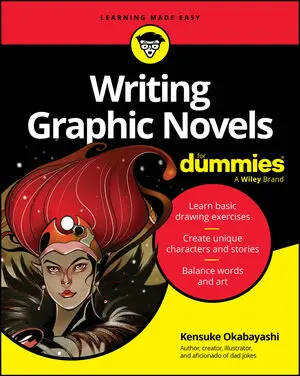
Turn your ideas into graphic novels with this step-by-step guide—including drawing exercises Writing Graphic Novels For Dummies walks you through the process of graphic novel creation step-by-step, guiding you through the process of developing ideas, concepts, and visuals to bring your unique stories to life.
Cheat Sheet / Updated 12-02-2025
The world of graphic novels is vast and ever-expanding—much like a pizza with endless topping options, there’s something for everyone. And with more creators jumping in to share their original, creator-owned stories, the “pie” only gets bigger. Graphic novels continue to rise in popularity, with more titles being adapted into movies and shows on platforms like Netflix, Hulu, Amazon Prime, Peacock, and Paramount.

Get started with the powerful visual language and storytelling medium that is manga Manga is a unique style of drawing. It's also a great way to make topics like history and politics appealing to a wide audience. Manga For Dummies teaches you the basics of drawing in the manga style. This step-by-step guide shows you how to apply the basic rules of manga figure drawing, whether you're a complete beginner or a professional artist.
Cheat Sheet / Updated 04-19-2022
Learning how to draw people is a process that starts with purchasing the right art supplies. Try a simple method for drawing a human head and if you make a figure drawing mistake, use some quick techniques to fix the problem. Drawing people in public settings is fun and relaxing, so consider this list of inspiration spots — just be sure to take the supplies you need with you.
Cheat Sheet / Updated 03-25-2022
The Japanese comics and cartoons known as manga bring a unique style to age-old art forms. Like the art forms that precede it, manga works within specific archetypes and genres. However, the manga conventions are a new twist, and if you’re exhibiting at one you need to know what to bring.Common manga archetypesThe type of Japanese comics or cartoons called manga has its archetypes — classic examples of the art — just like every other art form.
Article / Updated 11-12-2021
Following are the basic stages that a manga-ka (a manga artist) uses to create an original plot. The basic stages are widely embraced by the manga-ka community today, and they originate from classical Chinese poetry.
Stage 1: Ki — Introduction of an idea
Stage 1 basically sets up the context and scene so that the story can begin and the characters can begin to interact.
Article / Updated 11-12-2021
When you know how to draw a manga figure, you're ready to turn your attention to creating your own characters. A number of common archetypes appear often in manga. In this case, archetypes are basically sets of personalities and attributes assigned to a character. An archetype may include, for example, the color of the individual's hair and eyes and the type of body build the character has.
Article / Updated 03-26-2016
If you want to build your figure drawing confidence, put down the drawing tools and use the freehand method to draw the basic structure of the head. Just follow these basic steps:
Draw an oval shape that resembles an upside-down egg.
Draw a horizontal line and a vertical line to form a cross that divides the oval evenly.
Article / Updated 03-26-2016
Even the most motivated artist can benefit from outside education and another artist’s input to help with figure drawing. A variety of outside inspiration exists to help you create fresh figure drawing ideas and methods. Here are a few great places for studying and drawing the human form:
Continuing education
Article / Updated 03-26-2016
Even the most experienced artists make mistakes in their work. Fortunately if you make a figure drawing mistake it doesn’t have to be completely removed to maintain the integrity of your drawing. Here are some clever techniques for fixing figure drawing bloopers:
Use a kneaded eraser (the advantage is that you have no eraser dust).

