





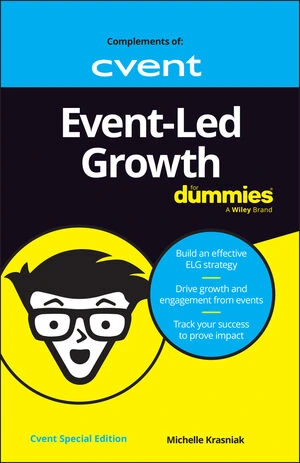

In this article you will learn:
- Why traditional event marketing falls short
- The business case for event-led growth
- How to get started with event-led growth
Events have always been part of the marketer’s playbook, but the environment is constantly evolving. Digital fatigue is real, ad channels are oversaturated, inboxes are overflowing, and buyers expect value upfront before they talk to a sales rep. At the same time, third-party data is becoming less reliable, while sales cycles keep getting longer and more complex. These shifts have created the perfect conditions for event-led growth (ELG) because events deliver authentic, high-impact engagement and give teams the first-party insights they need to make informed decisions that actually move the business forward.
Why traditional event marketing falls short
Traditional event marketing has struggled to keep pace with these changes as it often focuses on execution rather than impact, with success measured by RSVPs or check-ins instead of pipeline and revenue. Programs operate in silos and are oftentimes disconnected from Sales, Customer Success, and RevOps. The work gets bogged down in manual effort that eats up time and makes it hard to connect what you’re doing to the buyer journey or the larger priorities of the business. ELG changes that mindset completely. It positions events as a continuous go-to-market (GTM) channel that supports acquisition, expansion, and retention. Events become strategic touchpoints across the entire customer journey rather than one-off campaigns.
This shift matters because ELG is a unified GTM strategy powered by cross-functional collaboration. Marketing drives awareness and engagement, Sales uses events to build pipeline and deepen relationships, and Customer Success uses them to increase adoption and strengthen loyalty. When teams work in sync, events finally become measurable and repeatable. Shared playbooks, connected systems, and clean data make it possible to scale event programs — and make it easier to show exactly how those programs drive pipeline, revenue, and long-term value.
The business case for event-led growth
The business impact is clear: 72 percent of marketers say prospects who attend events close faster, and 31 percent report a minimum 20-30 day decrease in their sales cycle. Research from Cvent and Splash shows that 88 percent of respondents say events generate a steady revenue stream, 76 percent met their revenue goals every quarter, and 52 percent said at least half of their closed won deals were influenced by events. Even in unpredictable markets, events continue to perform because they create momentum at every stage of the buyer journey.
The strength of ELG becomes even more apparent when teams act on real engagement signals. Events shorten the gap between interest and action by giving Sales immediate visibility into attendance and behavior, which supports faster and more personalized follow up. Customer teams use onboarding events, product trainings, and exclusive meetups to deepen relationships and reduce churn. Every touchpoint becomes a chance to support adoption, advocacy, and long-term value. These results don’t happen by accident — they happen because events combine education, connection, and intent signals in a single moment.
How to get started with event-led growth
Thankfully, getting started with ELG doesn’t require complex workflows. Kicking off an initiative can be as simple as:
- Aligning each event with a clear revenue objective that everyone can explain in one sentence
- Mapping personas and funnel stages to the right formats so events feel timely, relevant, and purposeful
- Building a repeatable playbook or template so every event is consistent and compliant
Once teams agree on goals, metrics, and personas, they can use integrated systems and consistent data to measure what works and improve upon what doesn’t. With these steps in place, events stop being isolated tactics and become a core part of the revenue engine that drives awareness, influence, acceleration, and retention.
When organizations embrace this mindset, ELG becomes more than an idea…it becomes a reliable and scalable way to grow. Ultimately, teams that embrace ELG don’t just run better events — they run a better business.
About This Article
This article can be found in the category:
Hot off the press
Explore Related content



