Preparing For End of Life For Dummies Cheat Sheet


Welcome to the Preparing For End of Life For Dummies Cheat Sheet. Here you’ll find information on how to think about end of life and how to prepare. It can be a long process and that’s why it can be useful to have help. End-of-life doulas are specialized professionals in the end-of-life process, and this cheat sheet discusses what they are, how to find one, and what to consider in engaging a doula. Thank you.
What does end of life really mean?
End of life is not just about death. End of life is about the last phase of your life; it includes death, which is the event that concludes life. Preparing and dealing with all the matters, issues, affairs, logistics, and decisions of death begin well before death and last well after death. Therefore, end of life can be a very l-o-n-g time, sometimes years. The timeline for end of life is depicted here:
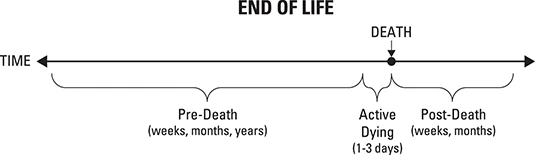
Just like any major transition in life, advance planning and preparation can make the process smooth, easy, and secure, and relieve anxiety, worry, and stress. Thinking and making decisions about death and dying can be emotionally challenging, and there are a lot of logistics and practical matters to deal with as well. Make sure you have the proper emotional, physical, social, and spiritual support you need in place to face end of life with calm and peace of mind.
What is an end-of-life doula?
An end-of-life doula, also commonly known as a death doula, is a relatively new professional in the deathcare space, who specifically serves those preparing for end of life. What luck!
Here are some common questions about end-of-life doulas:
- What is an end-of-life doula? An end-of-life doula is a non-medical professional who guides, supports, educates, and companions individuals and their loved ones through the dying process. They provide a holistic and compassionate approach to death through active listening, nonjudgment, and calm presence.
- What does an end-of-life doula do? Doulas provide emotional, spiritual, logistical, and informational support to the dying and their loved ones. More often, doulas fill the gaps of care and do what’s needed. They are great complements to medical and community-based supports.
- What specific services does an end-of-life doula offer (or not offer)? End-of-life doulas offer a wide range of services. Some doulas are broad-based, while others specialize. Some doulas only work during specific time periods within the end-of-life time frame. Some typical services include advance care planning, care and resource management, life review and meaning-making, legacy projects, vigil planning and support, respite care, grief support, and rituals and ceremonies. End-of-life doulas are nonmedical and do not give medical advice, nor do they handle or administer medication.
- Why would I want an end-of-life doula? If you or someone close to you has been diagnosed with a terminal illness, is elderly, or approaching the end of life, consider the support of an end-of-life doula. Their role is to ensure that your wishes and preferences are heard and respected until the very end. Their approach is rooted in compassion and openness, aiming to provide calm, respect, knowledge, and comfort during an emotionally intense time.
- How are end-of-doulas different from hospice? End-of-life doula services do not replace hospice's medical team of nursing and physician care; they complement them. Doulas offer more time, more personalized attention, more continuity at bedside, more client advocacy, and more availability beyond what hospice is normally able to provide.
- Are end-of-life doulas covered by insurance? End-of-life doulas are not covered under medical or private insurance. End-of-life doulas are privately paid by the client.
- How much do doulas charge for their services? Most doulas have a specific pay structure, like packages or hourly rates, based on the specific services provided. Many doulas charge on a sliding scale. End-of-life doulas do provide a professional service and the costs for this service, as in any client relationship, should be clearly communicated and established from the beginning. There are some doulas who provide pro bono services or by donation only; please inquire.
- When should I contact an end-of-life doula? End-of-life doulas can be contacted at any time, from as early as an initial diagnosis to even after death for post-death support. The sooner the doula enters into the end-of-life process, the more time they have available to get to know you, your loved ones, and the care team. There is also more time for developing trust, determining and prioritizing end-of-life needs, completing the necessary end-of-life paperwork, and creating and implementing quality time and space for you and your loved ones.
- How long will a doula stay with me? The length of time for any one visit is variable based on your needs but is usually one hour. Doulas are typically available when requested and can remain for as long as needed. Some doulas do not provide on-call services. A doula’s involvement may last from a few days or weeks to several months or more than a year, depending on your condition.
How to find an end-of-life doula
You have decided to bring in an end-of-life doula to support you at end of life — great! Now you may be wondering, How do I find one? There are several different ways to find an end-of-life doula in your area.
- The National End-of-Life Doula Alliance (NEDA) is a nonprofit membership organization that inspires, informs, and assists end-of-life doulas in effecting positive changes in how people experience end of life. They maintain an active doula directory, including listings in all 50 states of the United States and some international countries.
- Many private end-of-life doula training organizations maintain directories of their own trained end-of-life doulas. The International End-of-Life Doula Association (INELDA) and Going with Grace are two well-regarded organizations in the field. INELDA has even developed its own certification program, so it is possible to find doulas with a higher level of proficiency and experience by searching for INELDA-certified doulas.
- You can inquire at your local hospices or funeral homes to see whether the staff know of any end-of-life doulas. They may have come across or have coordinated with local doulas in the past when servicing a family. See if they can make a referral.
- You can attempt a Google search for end-of-life doulas in your local area, but be aware that many end-of-life doulas do not have websites.
Questions to ask a doula
Here are some questions you might ask potential end-of-life doulas you are considering:
- Why did you become a doula?
- How would you describe your approach to doula work?
- What kind of training do you have?
- What is your level of end-of-life care experience?
- How many deaths have you supported/been present for?
- Will you come to my home or wherever I am located?
- What services will you provide for me?
- Do you support my loved ones or caregivers too?
- Do you interact with my care team, and if so, in what way?
- What is your pricing structure and what is/is not included?
- May I email, text, or call you with questions? Are these included in the fee or extra?
- Are you available to be present at death?
- Are you available on-call? If not, do you have back-up doulas who you work with?
Questions to ask yourself
The most important criteria for any doula you are considering is “fit.” You are inviting someone into your end of life — an intimate time when you will be raw, vulnerable, and real. So an end-of-life doula must be someone you can trust and you feel is a good fit for you.
After you’ve talked with a potential end-of-life doula, take some time to reflect on your impressions. Here are some questions to ask yourself:
- Did you feel as if the doula was really listening to you?
- Did you feel as though you could speak whatever is on your mind?
- Were you heard and not judged?
- Did the doula ask you any questions?
- Did you feel the doula was interested in you and what you want?
- Did the doula communicate well?
- Did the doula seem knowledgeable?
- Did you feel comfortable with the doula?
About This Article
This article can be found in the category:
Hot off the press
Explore Related content