Buffer ETFs For Dummies Cheat Sheet


Investing can be scary, especially when you don’t know what you’re doing. Fortunately, financial experts have come up with a solution to make it less frightening — buffer ETFs, investment vehicles that allow you to participate in the growth of a reference asset (such as the S&P 500, the Nasdaq-100, gold, or bitcoin) while protecting against a certain percentage of any loss. And Buffer ETFs For Dummies provides the know-how for using these intriguing investment vehicles to your advantage.
Here’s a quick guide to get you up to speed on buffer ETFs and launch you on your journey of discovering whether they’re right for you and your investment objectives.
What is a buffer ETF?
A buffer ETF is an investment vehicle that enables you to participate in market gains up to a predetermined cap while also setting a defined level of downside protection (the “buffer”), as shown in Figure 1. (An exchange-traded fund [ETF] is a basket of securities that trades like a stock; every ETF has its own ticker symbol.)
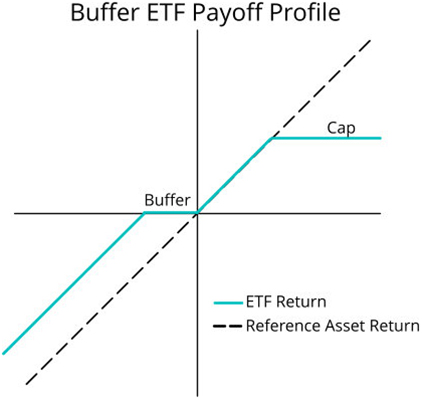
Every buffer ETF is defined by the following five characteristics:
- Reference asset: The asset the buffer ETF is designed to track during its defined outcome period, such as SPDR S&P 500 ETF Trust (SPY), Invesco QQQ Trust (QQQ), or iShares Russell 2000 ETF (IWM).
- Downside buffer: The initial amount of reference asset loss the fund seeks to protect against over the full outcome period. Typically, the buffer protects against the first loss of 9, 10, 15, or 20 percent, but some funds have deeper buffers offering up to 100 percent protection.
- Upside cap: The maximum return the fund can earn over the full outcome period. Caps vary depending on the fund, the buffer level, the underlying reference asset, market conditions (volatility and interest rates), and other factors.
- Outcome period: The duration the upside cap and downside buffer are in effect, typically 3, 6, or 12 months.The cap and buffer reset at the start of the next outcome period with fresh downside protection and a new upside cap.
- ETF wrapper: The ETF wrapper facilitates the buying and selling process and makes buffer ETFs highly liquid and tax-efficient, meaning they typically contain gains and losses within the fund without creating a taxable event for shareholders.
How to find and research buffer ETFs: 10 issuer websites
Every issuer of buffer ETFs has a website where you can find information about the funds they offer. The table below leads you to the websites of ten issuers of buffer ETFs. Innovator and FT Vest are the leaders in the space, but others have some unique offerings you may want to consider.
One big caution and two key points for safer investing in buffer ETFs
Before you buy or sell a buffer ETF, be aware that each has a starting buffer and cap that change over the course of the outcome period. So, for example, a fund with a starting buffer of 10 percent may provide little to no buffer a few months into its outcome period, if the reference asset it tracks has plunged in value.
Likewise, the indicated starting cap is accurate only at the beginning of a new outcome period. When the reference asset begins trading on the first day of the outcome period, the fund’s potential upside will increase or decrease depending on the performance of the reference asset. For example, suppose a fund’s starting cap is 20 percent. Midway through its outcome period, the fund has gained about 10 percent. If you buy it at that point in time, your return will be capped at about 10 percent over the remainder of the outcome period. And, if the fund has increased in value by 10 percent since its last reset date, your downside-before-buffer risk will be approximately 10 percent; this means your investment could lose 10 percent of its value before the buffer starts providing downside protection.
It’s critical to understand intra-outcome parameters before entering a buy or sell order of a buffer ETF that has already started trading in its new outcome period.
Here are two key points to keep in mind when buying and selling buffer ETFs:
- Buffer ETFs are designed to be purchased on the reset date and held to the next reset date. You won’t get the full benefit of the starting outcome parameters if you buy or sell during the intra-outcome period.
- Before you buy or sell a buffer ETF during the intra-outcome period, be sure to check its remaining buffer and cap and downside before buffer, so you know what you’re getting. The starting buffer and cap are still important, but the current outcome parameters are what matters most when making an intra-outcome period purchase or sale.
5 tips for getting the most out of buffer ETFs
Buffer ETFs are designed to make participating in the stock market easier and alleviate some concern over potential losses, but they’re not risk-free, set-it-and-forget-it investments. Here are five tips to help you optimize your buffer ETF investment outcomes:
- Learn everything you can by frequently visiting the websites of the issuers of buffer ETFs. They’re constantly updating their content and coming up with new ideas and offerings. The buffer ETF space is still evolving, which means you have a lot to look forward to in the coming years.
- Pay attention to how your buffer ETF is performing relative to its reference asset during the intra-outcome period. There may be an opportunity to protect your unrealized gain or obtain a fresh buffer when it makes sense to do so. If you don’t pay attention, it could cost you — the same goes for any investment.
- Keep an eye on how the various reference assets are performing relative to one another. For example, if foreign stocks have been performing poorly relative to U.S. stocks, you may have an opportunity to add a buffer ETF that tracks iShares MSCI EAFE Index (EFA) to your portfolio at a discounted price. MSCI EAFE Index is a widely used benchmark that tracks the performance of large- and mid-cap stocks in developed countries outside the U.S. and Canada.
- Don’t overdiversify your portfolio. Most buffer ETFs track diversified reference assets that are comprised of hundreds of stocks, so owning one or two in a $1 million+ portfolio is plenty of diversification, in my opinion. Keep it simple.
- Pay particular attention when the reset date comes around for the buffer ETFs you own. What’s the estimate for the new cap over the next outcome period? Is it compelling? If not, consider a swap to a different buffer ETF with perhaps a different level of protection, reference asset, and outcome period duration.
7 buffer ETF pitfalls and how to avoid them
Buffer ETFs can make volatile markets feel more manageable, but they’re not as simple as they may first appear. Behind the defined outcomes are trade-offs, timing nuances, and structural details that can catch investors off guard. Before you rely on them as a portfolio stabilizer, you need to understand where things can go wrong. Here are seven common buffer ETF pitfalls, along with advice on how to avoid them:
About This Article
This article can be found in the category:
Hot off the press
Explore Related content