|
Published:
April 21, 2026

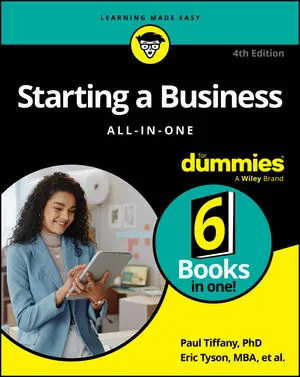
Starting a Business All-in-One For Dummies

Overview

Everything you need to know to become a founder in one easy guide

Starting a Business All-in-One For Dummies, 4th Edition is your complete resource for launching and running a successful business. Compiled from more than a dozen bestselling For Dummies books, this comprehensive guide covers every essential aspect of entrepreneurship—from legal foundations and tax planning to business strategy, bookkeeping, and growth tactics. This updated edition includes the latest startup tools and breakthrough techniques, showing you how to leverage AI to accelerate your new venture. You'll get step-by-step guidance on essential paperwork, plus proven strategies for thriving as a small business owner.

  • Master business fundamentals with six books in one
  • Navigate common startup challenges with expert solutions
  • Excel at planning, financing, marketing, and team management
  • Leverage cutting-edge tools like AI to gain competitive advantage

Perfect for both new entrepreneurs and experienced founders launching fresh ventures, this book provides everything you need to build your business from concept to success, the Dummies way.

Read More

About The Author

Paul Tiffany, PhD, is a professor at the Haas School of Business, UC Berkeley, where he teaches courses on public policy and management. He is an expert in business strategy and management. Prior to beginning his career in academia, Tiffany worked as a business consultant and continues to lead his own consulting agency.

Eric Tyson, MBA, has been a personal finance writer, lecturer, and counselor for the past 25+ years. He is the author or coauthor of numerous For Dummies bestsellers on personal finance, investing, and home buying.

Sample Chapters

starting a business all-in-one for dummies

CHEAT SHEET

Starting and running your own business can be one of the greatest joys in life. It can also be the hardest thing you ever do. The fact that no one is going to be standing over your shoulder telling you what to do can be simultaneously exhilarating and frightening. Finding sources of inspiration for great business ideas can keep you going in the absence of that voice over your shoulder.

HAVE THIS BOOK?

Articles from
the book

Although no one can guarantee that your business will be a success, if you work hard, price your products and/or services right, and keep your customers satisfied, you stand a good chance of starting and building a successful company. The results you get out of your business are a direct result of the work you put into it.
Are you looking to start your own small business? Before you can take on bookkeeping and start keeping the books for your small business, the first things you must get a handle on are key accounting terms. The following is a list of accounting terms that all bookkeepers use on a daily basis. ©Shutterstock/one photo Accounts for the balance sheet Here are a few basic accounting terms you’ll want to know: Balance sheet: The financial statement that presents a snapshot of the company’s financial position (assets, liabilities, and equity) as of a particular date in time.
Are you ready to put that work-from-home idea to work? (Take our work-from-home quiz to assess your readiness.) Not surprisingly, a work-from-home business is a business based in a home. Whether you do all the work in your home or you do some of it on customers’ or third-party premises, whether you run a franchise, a direct-sales operation, or a business opportunity, if the center of your operations is based in your home, it’s a work-from-home business.
If you want to hire great people for your business, you’ll need to hone your interviewer skills. After you narrow the field to the top applicants, the next step is to start interviewing.What kind of interviewer are you? Do you spend several hours preparing for interviews — reviewing résumés, looking over job descriptions, writing and rewriting questions until each one is as finely honed as a razor blade?
Job coaching plays a critical part in the learning process for employees who are developing their skills, knowledge, and self-confidence. Your employees don’t learn effectively when you simply tell them what to do. In fact, they usually don’t learn at all.With the right guidance, anyone can be a good job coach.
Many people talk about starting a work-from-home businesses, and many dream about becoming their own bosses. Making the transition from a full-time career to self-employment, however, is a big change in anyone’s life. Are you really ready to make the move to a home business, or should you put the idea of having your own work-from-home business on the back burner for a while longer?
Maybe you’ve been talking about your great business idea for a long time now. You know you can do it — so what’s stopping you? Or maybe you started taking steps toward making your idea a reality, but something came up and you just haven’t gotten around to committing yourself. The following suggestions can help you get some traction on your idea for starting a business.
Starting and running your own business can be one of the greatest joys in life. It can also be the hardest thing you ever do. The fact that no one is going to be standing over your shoulder telling you what to do can be simultaneously exhilarating and frightening. Finding sources of inspiration for great business ideas can keep you going in the absence of that voice over your shoulder.
Of course, you want your business to make money. Duh! That shouldn’t be the only reason you’re starting a business, but it’s certainly a big one. You spend money on your business, your customers pay you money, money goes out for this, money comes in for that . . . one glance at your books should remind you that the sheer money aspect of running a business can get complicated.
https://cdn.prod.website-files.com/6630d85d73068bc09c7c436c/69195ee32d5c606051d9f433_4.%20All%20For%20You.mp3

Frequently Asked Questions

No items found.