|
Published:
December 15, 2025

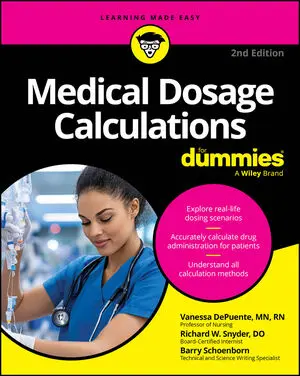
Medical Dosage Calculations For Dummies

Overview

An accurate and easy-to-read resource for students in medical dosage calculation classes

Medical Dosage Calculations For Dummies, 2nd Edition is an accurate guide to dosage calculation that tracks to standard course curricula. It's an easy-to-follow supplementary resource for students of nursing, pharmacology, paramedic programs and beyond, walking you through ratio-proportion, formula, and dimensional analyses for a wide variety of medication types.

You'll learn how medications are given, to whom, and how to chart accurately and clearly. You'll also discover how to handle the processes and language of medical dosing, as well as how to navigate the electronic medical records (EMRs) and electronic health records (EHRs).

Inside:

  • Brush up on your math
  • Understand the best practices in medical administration, including needle insertion instructions
  • Discover evidence-based practice guidelines and methods

Perfect for students currently taking a medical dosage calculations class, Medical Dosage Calculations For Dummies is also a great resource for working professionals interested in brushing up on the fundamentals.

Read More

About The Author

Vanessa DePuente, MN, RN, is the Interim Associate Dean of the Nursing Program at Everett Community College.

Richard W. Snyder, DO, is an internist and nephrologist who has been in clinical practice since 2004.

Barry Schoenborn is a long-time math, science, and technical writer. He is an author or co-author of numerous For Dummies books.

Sample Chapters

medical dosage calculations for dummies

CHEAT SHEET

No matter what initials you have after your name (RN, CNA, PA, and so on), you can bet you’ll see math on a daily basis if you’re going into (or are already in) a career in the medical field.Grasping some medical math basics — such as how to break down medical dosage problems into steps and use conversion factors — can simplify everyday situations all health care professionals face.

HAVE THIS BOOK?

Articles from
the book

As a healthcare professional, you have to convert patient weights, fluid volumes, medication weights, and more. Conversion math isn’t hard to do as long as you know the basic conversion factors. Here are the most useful ones: Converting lb to kg and kg to lb lb = kg × 2.2 kg = lb ÷ 2.2 Converting mL to L a
Whenever you’re administering intravenous (IV) infusions, you need to know the flow rate, infusion time, and total volume. Fortunately, calculating any one of these three variables is easy to do when you know the other two variables. Use the following equations: flow rate (mL/hr) = total volume (mL) ÷ infusion time (hr) infusion time (hr) = total volume (mL) ÷ flow rate (mL/hr) total volume (mL) = flow rate (mL/hr) × infusion time (hr) For example, if you must administer 1 L (1,000 mL) of fluid over 4 hours, use the first formula to calculate the flow rate, like so: flow rate (mL/hr) = total volume (mL) ÷ infusion time (hr) flow rate (mL/hr) = 1,000 ÷ 4 flow rate (mL/hr) = 250 The flow rate is 250 mL/hr.
No matter what initials you have after your name (RN, CNA, PA, and so on), you can bet you’ll see math on a daily basis if you’re going into (or are already in) a career in the medical field.Grasping some medical math basics — such as how to break down medical dosage problems into steps and use conversion factors — can simplify everyday situations all health care professionals face.
Making sure that you correctly calculate a dose doesn’t matter much if the medication itself is incorrect or the dosing instructions are unclear. Some abbreviations in prescriptions are unacceptable because they cause ambiguity and confusion (the enemies of patient safety and quality healthcare!). For this reason, you don’t want to see these abbreviations on any medical orders you work with.
https://cdn.prod.website-files.com/6630d85d73068bc09c7c436c/69195ee32d5c606051d9f433_4.%20All%20For%20You.mp3

Frequently Asked Questions

No items found.