|
Published:
June 9, 2026

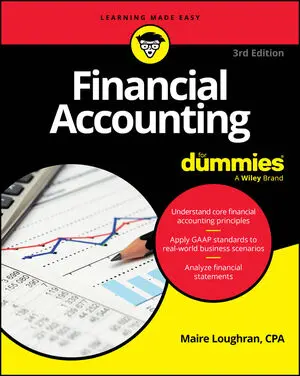
Financial Accounting For Dummies

Overview

Essential concepts and terminology to clarify business accounting for today’s economy

Financial Accounting For Dummies helps you decode the language of business, with clear explanations, practical examples, and updated guidance covering the latest GAAP standards. Learn the basics of decoding financial statements and keeping the books, along with more advanced topics like business investing. In this new edition, you’ll find new information on must-know topics like AI for accounting, keeping your data cybersecure, and accounting in specialty industries. Author and CPA Maire Loughran offers a friendly, accessible path to understanding how financial information is created, reported, and used. This timely and practical resource helps you stay ahead of the game in today’s fast-evolving financial landscape.

  • Gain a solid background in financial accounting concepts, with clear explanations and examples
  • Learn about major changes to GAAP accounting standards, and apply GAAP to emerging industries
  • Understand profit and loss, financial statements, and other accounting must-knows
  • Manage a startup, launch a career in accounting, or brush up your knowledge

Financial Accounting For Dummies is a valuable resource for business generalists, accountants-to-be, and financial professionals alike.

Read More

About The Author

Maire Loughran, CPA, is a ­certified public accountant and small business owner with more than 25 years of experience in accounting and financial reporting. She is the author of several For Dummies titles including Auditing For Dummies and Intermediate Accounting For ­Dummies.

Read an Excerpt

This is some text inside of a div block.
financial accounting for dummies

CHEAT SHEET

Financial accounting is the process of preparing financial statements for a business. The three key financial statements are the income statement, balance sheet, and statement of cash flows. They serve two broad purposes: to report on the current financial position of the company, and to show how well the company performs over a period of time.

HAVE THIS BOOK?

Articles from
the book

The three key financial statements are the income statement, balance sheet, and statement of cash flows. All three record the same daily accounting transactions occurring in a business, but each presents the facts slightly differently. Income statement: The income statement shows a company’s results of operations.
Financial accounting is the process of preparing financial statements for a business. The three key financial statements are the income statement, balance sheet, and statement of cash flows. They serve two broad purposes: to report on the current financial position of the company, and to show how well the company performs over a period of time.
In a financial accounting class, and on the job as an accountant, you need to know some jargon. Following is a glossary of words and phrases crucial to the accounting profession. Users of financial accounting information: The people or businesses that need to see the accounting transactions organized into financial statements to make educated decisions (such as whether to invest in or loan money to a company).
As a financial accountant, you may choose to work in public accounting (doing jobs for multiple business clients) or private accounting (performing accounting work only for your employer). You can also choose to specialize in governmental accounting, not-for-profit accounting, forensic accounting (which relates to legal proceedings or testimony), or other specific fields.
https://cdn.prod.website-files.com/6630d85d73068bc09c7c436c/69195ee32d5c606051d9f433_4.%20All%20For%20You.mp3

Frequently Asked Questions

No items found.