|
Published:
December 8, 2026

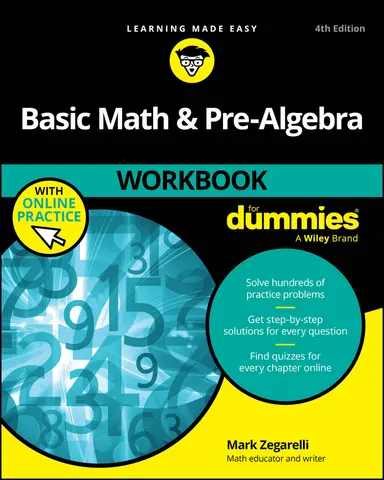
Basic Math & Pre-Algebra Workbook For Dummies

Overview

Build your math confidence one practice problem at a time.

Math is one of those skills that builds upon itself. Basic Math & Pre-Algebra Workbook For Dummies, 4th Edition (with online practice) is your friendly, hands-on guide to getting comfortable with the numbers. With hundreds of practice problems and clear explanations, you'll strengthen your skills and gain the confidence to tackle more advanced topics.

Work through exercises covering positive and negative numbers, whole numbers, fractions, decimals, and percents, then move on to variables, imaginary numbers, and algebraic equations. Each chapter includes an online quiz so you can track your progress and pinpoint exactly where you need more practice. Explanations and examples mirror today's teaching methods, keeping everything relevant and easy to follow.

Inside:

  • Get hundreds of practice problems that cover core math topics from whole numbers through algebraic equations
  • Build a solid foundation in fractions, decimals, and percents with step-by-step exercises and clear explanations
  • Track your progress with online chapter quizzes that help you identify areas where you need more practice
  • Explore variables, imaginary numbers, and introductory algebra concepts at your own comfortable pace and skill level
  • Discover practical examples and explanations aligned with current teaching methods so your learning stays relevant and accessible

Whether you're a student preparing for a pre-algebra course, a caregiver helping your child study for exams, or anyone looking to brush up on core math skills, this Dummies guide is the one for you.

Read More

About The Author

Mark Zegarelli is a math teacher and tutor with degrees in Mathematics and English from Rutgers University. He is the author of several For Dummies math titles, including Basic Math & Pre-Algebra For Dummies and Logic For Dummies.

Read an Excerpt

Excerpt Index
Table of Content
Excerpt Chapter 1
This is some text inside of a div block.
basic math & pre-algebra workbook for dummies with online practice

CHEAT SHEET

In this Cheat Sheet, you'll find easy-to-understand explanations and clear examples in these articles that cover basic math concepts — like order of operations; the commutative, associative, and distributive properties; radicals, exponents, and absolute values — that you may remember (or not) from your early math and pre-algebra classes. You'll also find handy and easy-to-understand conversion guides for converting between metric and English units and between fractions, percents, and decimals.

HAVE THIS BOOK?

Articles from
the book

In this Cheat Sheet, you'll find easy-to-understand explanations and clear examples in these articles that cover basic math concepts — like order of operations; the commutative, associative, and distributive properties; radicals, exponents, and absolute values — that you may remember (or not) from your early math and pre-algebra classes. You'll also find handy and easy-to-understand conversion guides for converting between metric and English units and between fractions, percents, and decimals.
To divide larger numbers, use long division. Unlike the other Big Four operations, long division moves from left to right. For each digit in the dividend (the number you’re dividing), you complete a cycle of division, multiplication, and subtraction.In some problems, the number at the very bottom of the problem isn’t a 0.
Dividing decimals is similar to dividing whole numbers, except you have to handle the decimal point before you start dividing. Here’s how to divide decimals step by step: Move the decimal point in the divisor and dividend. Turn the divisor (the number you’re dividing by) into a whole number by moving the decimal point all the way to the right.
The English system of measurement is most commonly used in the United States. If you were raised in the States, you’re probably familiar with most of the units: inches, pints, ounces, Fahrenheit, and so on.The following table shows the most common units as well as simple conversions from one unit to another. You can use it to answer the practice questions that follow.
When an expression has two sets of parentheses next to each other, you need to multiply every term inside the first set of parentheses by every term in the second set. This process is called FOILing.The word FOIL is a memory device for the words First, Outside, Inside, Last, which helps keep track of the multiplication when both sets of parentheses have two terms each.
To find the volume of a prism or cylinder, you can use the following formula, where Ab is the area of the base and h is the height: V = Ab x h Practice questions Find the volume of a prism with a base that has an area of 6 square centimeters and a height of 3 centimeters. Figure out the approximate volume of a cylinder whose base has a radius of 7 millimeters and whose height is 16 millimeters.
The formula for the volume of a pyramid is the same as for the volume of a cone. In this formula, Ab is the area of the base, and h is the height: Practice questions Find the volume of a pyramid with a square base whose side is 10 inches and with a height of 6 inches. Find the approximate volume of a cone whose base has a radius of 3 inches and whose height is 8 inches.
Cross-multiplication is a handy tool for finding the common denominator for two fractions, which is important for many operations involving fractions. In the following practice questions, you are asked to cross-multiply to compare fractions to find out which is greater or less. Practice questions 1. Find the lesser fraction: 2.
When an algebraic equation contains fractions, you can use cross-multiplication to solve the equation. The following practice questions contain two equal fractions, where you need to cross-multiply to solve them. Practice questions Rearrange the equationto solve for x. Solve the equation Answers and exp
You can solve algebraic equations by isolating x—that is, by getting x alone on one side of the equation and everything else on the other side. For most basic equations, isolating x involves a few steps, as you'll see in the following practice questions. Practice questions Find the value of x in the equation 9x – 2 = 6x + 7.
A quick method for solving algebra problems is to re-arrange the equation by placing all x terms on one side of the equal sign and all constants (non-x terms) on the other side. Essentially, you're doing the addition and subtraction without showing it. You can then isolate x. Practice questions Rearrange the equation 10x + 5 = 3x + 19 to solve for x.
When dealing with simple algebraic expressions, you don't always need algebra to solve them. The following practice questions ask you to use three different methods: inspecting, rewriting the problem, and guessing and checking. Practice questions In the following questions, solve for x in each case just by looking at the equation.
https://cdn.prod.website-files.com/6630d85d73068bc09c7c436c/69195ee32d5c606051d9f433_4.%20All%20For%20You.mp3

Frequently Asked Questions

No items found.