How to Classify Product Costs for a Manufacturer
Two issues exist when businesses classify product costs for a manufacturer. They must distinguish between manufacturing and non-manufacturing operating costs, and determine how to allocate indirect costs among different products.
These issues are described and illustrated below:
Drawing a line between manufacturing costs and non-manufacturing operating costs: The key difference here is that manufacturing costs are categorized as product costs, whereas non-manufacturing operating costs are categorized as period costs.
In calculating product costs, you include only manufacturing costs and not other costs. Period costs are recorded right away as expenses — either in variable operating expenses or fixed operating expenses (refer to the figure below). Here are some examples of each type of cost:
Wages paid to production line workers are a clear-cut example of a manufacturing cost.
Salaries paid to salespeople are a marketing cost and are not part of product cost; marketing costs are treated as period costs, which means they are recorded immediately to expense of the period.
Depreciation on production equipment is a manufacturing cost, but depreciation on the warehouse in which products are stored after being manufactured is a period cost.
Moving the raw materials and partially-completed products through the production process is a manufacturing cost, but transporting the finished products from the warehouse to customers is a period cost.
The accumulation of direct and indirect production costs starts at the beginning of the manufacturing process and stops at the end of the production line. In other words, product cost stops at the end of the production line — every cost up to that point should be included as a manufacturing cost.
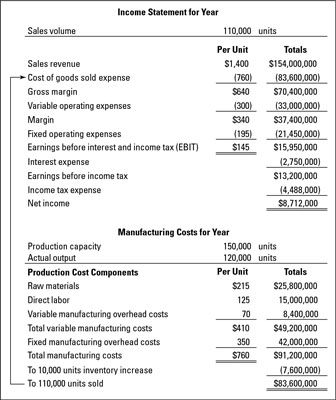
Example for determining the product cost of a manufacturer.
If you misclassify some manufacturing costs as operating costs, your product cost calculation will be too low. Also, the Internal Revenue Service may come knocking at your door if it suspects that you deliberately (or even innocently) misclassified manufacturing costs as non-manufacturing costs in order to minimize your taxable income.
Allocating indirect costs among different products: Indirect manufacturing costs must be allocated among the products produced during the period. The full product cost includes both direct and indirect manufacturing costs. Creating a satisfactory allocation method is difficult; the process ends up being somewhat arbitrary, but it must be done to determine product cost.
Managers should understand how indirect manufacturing costs are allocated among products (and how indirect non-manufacturing costs are allocated among organizational units and profit centers). Managers should also keep in mind that every allocation method is arbitrary and that a different allocation method may be just as convincing.

Accounting Glossary
accounting equation
The equation Assets = Liabilities + Equity, which demonstrates the two-sided nature of accounting and is useful for explaining the concept of double-entry accounting (or double-entry bookkeeping).

Accounting Glossary
accounting period
The time period for which financial information is being tracked in a business, such as monthly, quarterly, or annually.

Accounting Glossary
accounts receivable
An account that records the amounts that customers owe to a business.

Accounting Glossary
adjusting entry
A correction made to a bookkeeping account that adjusts for accounting errors or other necessary changes at the end of the accounting period.

Accounting Glossary
cash flows
Used to describe the source or sources of cash or how cash is used.

Accounting Glossary
Chart of Accounts
A list of all the accounts used by a business, including what types of transactions go into each account.

Accounting Glossary
debit
An accounting entry that increases an asset or expense account, and decreases a liability or income account.

Accounting Glossary
dividends
A portion of a company’s profits paid by share of common stock on a quarterly or annual basis.

Accounting Glossary
FASB
Financial Accounting Standards Board. FASB is the highest-ranking authority in the private (non-government) sector of the U.S. for making pronouncements on GAAP and for keeping accounting standards up-to-date.

Accounting Glossary
Federal Unemployment Tax
In the U.S., the fund that used to be known simply as Unemployment. Employers contribute to the fund, and states also collect taxes to fill their unemployment fund reserves. (The acronym FUTA means Federal Unemployment Tax Act.)

Accounting Glossary
fidelity bonds
A type of insurance — typically carried by employers for their employees — that helps guard against theft and reduce the risk of loss.

Accounting Glossary
FIFO
First-in, first-out. A method for costs of goods sold in which a business charges out product costs to cost of goods sold expense in the chronological order in which the goods were acquired.

Accounting Glossary
fungible
Describes a product that is interchangeable and virtually indistinguishable from another product.

Accounting Glossary
General Ledger
A summary of all of a business’s accounts and transactions.

Accounting Glossary
IASB
International Accounting Standards Board. The IASB (based in London) is the main authoritative accounting standards setter outside the U.S.

Accounting Glossary
Journals
The location in which bookkeepers keep records (in chronological order) of daily company transactions.

Accounting Glossary
LIFO
Last-in, first-out. A method for costs of goods sold that selects the last item you purchased first, and then works backward until you have the total cost for the total number of units sold during the period.

Accounting Glossary
LLP
Limited liability partnership. A legal structure that state laws offer to qualified professionals in which all the partners have limited liability.

Accounting Glossary
PC
Professional corporation. A legal structure that state laws offer to qualified professionals who otherwise would have to operate as an unlimited partnership liability.

Accounting Glossary
petty cash
A cash account that businesses keep on hand for unexpected expenses.

Accounting Glossary
revenue
Monies that are collected in the process of selling a company’s goods and services.

Accounting Glossary
salvage value
The amount that an asset is worth after it has been fully depreciated.

Accounting Glossary
statement of cash flows
A financial statement that summarizes a business’s cash inflows and outflows during an accounting period.

Accounting Glossary
transactions
Economic exchanges between a business or other entity and the parties with which the entity interacts and makes deals.

Accounting Glossary
worker’s compensation insurance
A type of insurance carried by employers that covers its employees in case they are injured on the job.