The Treble and Bass Clefs in Piano Music
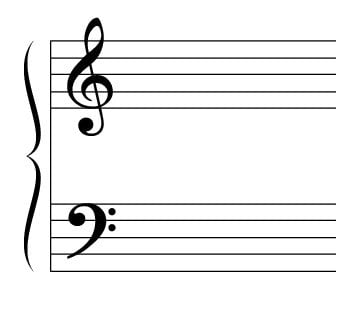
When using printed music to play piano, the treble and bass clefs identify the notes. A clef’s sole purpose in life is to tell you the names of the lines and spaces on the staff so that you can play piano music accurately. If the clef could talk, it would say something like, For this set of notes, the lines and spaces represent these keys.
Music uses several different clefs, but as a keyboard player you’re in luck — you only need to know two — the treble clef and the bass clef. You can think of it as having a clef for each hand because you generally play the notes on the treble clef with your right hand and the notes on the bass clef with your left hand.
Playing the treble clef
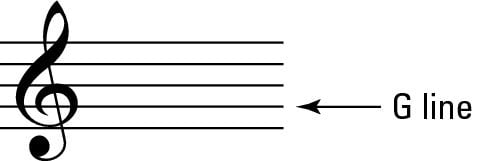
The treble clef is also called the G clef because it
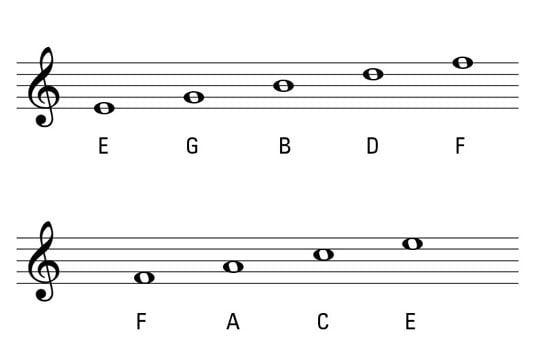
The G line encircled by the treble clef isn’t for just any old G key. It’s the G closest to the middle of the keyboard. After you find this G, reading the other lines and spaces on the staff is as easy as reciting the alphabet.
Going low to the bass clef
Your left hand typically plays the lower notes on the keyboard, which are also called bass notes. (For the record, that’s pronounced like base, not like the fish you caught last weekend.) The base notes are generally indicated by the bass clef.

Like the treble clef, the bass clef surrounds a particular line that represents a particular note: F. You can remember the special relationship between the bass clef and the note F by thinking about the following two things:
You can call the bass clef the F clef or just think of it as a stylized B (the dots are the humps) for bass.
The bass clef doesn’t surround the F just below the treble clef G. Instead, this F is one octave grouping below (or to the left).
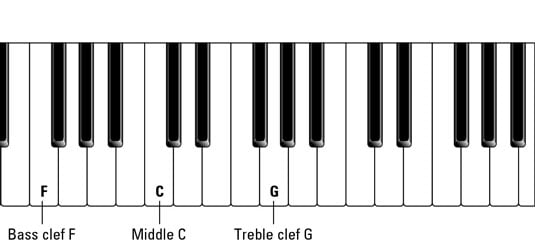
To read the notes on the bass clef, simply start with the F line and travel down (backward) and up (forward) through the alphabet.

Piano Glossary
accidental
A sharp or flat not in the key signature.

Piano Glossary
bar line
A line that divides music into measures, breaking up the musical paragraph into smaller, measurable groups of notes and rests.

Piano Glossary
bass clef
A musical symbol that indicates lower the notes, generally played with the left hand.

Piano Glossary
beat
The steady pulse of a piece of music; what you tap your foot to.

Piano Glossary
C position
Placing your right-hand thumb on middle C and your other right-hand fingers on the four successive white keys.

Piano Glossary
chord
Three or more notes played at the same time.

Piano Glossary
Circle of Fifths
An order that starts with no sharps and flats and cycles the ring of keys to all 12 keys.

Piano Glossary
clef
A musical symbol that tells you the names of the lines and spaces on the staff.

Piano Glossary
fingerings
Numbers written above the notes that tell you which finger to use for each note.

Piano Glossary
G position
Placing your right hand on the G above middle C and your other right-hand fingers on the four successive white keys.

Piano Glossary
grand piano
The largest piano. A concert grand is 9 feet long; a baby grand is about 5 feet.

Piano Glossary
grand staff
The treble clef and bass clef joined together with a brace at the start of the left side.

Piano Glossary
home note
The base note of a piece of music. All the notes in a song have a relation to the home note based on how close or far they are to home.

Piano Glossary
interval
The distance between any two musical notes.

Piano Glossary
key
A set of notes that corresponds to a certain scale.

Piano Glossary
key signature
Notation placed just after the clef on every line of music to tell the performer what key the song is in.

Piano Glossary
ledger line
An imaginary line running above or below the staff, extending the five-line staff to represent notes above and below the staff.

Piano Glossary
measure or bar
A batch of notes with a specific number of beats — most commonly four beats — that helps a performer keep time.

Piano Glossary
middle C
The 40th key of a piano, close to the center of the keyboard. The first key a new pianist learns the placement of.

Piano Glossary
MIDI Musical Instrument Digital Interface
A device that allows communication between electronic, digital equipment.

Piano Glossary
notehead
The printed representation of a note. A notehead is oval and may be solid or open, an attached to a stem or not.

Piano Glossary
octave line or ottava line
The line that tells you to play the indicated note or notes an octave higher or lower than written.

Piano Glossary
root note
The lowest note of a chord.

Piano Glossary
scale
A series of notes in a specific, consecutive order.

Piano Glossary
staff
The five lines and four spaces music is written on.

Piano Glossary
tempo
How fast or slow the beat is.

Piano Glossary
time signature
The indication of the meter of a piece of music.

Piano Glossary
tonic
The bottom note of a scale.

Piano Glossary
treble clef
A musical symbol that indicates higher the notes, generally played with the right hand.

Piano Glossary
triplet
Three notes per beat.

Piano Glossary
upright piano
A piano that sits upright against a wall. Also called verticals, they vary in height from the spinet up to full-size uprights.