
When you’ve just walked the cap-and-gown line, you can sidestep “no experience” potholes by impressing employers with your vim and vigor, accomplishments, and up-to-date knowledge. Here’s a primer on putting together a resume for a recent graduate that can help you break into your desired field.
Check out award-winning new graduate resumes created by professional resume writers at CareerDirectors under the Find a Career Pro navigation button. Here you can find a number of great examples for overcoming new graduate challenges.
Promote your strengths
As a recent graduate, you have four key selling points and various minor ones:- You’re energetic and fired up to tackle assigned tasks and conquer the world.
- Your job skills and knowledge are up-to-date, and you’ve likely gained a lot of hands-on experience you may take for granted.
- You’re available for the right price. You cost much less than an older, experienced person. Maybe half as much.
- You belong to a global, networked era and aren’t afraid of technology.
Recognize your rookie soft spots
Your key weaknesses are internal and external, but, luckily, they can all be overcome with resume strategy. As a new professional, you risk- Being stereotyped by prospective employers as having book smarts but lacking practical experience.
- Taking for granted the relevant value you have to offer and not selling all the knowledge and skills gained from projects, papers, class learning, volunteerism, internships, and seemingly unrelated employment.
Demonstrate how recent graduates add value
Just as the times change, so do the strategies for putting together resumes. Your professors may recommend that you simply list your jobs and skills, but these days, that’s not enough. You need to recognize that your resume isn’t a list of everything you’ve done. It’s about selling yourself for jobs in the field you’re targeting. What is most important is including content on your resume that shows you’re ready for that type of position.Use the following key strategies to make your resume sell.
Data-mine your college experience
Need a job? Get experience! Need experience? Get a job! This predicament has frustrated new graduates since the Industrial Revolution.It might seem like you have a difficult resume challenge when you have nothing but education to work with. But that’s just not the case! Every core course you took and every volunteer role you held may offer juicy nuggets of value to your resume.
Consider the following factors to identify the experience and skills you garnered in college and match your information with the job you hope to land:
- Work: Internships, summer jobs, part-time jobs, campus jobs, entrepreneurial jobs, temporary work, and volunteer work.
- Sports: Proven ability to achieve goals in a team environment; strength in competition, which looks good for many types of positions such as sales.
- Awards and honors
- Research papers and projects
- Knowledge: Skills and abilities gained from completing core courses.
- Campus leadership
- Grade Point Average (GPA): If it’s 3.0 or above; otherwise, omit it (some advisers set the GPA floor at 3.5).
- Technical skills and software facility
Clarify your aim
Always start by very briefly clarifying your job target with your objective header. Ditch the wordy (and lofty) job objectives because that’s considered old school. Cut to the chase, like this:Research position in urban planning field in Chicago area.or
Qualified for positions in: Sales ~ Marketing ~ Public Relations
Summarize what makes you stand out
Include a summary to point out your strong points (I walk you through this process in Chapter 7). As a new grad, think about what professors told you were your strengths or what they wrote on your papers. Reread the recommendation letters you received from internships. Think about any recognitions or awards you were given for clubs, academics, or volunteer work.Your goal is to state in two or three sentences what makes you stand out. For example:
Visionary and high-energy young professional recognized for savvy in targeting marketing projects and PR campaigns. Experience: worked on campaigns for the XYZ Company and the ABC Company. Creative: campaign selected out of 24 presented by fellow competitors. Quick-to-learn: attained 3.75 GPA in BS in Marketing.And it’s all true. Consider how it breaks down:
Statement: Visionary and high-energy young professional recognized for savvy in targeting marketing projects and PR campaigns.Translation: I have been told by my professors, bosses, and internship managers that I have a lot of energy and vision for marketing and PR.
Statement: Experience: worked on campaigns for the XYZ Company and the ABC Company.
Translation: I completed case study projects in my marketing classes on these companies that led to mock campaigns being developed.
Statement: Creative: campaign selected out of 24 presented by fellow competitors.
Translation: One of my case studies was overseen by a real marketing agency. Of my 24 classmates, my campaign proposal was selected as the one they would pitch to the client.
Statement: Quick-to-learn: attained a 3.75 GPA in BS in Marketing.
Translation: It is always a good idea to showcase your GPA in your resume if you have attained at least a 3.0. Otherwise, leave it off.
Sell your skills, knowledge, and training
You may feel compelled to follow the direction of your professors and friends, and limit what you have learned to the names of classes written under your new degree in the resume’s education section. Don’t do it! This is how employers get the idea you just have book smarts, and your resume fails to provide the necessary keywords for computer scans.
Instead, this is where you turn your classroom learning, school papers, projects, transferrable work, and volunteer skills into resume gold. Under your summary, all you need to do is add a two- or three-column list with the title:Knowledge, Skills, and TrainingFill this section with the key skills, knowledge, and training you have for your target job. A marketing grad might include:
Advertising, Marketing, Public Relations, Budgeting, Pricing, Graphic Design, Client Relations, Project Planning, Market Research, Branding, Writing & Editing, Social MediaCheck out the following figure for an example of how this can look.
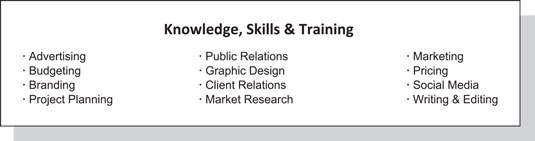 List your knowledge, skills, and training with bullets.
Now your resume leads with some keyword meat that you will support later in the experience section.
Most new grads make the mistake of skipping the keyword section because they feel they have little to offer. But that’s just wrong and a disservice to all the knowledge and hands-on skills you gained while attaining your degree. Dig deep into course descriptions, course syllabi, and textbook tables of contents to find the keywords relevant to your job target.
If you aren’t sure what to play up in the keyword section, take a look at descriptions of jobs you are targeting. This will give you a good indication of the skills employers are seeking and should help you shape what you include.
Experience isn’t just about paid jobs
Thicken your work experience by including all unpaid positions, internships, special projects, and volunteer jobs/leadership roles (such as campus club president). List them just like you would employment in reverse chronological order under your experience section. For example:Marketing Studies, FT – ABC University, Orlando, FLMarketing Campaigns: Completed campaign design for XYZ company course project that was selected by Stark Advertising Agency as the best out of 24 entries. Met with customer and Stark staff on mock pitch.
Marketing Collateral: Designed numerous collateral pieces from press releases to emails, websites, and brochures using Photoshop, AI, and WordPress in design class.
President (Marketing Responsibility) – 123 Sorority, Orlando, FL
Recruiting & Marketing Campaigns: Collaborated with volunteers to develop effective on-campus and off-campus recruiting campaigns that led to 30 percent increase in pledges over prior three years.
Communications & Promotions: Represented sorority to key influencers such as university administrative staff. Attained permission for unique on-campus fundraiser that led to raising $12,000 in one semester.
Highlight the experience most relevant to your intended future. If you have at least one year of full-time professional experience, place your education section after your experience section — unless your education is changing your career path.
Dump unhelpful information
Don’t fatten your resume with irrelevant data such as hobbies, unless they are directly relevant to your job target or the employer. Include an activity only if it reveals skills, competencies, accomplishments, results, or other qualification to support your intended job. Omit high school data unless it adds a unique fact to the total impression that you’re creating.Also, if you’re mailing your resume via the U.S. Postal Service, don’t enclose it in a report cover or bulky package; just slip it and your cover letter in a standard envelope. And forget about including school transcripts or letters of recommendation. Those belong in a nice three-ring binder portfolio you carry with you to the interview.
Make unrelated work history relatable
It can feel easy to just write down what you did in your unrelated jobs and leave it at that. But what if your job was as a cashier and you’re targeting marketing coordinator? Words just aren’t going to mesh and sell you to the prospective employer.This is where you have to do a little analysis of how what you have to offer can cross the bridge to what the employer needs.
First, break your job down into fragments and explain them. For example, with the cashier description, don’t just say that your responsibility was “scanning products, making money transactions, and dealing with customers.” Instead do this:
- Look at job descriptions that match what you are targeting.
- Consider how your skills can best be explained to fit those requirements.
- Describe each function in terms of your accomplishments and their outcomes.
Avoid gaffes common to new graduates
New graduates are more likely than experienced job seekers to make the following mistakes.- Falling short of image standards: If you present an online resume blemished with the type of shorthand used for tweets and texting, or a paper resume flawed with typos, or a persona degraded with party pictures or a goofy profile on a social media site, you flunk.
- Omitting heavy-hitter points: You fail to distinguish yourself by creating an opening summary that calls to mind an image of your brand, as I describe earlier in this chapter.
Keep your summary brief — three to four accomplishments is plenty.
- Overcompensating with gimmicky language: Don’t get cutesy in your resume to compensate for a lack of qualifications. Avoid using exotically original language, such as “eyelinered genius,” a term used by a business graduate applying for an entry-level marketing position in the cosmetics industry. The term may be colorful, but charm communicates better in the interview.
- Making employers guess: Employers hate being asked to decipher your intent. Merely presenting your declared major and transcript excerpts isn’t enough to kick off a productive job search. Add a targeted objective header statement, summary, and keyword section directed at a specific career field and type of position.
- Leveling the experience field: Your resume is no place to give every job equal billing. Do what you can to make each one relevant for the prospective employer, but don’t be afraid to limit one to just a single line of job title, company name, location, and date in your reverse chronology for positions that just don’t seem to offer any relevant value.
- Stopping with bare bones: Some rookies look at a sheet of paper and then at their embarrassing, bedraggled collection of jobs in their paid-experience stew. Desperate to get anything written, they settle for employer, job title, and dates of employment.
The solution is to pull together all experience, including volunteer and part-time gigs. Sit, think, think some more, and add all your relevant competencies and skills pointing in the direction in which you wish to work. You can use Chapter 8 as a good guide for avoiding what I call this issue of blank page syndrome.
- Hiding hot information: Data buried is data forgotten. Employers remember best the information you give first in a resume, not the data folded into the middle. The first one-third to one-half of the first page of your resume is prime real estate; determine your selling points and pack that punch up front.
- Ignoring employers’ needs: Even the smartest new graduates make this mistake: They forget to find out what employers want from new hires. At this moment in time, no one cares what you want — the only thing that matters is the value-pack you bring to the employer. Rigorously study numerous job descriptions for your targeted positions so you can gain gems of wisdom for where to put your focus.
- Writing boastfully: Appearing too arrogant about your talents can cause employers to question your ability to learn and function as a junior team member. Even when you’re just trying to compensate for your inexperience, avoid terminology that comes across as unnatural or blatantly self-important.
When you’re not sure whether you sound too full of yourself, ask those who know you to read your resume and share feedback about what kind of person they think your resume represents. Then, go back and tweak wording if it needs to be toned down (or built up). An online thesaurus or crossword dictionary can be a great tool in coming up with similar words.
Click here to view a resume for a recent graduate.