Recording Store Credit Transactions in a Bookkeeping System
When sales are made on store credit, you must record specific information into the accounting system. In addition to entering information regarding cash receipts, you update the customer accounts to be sure each customer is billed and the money is collected. You debit the Accounts Receivable account, an asset account shown on the Balance Sheet, which shows money due from customers.
Here’s how a journal entry of a sale made on store credit looks:
|
|
Debit |
Credit |
| Accounts Receivable |
$84.80 |
|
| Sales |
|
$80.00 |
| Sales Tax Collected |
|
$4.80 |
| Cash receipts for April 25 |
|
|
In addition to making this journal entry, you enter the information into the customer’s account so that accurate bills can be sent out at the end of the month. When the customer pays the bill, you update the individual customer’s record to show that payment has been received and enter the following into the bookkeeping records:
|
|
Debit |
Credit |
| Accounts Receivable |
$84.80 |
|
| Sales |
|
$84.80 |
| Payment from S. Smith on Invoice 123. |
|
|
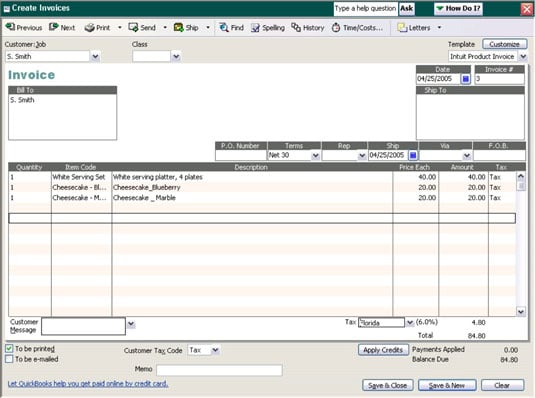
If you’re using QuickBooks, you enter purchases on store credit using an invoice form like the one in the following figure. Most of the information on the invoice form is similar to the sales receipt form, but the invoice form also has space to enter a different address for shipping (the Ship To field) and includes payment terms (the Terms field).

QuickBooks sales invoice for purchases made on store credit.
QuickBooks uses the information on the invoice form to update the following accounts:
Accounts Receivable
Inventory
The customer’s account
Sales Tax Collected
Based on this data, when it comes time to bill the customer at the end of the month, with a little prompting from you (see the next figure), QuickBooks generates statements for all customers with outstanding invoices. You can easily generate statements for specific customers or all customers on the books.
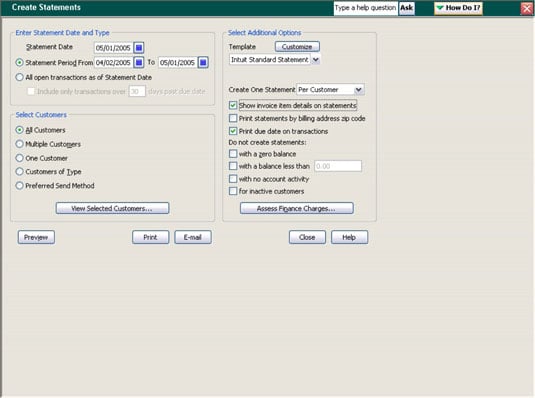
Generating statements for customers using QuickBooks.
When you receive payment from a customer, here’s what happens:
1. You enter the customer’s name on the customer payment form (shown in the next figure).
2. QuickBooks automatically lists all outstanding invoices.
3. You select the invoice or invoices paid.
4. QuickBooks updates the Accounts Receivable account, the Cash account, and the customer’s individual account to show that payment has been received.
If your company uses a point of sale program that’s integrated into the computerized accounting system, recording store credit transactions is even easier for you. Sales details feed into the system as each sale is made, so you don’t have to enter the detail at the end of day. These programs save a lot of time, but they can get very expensive — usually at least $400 for just one cash register.
Even if customers don’t buy on store credit, point of sale programs provide businesses with an incredible amount of information about their customers and what they like to buy. This data can be used in the future for direct marketing and special sales to increase the likelihood of return business.
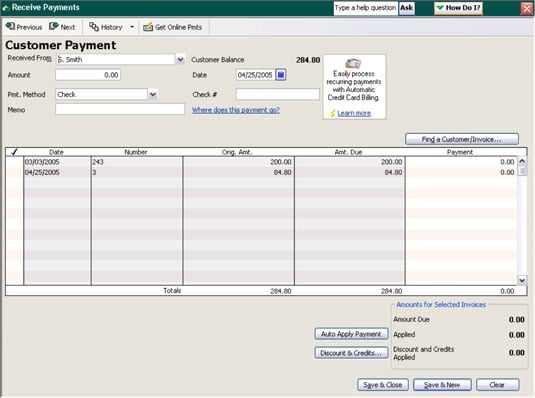
In QuickBooks, recording payments from customers who bought on store credit starts with the customer payment form.

Accounting Glossary
accounting equation
The equation Assets = Liabilities + Equity, which demonstrates the two-sided nature of accounting and is useful for explaining the concept of double-entry accounting (or double-entry bookkeeping).

Accounting Glossary
accounting period
The time period for which financial information is being tracked in a business, such as monthly, quarterly, or annually.

Accounting Glossary
accounts receivable
An account that records the amounts that customers owe to a business.

Accounting Glossary
adjusting entry
A correction made to a bookkeeping account that adjusts for accounting errors or other necessary changes at the end of the accounting period.

Accounting Glossary
cash flows
Used to describe the source or sources of cash or how cash is used.

Accounting Glossary
Chart of Accounts
A list of all the accounts used by a business, including what types of transactions go into each account.

Accounting Glossary
debit
An accounting entry that increases an asset or expense account, and decreases a liability or income account.

Accounting Glossary
dividends
A portion of a company’s profits paid by share of common stock on a quarterly or annual basis.

Accounting Glossary
FASB
Financial Accounting Standards Board. FASB is the highest-ranking authority in the private (non-government) sector of the U.S. for making pronouncements on GAAP and for keeping accounting standards up-to-date.

Accounting Glossary
Federal Unemployment Tax
In the U.S., the fund that used to be known simply as Unemployment. Employers contribute to the fund, and states also collect taxes to fill their unemployment fund reserves. (The acronym FUTA means Federal Unemployment Tax Act.)

Accounting Glossary
fidelity bonds
A type of insurance — typically carried by employers for their employees — that helps guard against theft and reduce the risk of loss.

Accounting Glossary
FIFO
First-in, first-out. A method for costs of goods sold in which a business charges out product costs to cost of goods sold expense in the chronological order in which the goods were acquired.

Accounting Glossary
fungible
Describes a product that is interchangeable and virtually indistinguishable from another product.

Accounting Glossary
General Ledger
A summary of all of a business’s accounts and transactions.

Accounting Glossary
IASB
International Accounting Standards Board. The IASB (based in London) is the main authoritative accounting standards setter outside the U.S.

Accounting Glossary
Journals
The location in which bookkeepers keep records (in chronological order) of daily company transactions.

Accounting Glossary
LIFO
Last-in, first-out. A method for costs of goods sold that selects the last item you purchased first, and then works backward until you have the total cost for the total number of units sold during the period.

Accounting Glossary
LLP
Limited liability partnership. A legal structure that state laws offer to qualified professionals in which all the partners have limited liability.

Accounting Glossary
PC
Professional corporation. A legal structure that state laws offer to qualified professionals who otherwise would have to operate as an unlimited partnership liability.

Accounting Glossary
petty cash
A cash account that businesses keep on hand for unexpected expenses.

Accounting Glossary
revenue
Monies that are collected in the process of selling a company’s goods and services.

Accounting Glossary
salvage value
The amount that an asset is worth after it has been fully depreciated.

Accounting Glossary
statement of cash flows
A financial statement that summarizes a business’s cash inflows and outflows during an accounting period.

Accounting Glossary
transactions
Economic exchanges between a business or other entity and the parties with which the entity interacts and makes deals.

Accounting Glossary
worker’s compensation insurance
A type of insurance carried by employers that covers its employees in case they are injured on the job.