
Paste Options in Excel 2013
Excel 2013 displays a Paste Options button with the label, (Ctrl), to its immediate right at the end of the pasted range, after you click the Paste button on the Home tab of the Ribbon or press Ctrl+V to paste cell entries that you copy to the Clipboard. When you click this drop-down button or press the Ctrl key, a palette appears with three groups of buttons.
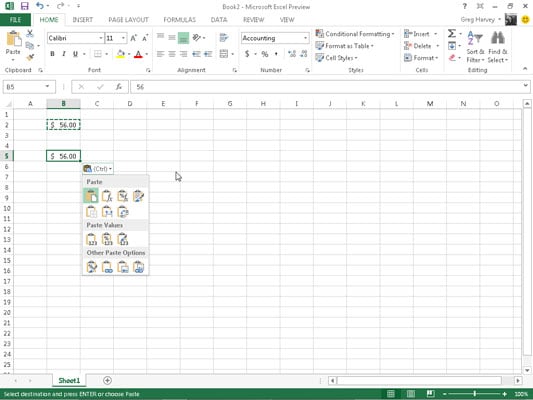
You can use these paste options to control or restrict the type of content and formatting that’s included in the pasted cell range. The paste options (complete with the hot key sequences you can type to select them) on the Paste Options palette include:
Paste (P): Excel pastes all the stuff in the cell selection (formulas, formatting, you name it).
Formulas (F): Excel pastes all the text, numbers, and formulas in the current cell selection without their formatting.
Formulas & Number Formatting (O): Excel pastes the number formats assigned to the copied values along with their formulas.
Keep Source Formatting (K): Excel copies the formatting from the original cells and pastes this into the destination cells (along with the copied entries).
No Borders (B): Excel pastes all the stuff in the cell selection without copying any borders applied to its cell range.
Keep Source Column Widths (W): Excel makes the width of the columns in the destination range the same as those in the source range when it copies their cell entries.
Transpose (T): Excel changes the orientation of the pasted entries. For example, if the original cells’ entries run down the rows of a single column of the worksheet, the transposed pasted entries will run across the columns of a single row.
Values (V): Excel pastes only the calculated results of any formulas in the source cell range.
Values & Number Formatting (A): Excel pastes the calculated results of any formulas along with all the formatting assigned to the labels, values, and formulas in the source cell range into the destination range. This means that all the labels and values in the destination range appear formatted just like the source range, even though all the original formulas are lost and only the calculated values are retained.
Values & Source Formatting (E): Excel pastes the calculated results of any formulas along with all formatting assigned to the source cell range.
Formatting (R): Excel pastes only the formatting (and not the entries) copied from the source cell range to the destination range.
Paste Link (N): Excel creates linking formulas in the destination range so that any changes that you make to the entries in cells in the source range are immediately brought forward and reflected in the corresponding cells of the destination range.
Picture (U): Excel pastes only the pictures in the copied cell selection.
Linked Picture (I): Excel pastes a link to the pictures in the copied cell selection.
The options in the Paste Special dialog box include:
All to paste all the stuff in the cell selection (formulas, formatting, you name it).
Comments to paste only the notes that you attach to their cells.
Validation to paste only the data validation rules into the cell range that you set up with the Data Validation command (which enables you to set what value or range of values is allowed in a particular cell or cell range).
All Using Source Theme to paste all the information plus the cell styles applied to the cells.
All Except Borders to paste all the stuff in the cell selection without copying any borders you use there.
Column Widths to apply the column widths of the cells copied to the Clipboard to the columns where the cells are pasted.
All Merging Conditional Formats to paste Conditional Formatting into the cell range.
None to prevent Excel from performing any mathematical operation between the data entries you cut or copy to the Clipboard and the data entries in the cell range where you paste.
Add to add the data you cut or copy to the Clipboard and the data entries in the cell range where you paste.
Subtract to subtract the data you cut or copy to the Clipboard from the data entries in the cell range where you paste.
Multiply to multiply the data you cut or copy to the Clipboard by the data entries in the cell range where you paste.
Divide to divide the data you cut or copy to the Clipboard by the data entries in the cell range where you paste.
Skip Blanks check box when you want Excel to paste everywhere except for any empty cells in the incoming range. In other words, a blank cell cannot overwrite your current cell entries.
Transpose check box when you want Excel to change the orientation of the pasted entries. For example, if the original cells’ entries run down the rows of a single column of the worksheet, the transposed pasted entries will run across the columns of a single row.
Paste Link button when you’re copying cell entries and you want to establish a link between copies you’re pasting and the original entries. That way, changes to the original cells automatically update in the pasted copies.
The options that appear on the Paste Options palette are context sensitive. This means that the particular paste options available on the palette depend directly upon the type of cell entries previously copied to the Office Clipboard.
Additionally, you can access this same palette of paste options by clicking the drop-down button that appears directly beneath the Paste button on the Ribbon instead of clicking the Paste Options button that appears at the end of the pasted range in the worksheet or pressing the Ctrl key on your keyboard.

Excel Glossary
active cell
The worksheet cell that contains the cell cursor. Each worksheet can have only one active cell.

Excel Glossary
AutoComplete
A feature that looks at the entries that you make in a worksheet column and automatically duplicates them in subsequent rows whenever you start a new entry that begins with the same letter or letters as an existing entry in that column.

Excel Glossary
AutoCorrect
A feature that alerts Excel 2007 to common typing errors and your own typing errors (that you specify) and tells the program how it should automatically fix them for you.

Excel Glossary
AutoFill
An Excel 2007 feature that quickly creates a series of entries based on the data you enter in one or two cells. AutoFill works with days of the week, months of the year, yearly quarters; consecutive series of numbers; and formulas. You also can add your own custom AutoFill series.

Excel Glossary
AutoFilter
A feature in Excel 2010 that enables you to temporarily hide everything in a table except the records you specifically want to view, based on criteria you specify.

Excel Glossary
Backstage view
A new feature in Excel 2010 — accessible from the green File tab — that enables you to manage files and to view the properties and stats about the workbook file you're editing.

Excel Glossary
cell
The intersection of a column and row in the worksheet.

Excel Glossary
cell address
The cell identifier, determined by its column letter(s) followed by the row number, as in cell A1, the very first cell of each worksheet at the intersection of column A and row 1.

Excel Glossary
cell cursor
The black border that surrounds the active cell in a worksheet.

Excel Glossary
clip art
Readymade drawings, illustrations, and photos offered by Microsoft for use in Microsoft Office applications.

Excel Glossary
Compatibility Checker
A utility in Excel 2007 and 2010 that you use to find potential compatibility issues if you plan to save an Excel workbook file in the older Excel 97–2003 file format.

Excel Glossary
current cell
The worksheet cell that contains the cell cursor. Each worksheet can have only one current cell.

Excel Glossary
data table
A range of cells in a worksheet in which you enter a series of possible values that Excel plugs into a formula so you can perform what-if analysis on the data.

Excel Glossary
dialog box
A rectangular window with settings and commands that appears when you click a dialog box launcher or certain other commands on the Ribbon.

Excel Glossary
dialog box launcher
A small icon in the lower-right corner of a group of command buttons on the Ribbon that you click to access a dialog box with additional related settings and commands.

Excel Glossary
function
A part of a formula that takes a number of specific arguments and then returns a single value based on those arguments.

Excel Glossary
gallery
A drop-down list of thumbnail selections that appears when you click certain command buttons on the Ribbon.

Excel Glossary
group
A section of a tab on the Excel 2007 Ribbon that organizes related command buttons into subtasks normally performed as part of the tab's larger core task. The name of a group appears at the bottom of the group, such as the Font group on the Home tab.

Excel Glossary
hyperlink
Specially formatted text that anyone can click to jump to Web sites, move to other cells or workbooks, or create an e-mail message.

Excel Glossary
keyboard shortcuts
A combination of keys that you can press to execute certain commands, as opposed to finding and clicking the commands' buttons on the Ribbon or elsewhere.

Excel Glossary
Live Preview
A feature in Excel 2007 that enables you to point to thumbnails on a drop-down gallery to see how a new font, font size, table style, or cell style would look on your selected data before you actually apply it.

Excel Glossary
macro
A series of commands or actions in Excel that are recorded and saved together in a file. You can run the macro whenever you need to perform the task.

Excel Glossary
Name box
The left-most section of the Formula bar that displays the address or name of the current cell.

Excel Glossary
pivot table
A special type of table unique to Excel 2007 that enables you to summarize large amounts of data and pivot or rearrange the table's data to display different summaries of the information it contains.

Excel Glossary
Ribbon
A new feature of the Excel 2007 interface that replaces the menus and toolbars of previous versions; appears at the top of the Excel window, just below the title bar.

Excel Glossary
ScreenTip
A small window that displays descriptive text when you point to but don't click a command on the Ribbon or other objects in a worksheet.

Excel Glossary
sheet tabs
Small tabs near the bottom of a worksheet that you click to move between the worksheets in a workbook. You can assign descriptive names to sheet tabs.

Excel Glossary
slicers
New graphic objects in Excel 2010 that enable you to quickly filter the contents of a PivotTable on more than one field.

Excel Glossary
SmartArt
A type of graphic object in Excel 2007 that gives you the ability to quickly and easily construct graphical lists and diagrams in the worksheet.

Excel Glossary
sparklines
Tiny graphs (miniature charts) that fit within a single cell in the worksheet, used to show basic trends in data.

Excel Glossary
Status bar
A horizontal bar that appears at the bottom of the Excel 2007 window and keeps you informed of Excel's current mode. In addition, you can use the Status bar to select a new worksheet view and to zoom in and out on the worksheet.

Excel Glossary
tabs
The various "pages" of Excel 2007's Ribbon interface that you click to display command buttons relating to the tab's name, such as Page Layout and Formulas.

Excel Glossary
template
A pre-designed worksheet that can be used as a basis for creating new worksheets.

Excel Glossary
WordArt
Stylized text objects that you use to add pizzazz and emphasis to headings and other text in Excel 2007 worksheets.

Excel Glossary
workbook
The basic file type that you create when you use Excel 2007. A new workbook consists of three worksheets by default.

Excel Glossary
worksheet
The main document that you work in when you enter data into cells within Excel 2007. A worksheet is stored in a workbook file.

Excel Glossary
worksheet area
The portion of an Excel 2007 worksheet in which you enter cell data and add objects such as charts and graphics.

Excel Glossary
XPS XML Paper Specification
A file format developed by Microsoft that enables people to open and print documents in XPS Reader without access to the original programs with which the documents were created (such as Excel).

Excel Glossary
Zoom slider
An object on the Status bar in Excel 2007 that enables you to increase the magnification in a worksheet or shrink it down to get an overall picture of the worksheet data.