

Japanese Grammar: Particles
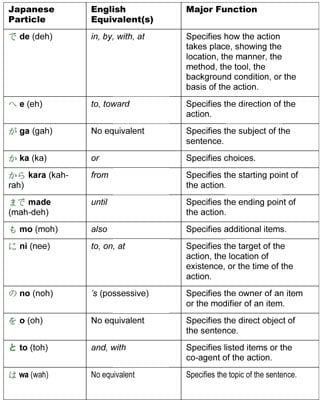
English grammar has articles and prepositions, but Japanese grammar has particles that follow a noun to show the noun's function. Japanese particles denote such things as the topic of the sentence; the start point, end point, and direction of the action; the tools and means of the action; and even the subject and direct object of the sentence. The following table shows the Japanese particles with pronunciations in parentheses, their English equivalents (if one exists), and their roles.
Language Phrases Glossary
accusative case
When noun or pronoun is the direct object of the verb of the sentence, you are required to switch to the accusative case ending.

Language Phrases Glossary
dative case
When noun or pronoun is the indirect object of the verb of the sentence, you are required to switch to the dative case ending.

Language Phrases Glossary
genitive case
When the noun or pronoun indicates possession, you are required switch to the genitive case ending.

Language Phrases Glossary
instrumental case
A Russian grammatical term that indicates that the noun or pronoun assist in the carrying out of an action, you are required to switch to the accusative case ending.

Language Phrases Glossary
interrogative
Words used to ask questions, such as who, what, when, where, and why.

Language Phrases Glossary
macron
A small, horizontal mark above the vowel that indicates a long vowel sound. Make the vowel sound like its name.

Language Phrases Glossary
nominative case
When noun or pronoun is the subject of the sentence, you are required to switch to the nominative case ending.

Language Phrases Glossary
prepositional case
A grammatical case that indicates that the noun or pronoun is the object of a preposition, you are required to switch to the accusative case ending. Used with the Russian prepositions: v (v; in), na (nah; on), o (oh; about), and ob (ohb; about).