Identifying Horse Parts and Markings

If you hang around a stable for any length of time, you'll notice that horse people have a language all their own. This language — which sounds like a foreign tongue to the uninitiated — is what horse people use to describe the intricate details of the horse's body.

Checking out the parts

Nature made horses to be virtual running machines that can reach speeds of nearly 40 miles per hour. The equine body is an impeccably designed combination of muscle and bone in an elegant and graceful package.

People who spend time around horses not only begin to appreciate equine anatomy but also come to understand it. Horse people talk about their horses' bodies the way mechanics talk about cars. In the equine world, if you want to keep up with such conversations, you must know the lingo and the blueprint. Here are some parts of the horse you need to know (see Figure 1 for more.):

  • Withers: The area on the horse's back just after the neck but above the shoulders
  • Fetlock: The horse's ankle
  • Forelock: The hair between the horse's ears that falls onto the forehead
  • Hocks: The elbow-like joint of the horse's back legs
  • Muzzle: The area of the horse's head that includes the mouth and nostrils

Figure 1: The parts of the horse work together to build a virtual running machine.

Have you heard the expression, No hoof, no horse? Well, it's true. Without healthy hooves, horses can't function well. Becoming familiar with the parts of the horse's hoof (see Figure 2) gives you intimate knowledge of this most important part of the equine body. This knowledge helps you take better care of your horse's tootsies, too.


Figure 2: Knowing the parts of the hoof is essential in caring for horses.

Looking at markings

Leg and facial markings are great for helping to identify individual horses. Each marking has a name, and each name is universal among equine aficionados. Figure 3 shows the most common horse facial markings. Keep in mind that the following patterns often have subtle variations.

  • Bald: White that starts above the forehead, goes to the muzzle, and extends beyond the bridge of the nose to the side of the face
  • Blaze: Wide white area that runs along the bridge of the nose
  • Snip: White spot located on the muzzle, between or just below the nostrils
  • Star: White spot on the forehead
  • Stripe: Narrow white stripe down the center of the face, on the bridge of the nose

Figure 3: Facial markings can help you identify individual horses.

Figure 4 shows typical white leg markings on horses. They include

  • Coronet: A small white band just above the hoof
  • Half cannon: A white marking that extends from the edge of the hoof halfway up the middle of the leg
  • Half pastern: A white marking that extends from the edge of the hoof halfway up the pastern
  • Sock: A white marking that extends from edge of the hoof two-thirds of the way up the leg
  • Stocking: A white marking that extends from edge of the hoof to the knee or hock
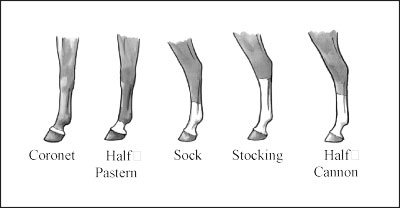
Figure 4: You can find a variety of white leg markings on horses.

Comments (15)

  1. Posted by Isabella
    What is the part inbetween the two front legs and hind legs where there is a scabby or bone like thing sicking out. I know that it is hereditary and people use it in big shows, but what is it called and what is it really there for?
  2. Posted by Amy
    I assume you are referring to the small bony knob on the inside of each leg. That is called the "chestnut". It no longer has a purpose- it was a toe on prehistoric horses.
  3. Posted by Morgan
    ew
  4. Posted by lauren
    ahh the chesnut question i allways get my mates with that and if you do have youre own horse what i do when i go to a show if its quite big ill pick it off but only when its wet and only the top layer :) pl go to www.ilovehorsesrocky.piczo.com
  5. Posted by KrYsTiN <3
    the chestnut.....yes....seems quite gross to those who do not understand the horse. I love how this refers to us horse ppl as "having a lnguahe of our own"....i find it hilarious when non-horse ppl try to join a conversation full of horse ppl :P
  6. Posted by Finlay
    Can white horses have snips, blazes, stripes or bald? And can they have the markings on the leg if they're white?
  7. Posted by gabriela
    hola me llamo gabriela consuelo.tengo 13 años y soy de venezuela busco novio de 13 en adelante cualquier informacion contactenme al gaby_sweet@hotmail.com
  8. Posted by gabrilla
    i got this test today abour horses and i dont know much about horeses so that is why i am on here to see what are the horses body parts are made for. and why do they need them. what they eat, where do they sleep, where are most horses live, what is the owerners name i am needind this so much so if any one can help me. can you please tell me all those things i would much love that lotsssssssssssssssssssssssssssss thank you teneka
  9. Posted by me
    wow i know this stuff
  10. Posted by rebeckar
    Most of my friends are horsey but it is sooo funny when a non horsey one joins the convo and goes ' ya know the bit here on the horse and the seat that goes on its back :L x
  11. Posted by miley
    cool
  12. Posted by Mee
    inoo iits funny init wen ppl sey summit bwt a horse and ur like watt haha ! :S x bt if u fink bwt it every1 who is in horses was like tht 1 dayy :)
  13. Posted by chloe
    im going to horse camp!!!!!!!!!!!!!!!!!!!!!!!!!!!!!!!!!!!!!!!!!!!!!!!!!!!!!!!!!
  14. Posted by jessica
    A chestnut is the "scabby thing" in between the legs. I came 2 this site because i needed help with parts of a horse for shows and what not...at my last show the judge started asking me questions and i didnt know what to say! =] so thank you this site has helped alot!
  15. Posted by jenny
    The image of the bottom of the hoof is very inaccurate. The part labelled "bars" is wrong, that is the collateral groove. The bars would be the part next to the CG and they should end half way down the frog - you have them extending all the way round the frog...

Leave a Reply


Post Comment
Advertisement

Grab a free widget and we'll bring interesting & helpful tips to your favorite personal page each day

Sign Up for RSS Feeds

Pets

Inside Dummies.com
