
How to Store Bareroot Roses before Planting
By The National Gardening Association, Bob Beckstrom, Karan Davis Cutler, Kathleen Fisher, Phillip Giroux, Judy Glattstein, Mike MacCaskey, Bill Marken, Charlie Nardozzi, Sally Roth, Marcia Tatroe, Lance Walheim, and Ann Whitman from Gardening All-in-One For Dummies
You’ll probably have to store bareroot roses for some time before you can plant them, particularly if you purchase them through the mail. The key is to keep the plants cool so that they don’t start growing and the roots moist so that they don’t dry out. Inspect bareroot roses, as soon as they arrive or you get them home. As long as plenty of moist packing surrounds the roots, you can store the plants in a cool (not freezing) place, such as a garage or basement, for a week to ten days (even longer if you have some empty refrigerator space). Keep the top of the plastic wraps open, the roots moist, and don’t store the roses in direct sunlight.
If you have to store the plants for more than ten days, your best bet is to completely unpack them and heel them in. Heeling in is a way to store bareroot roses by packing their roots in moist (not soggy) soil until planting time. Where and how you heel in your roses depends on how many roses you have and on the soil conditions outdoors.
If you have just a few roses, place them in a bucket or box and pack the roots and top third of the plant with moist sawdust, compost, peat moss, or soil. Store the whole thing in a cool (35° to 40°F or 1° to 4°C) place and check the packing often to make sure that it’s moist. Unpack the roses at planting time, being very careful not to do too much harm to the tiny root hairs that may have grown along the main roots.
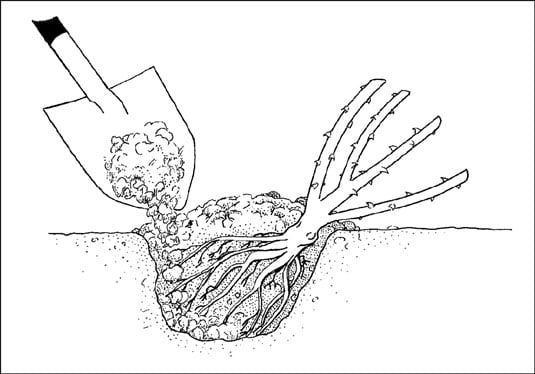
If you have to store multiple roses and can work the ground outdoors, dig a shallow trench (about a foot deep), slightly slanted on one side, in a shady area of the garden (such as the north side of the house). Lay the roses on a 45-degree angle and pack the roots and the bottom third of the plant with moist soil or compost. Check the packing often to make sure that it’s moist. Add water if necessary. Gently remove the roses from the trench at planting time.
Don’t keep roses heeled in much past the earliest planting time in your area because the plants start to develop fragile new roots and fragile new top growth, both of which you can damage when you start handling the plants.
Potted roses are easier to store until planting time. Just keep the soil moist, so that the plants don’t dry out. If you store growing roses for more than a week or two, you may want to fertilize them with a diluted liquid fertilizer, following the label instructions. Of course, you may want to grow your roses in pots or other containers. In this case, you can rest assured that you’ll need a bigger pot than the one in which you bought your rose.

Gardening Glossary
annuals
Plants that complete their entire life cycle within one growing season. The plant germinates from seed, grows and blooms, and then produces seed and dies.

Gardening Glossary
biennials
A plant that take two growing seasons to complete its life cycle. It germinates and grows leaves and stems in the first year; produces flowers and fruit (seed) in the second, and then dies.

Gardening Glossary
bolt
When a plant flowers or produces seed prematurely.

Gardening Glossary
cold frame
A wooden or concrete block box in which you can grow plants or hold dormant during the cold winter months.

Gardening Glossary
cole crops
A family of vegetables, including broccoli, cabbage, cauliflower, kale, and Brussels sprouts. They thrive in cooler weather.

Gardening Glossary
complete fertilizer
Any fertilizer that contains all three of the primary nutrients, N-P-K (nitrogen, phosphorus, potassium). Phrase is based on regulations governing the fertilizer industry. Does not mean that the fertilizer literally contains everything a plant needs to thrive.

Gardening Glossary
deadheading
The practice of pinching or cutting off spent flowers

Gardening Glossary
evaporative-pad humidifier
A humidifier in which fans blow across a moisture-laden pad that sits in a reservoir of water.

Gardening Glossary
harden off
The process of acclimating plants grown indoors gradually to the brighter light and cooler temperatures of the outside world.

Gardening Glossary
hardiness
The ability of a plant to survive is called its hardiness.

Gardening Glossary
humus
A stable end product of organic-matter decomposition that's believed to increase microbial activity in soil, improve soil structure, and enhance the root development of plants.

Gardening Glossary
Bacillus thuringiensis Bt
An effective bacteria that attacks only the larvae of caterpillar family insects. It is safe to other insects, animals, and humans.

Gardening Glossary
macronutrients
Mineral nutrients that plants need in the largest quantities: nitrogen, phosphorus, potassium, calcium, magnesium, and sulfur.

Gardening Glossary
mulch
Organic or inorganic material placed over the surface of soil, usually directly over the root zone of growing plants. Used to conserve moisture, kill weed seedlings, modify soil temperature, provide attractive covering to garden beds.

Gardening Glossary
organic matter
Once-living stuff like compost, sawdust, animal manure, ground bark, grass clippings, and leaf mold (composted tree leaves). Used to enrich soil and improve soil texture.

Gardening Glossary
perennials
Any plant with a life cycle of three or more years. Herbaceous (non-woody) perennials include flowering plants and herbs, mainly. Woody perennials include trees and shrubs. Longevity depends on the plant and growing conditions.

Gardening Glossary
pH
The measure of soil's acidity. Soil with low pH means it's too acidic; soil with high pH means it's alkaline. Most plants grow best in soil with a pH value between 6.5 and 7.2. Neutral soils measure 7.

Gardening Glossary
photosynthesis
The process through which plants take nutrients from the air and from the water in the soil to produce sugars that fuels the plant's growth.

Gardening Glossary
primary nutrients
Nitrogen, phosphorous, and potassium are the three nutrients plants need in the largest quantities.

Gardening Glossary
root crops
Plants with edible underground roots such as onions, carrots, beets, potatoes, turnips. Most root crops are cold-weather crops.

Gardening Glossary
self-blanching
A type of cauliflower with leaves that naturally curl over the head and exclude light. Requires cool temperatures for leaves to curl effectively.

Gardening Glossary
sets
Small onion bulbs, about 1/2-inch wide, that were started from seed the previous year. Grow onion sets with the pointy end up.

Gardening Glossary
side-dressing
The act of adding a small amount of fertilizer around or "on the side" of plants after they're growing.

Gardening Glossary
succession planting
Planting small, 2-to-4-foot patches of plants every two weeks throughout the growing season so that you can harvest a crop over an extended period of time.

Gardening Glossary
thinning
The act of cutting the least robust seedlings in your garden to give the healthier plants more room to grow.

Gardening Glossary
vining crops
Crops that grow on vines, such as cucumbers, melons, pumpkins, and winter squash. They usually require support (staking, trellising, etc.) to keep them off the ground.