
How to Maintain a Food Journal to Fight Belly Fat
Do you want to double the amount of weight and belly fat you lose? Keeping a food journal is a simple way to do it. Studies have shown that keeping a record of what you eat throughout the day can actually help you lose twice as much weight as someone who doesn’t.
There’s a good reason for this success: It’s easy to lose track of what you’re actually eating in a day, including the actual portions and the small snacks you grab on the run. So writing everything down keeps your intake in the forefront of your mind.
Research indicates that most folks underestimate their caloric intake by as much as 25 to 40 percent. This inaccuracy can have a dramatic effect on your waistline.
A food journal helps you really see what and how much you’re truly eating. It’s also a terrific way to make sure what you’re eating is balanced. It’s important that you’re eating the foods that help shrink belly fat on a regular basis. And how are you going to make sure you’re doing that? With a food journal, of course!
Keeping a food journal is easy and requires little time. You can keep a food journal in a number of ways. People use all sorts of methods, including computers, text messages, and cellphone applications. You can keep track whatever way works best for you as long as you make sure to follow a few simple rules. When keeping a food journal, always include each of the following items:
Time of the meal or snack eaten.
How hungry you were before eating and how full you were after. (Try using a rating scale from 1 to 10, with 1 being not hungry at all and 10 being famished.)
The location of where you ate, such as at home, at work, in the car, at a restaurant, and so on.
Any emotions you were experiencing before you ate, such as stress, frustration, and so on.
Everything you ate and drank as well as the portion of each food or beverage. (For example, don’t just write olive oil. Make sure you write 1 teaspoon of olive oil.)
Keeping track of your food intake helps you see whether you may be consuming too much or too little of a particular food group, whether you’re experiencing any sort of emotional eating, and whether you’re waiting too long and letting yourself get too hungry before eating.
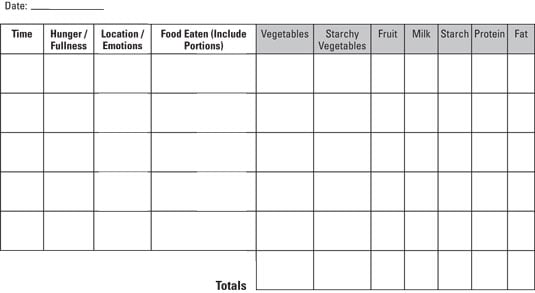
Here is an example of a food journal for weight loss clients. It allows you to track the time and location of your meal, your hunger and emotions, the portion size, and the food group your food or beverage falls into. You can copy it and easily keep it with you wherever you go.
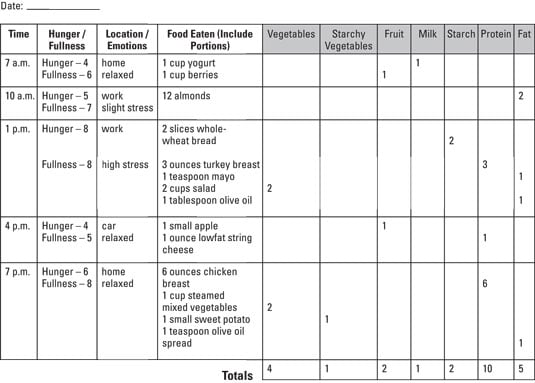
Following is an example of a completed journal so you can see how it works. After you complete your food journal, add up your totals to see whether you met your meal plan goals for the day or whether you need to work on certain areas so you can be more in line with your daily goals.
Fitness Glossary
aeroboxing, kickboxing
A class that takes the moves of a kickboxer’s training and choreographs them to music.

Fitness Glossary
anaerobic threshold
The point at which your body switches from using oxygen as its primary source of energy to using stored sugar. When you’re in poor physical shape, you hit your anaerobic threshold while exercising at relatively low levels of exercise.

Fitness Glossary
barbells
The larger weights (for power lifting in a weight training program) that include a long bar with weights added to each end. You need to use both hands to lift a barbell.

Fitness Glossary
Bioelectrical Impedance Analysis BIA
A method of measuring your body fat in which you lie on your back while a signal travels from an electrode on your foot to an electrode on your hand. The slower the signal, the more fat you have.

Fitness Glossary
blood pressure
A measurement of how open your blood vessels are. Low numbers mean that your heart doesn’t have to work very hard to pump the blood through your blood vessels.

Fitness Glossary
body composition
How much of your body is composed of fat and how much is composed of everything else. Your body composition is also called your body-fat percentage.

Fitness Glossary
body mass index BMI
A way of relating your height and weight to estimate how fat you are. You can use a simple formula to determine your BMI.

Fitness Glossary
body sculpting
A non-aerobic, muscle-toning class, usually focused on core strength.

Fitness Glossary
BOSU
A domed, flexible apparatus that helps to improve balance and can be used in a step aerobics exercise routine. BOSU is an acronym for Both Sides Utilized.

Fitness Glossary
cardio
A term (short for cardiovascular) that is often used interchangeably with aerobic. Aerobic exercise is any repetitive activity that you do long enough and hard enough to challenge your heart and lungs.

Fitness Glossary
chi
Otherwise known as "life energy," this is the life force that pulses through your body and keeps you vital. Blocked chi can cause sickness or unhappiness.

Fitness Glossary
circuit training
A fast-paced class or exercise routine in which you do one exercise for 30 seconds to 5 minutes and then move on to another exercise at the next station. Combines cardio exercise with strength training.

Fitness Glossary
core
The abdomen, obliques, lower back, butt, and so on, that form the midsection. Many forms of exercise focus on strengthening the body's core.

Fitness Glossary
core conditioning
A non-aerobic, muscle-toning class, usually focused on core strength.

Fitness Glossary
cross-training
A method of varying your workouts to take your fitness to the next level by adding new forms of training to your current routine.

Fitness Glossary
Dual-Energy X-ray Absorptiometry DEXA
A method of measuring your body fat that also determines where the fat is located on your body, a more relevant health indicator.

Fitness Glossary
dumbbells
Smaller weights (for a weight training program) that you can lift with one hand.

Fitness Glossary
elliptical trainer
The hottest trend in cardio machines, which is part stair-climber, part treadmill, part stationary cycle. Your legs travel in an elongated circular movement, and, on some models, you pump arm poles back and forth for an upper-body workout.

Fitness Glossary
exercise ball
A large plastic ball that is an excellent tool for doing challenging exercises (with or without weights) that require varying forms of strength and control.

Fitness Glossary
Fartlek
A type of interval training program that doesn't use an exact measure of time or distance. You just do your intervals whenever you feel like it. The term Fartlek means "speed play" in Swedish.

Fitness Glossary
fitness walking
A faster and more intense walking technique than casual (lifestyle) walking that burns more calories and helps you lose weight. When you fitness walk, you generally move along at a brisk pace of 3.5 to 4.3 miles an hour, covering a mile in 14 to 17 minutes.

Fitness Glossary
flexibility
The range of motion or distance you can move a joint through. Stretching is the key to maintaining your flexibility.

Fitness Glossary
free weights
Portable weights used in a strength training program.

Fitness Glossary
freestyle
The traditional type of swimming movement that uses the front crawl.

Fitness Glossary
heart rate
The number of times your heart beats per minute.

Fitness Glossary
high-impact aerobics
A traditional dance-inspired routine that involves jumping or hopping and moves at a slower pace than low-impact aerobics. High/low combines the two types of routines.

Fitness Glossary
in-line skating; Rollerblading
A type of skating in which you wear skates with urethane wheels that enable you to glide, sprint, curve, turn, and spin.

Fitness Glossary
interval training
A training technique in which you alternate short, fairly intense spurts of exercise with periods of relatively easy exercise.

Fitness Glossary
kickboxing; aeroboxing
A class that takes the moves of a kickboxer’s training and choreographs them to music.

Fitness Glossary
lifestyle walking
A casual walking technique that is low to moderate intensity and relatively slow paced. Most lifestyle walkers walk an average of 2.5 to 3.5 miles per hour, which means that they walk about 1 mile every 17 to 24 minutes.

Fitness Glossary
low-impact aerobics
A traditional dance-inspired routine in which you always have one foot on the floor — you don’t do any jumping or hopping. High/low combines the two types of routines.

Fitness Glossary
marathon
An organized 26.2-mile race for runners and walkers.

Fitness Glossary
maximum heart rate
The maximum number of times your heart should beat in a minute without dangerously overexerting yourself.

Fitness Glossary
meditation
A mental process involving focused attention, or calm awareness, which is also called mindfulness.

Fitness Glossary
mountain bike
A fat-tire outdoors bicycle with upright handlebars that is built to withstand rough terrain.

Fitness Glossary
multi-gym
A home gym contraption that looks like a bunch of health-club weight machines welded to each other.

Fitness Glossary
muscular failure
In a strength training program, the point at which your last repetition with weights is so difficult that you cannot perform another repetition.

Fitness Glossary
orthotics
Fitted shoe inserts designed by a podiatrist that correct weight distribution along the foot.

Fitness Glossary
periodization
A method of organizing a strength training workout program into several periods, each lasting about four weeks. Each phase has a different emphasis.

Fitness Glossary
Pilates
A form of exercise that emphasizes correct form using your body’s core. Pilates is named after its inventor, Joseph Pilates, who invented the technique for injured dancers.

Fitness Glossary
plantar fasciitis
An inflammation of the tough fibrous band of tissue that runs the length of the bottom of your foot.

Fitness Glossary
pulse
The number of times your heart beats per minute.

Fitness Glossary
Qigong
An element of a T'ai Chi practice that covers many different types of movements that involve using and feeling the body's energy.

Fitness Glossary
recumbent bike
A type of stationary bike with a bucket seat that provides back support so that you pedal straight out in front of you.

Fitness Glossary
repetition rep
One complete motion of an exercise, often used in reference to strength training.

Fitness Glossary
RICE
An acronym that stands for Rest, Ice, Compression, and Elevation — common treatment methods prescribed for runners with training injuries.

Fitness Glossary
road bike
The traditional type of outdoor bicycle with curved handlebars that is built for speed.

Fitness Glossary
rolling stair climber
A cardiovascular machine that resembles a section of a department-store escalator. A set of stairs rotates in a circle so that you climb continuously, but never getting anywhere.

Fitness Glossary
rowing machine
A cardiovascular machine that increases stamina, upper body endurance, strength, and flexibility by mimicking a rowing motion. Also called a rower.

Fitness Glossary
set
A group of consecutive repetitions in a strength training program.

Fitness Glossary
Spinning
A popular group studio cycling program invented by ultra-distance cyclist Johnny G. and licensed by Schwinn, which manufactures the bikes used in these classes.

Fitness Glossary
stair-climber
A cardiovascular machine that has two foot plates you pump up and down to mimic the action of climbing stairs. Also called a stepper.

Fitness Glossary
stationary bike
A cardiovascular machine that comes in two styles: upright bikes and recumbent bikes.

Fitness Glossary
step aerobics
A choreographed routine of stepping up and down on a rectangular, square, or circular platform.

Fitness Glossary
strength training
A type of workout that uses any combination of weight machines and free weights (dumbbells and barbells) to build muscle strength.

Fitness Glossary
stride frequency
The number of strides that a runner takes over a certain time period.

Fitness Glossary
studio cycling
Group exercise classes that are taught on stationary bicycles.

Fitness Glossary
T'ai Chi
An ancient martial art focusing on smooth, slow movements that cultivate inward focus and free energy flow. T'ai Chi is properly pronounced tie-jee.

Fitness Glossary
target heart-rate zone
A range that is between 50 percent and 85 percent of your maximum heart rate that can tell you what heart rate to aim for during a workout.

Fitness Glossary
treadmill
A popular choice for a cardiovascular machine in a home gym if you enjoy fitness walking and jogging (or running).

Fitness Glossary
upright bike
The traditional kind of stationary bike, which resembles a regular bicycle.

Fitness Glossary
walk-run
A workout in which you alternate walking and running. By sprinkling running intervals throughout your walking workout, you can spike up exercise intensity and burn more calories.

Fitness Glossary
water aerobics
Aerobics classes that do traditional workouts in waist- to neck-high water in a swimming pool. The resistance of the water makes the workout feel far more intense, while the water cushions you from the impact.

Fitness Glossary
weight machines
Stationary equipment mostly found at gyms that are easy to use and help you to safely and quickly advance through a strength-training workout.

Fitness Glossary
weight-bearing exercise
A type of exercise in which your skeleton is supporting any sort of weight, as it does when you walk, run, or lift weights.

Fitness Glossary
Wushu
The martial art or traditional self-defense activities practiced with or without weapons (includes T'ai Chi).

Fitness Glossary
yin and yang
The terms for opposites that are opposing yet complementary. A concept used throughout all of T’ai Chi and Qigong.

Fitness Glossary
yoga
A series of poses (known as asanas) that you hold from a few seconds to several minutes. The moves — a blend of strength, flexibility, and body-awareness exercises — are intended to promote the union of the mind, body, and spirit.