
How to Machine-Milk a Goat
Raising goats for milk is part of a green lifestyle. If you don't think your hands are strong enough to hand-milk your goats, you have a problem such as carpal tunnel, or milking your goats by hand just takes too long, consider getting a milking machine. Small-scale dairy goat farms use a bucket milk machine rather than one with a direct line into a bulk milk tank.
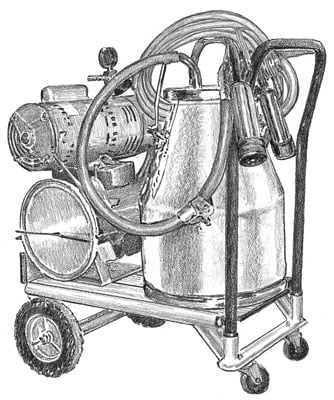
A bucket milking machine works well if you don't have a large number of goats to milk.
A milking machine is a combination of several components that work together to create a vacuum that draws milk from the teats, alternating with air, which causes the milk to flow into a container in a rhythmic fashion, similar to a kid nursing.
New ones are pretty expensive, but you can sometimes find a used one online for a reasonable price.
Like any skill, machine-milking takes practice. Try to find other goat owners who machine-milk so you can get an idea of what to expect from a milk machine and what using one entails.
Here are the steps for milking a goat with a milking machine:
Sanitize the milking machine with a sanitizer such as Clorox.
Turn the milking machine on and check that a vacuum is being created in each attachment before attaching the inflations to the doe.
Improper vacuum attachment can lead to mastitis. To check whether it is working effectively, listen to the machine for a hissing noise with the cluster vacuum shut off. If it is working properly, the hissing noise will decrease.
Secure the goat in the milk stand and give her some grain to eat.
Wash your hands.
Hand-milk one or two squirts from each teat into a cup.
This allows you to check for abnormalities and removes any milk close to the surface of the teat that is more likely to be contaminated with bacteria. If the milk is abnormal, dispose of it after milking.
Clean the udder and teats with warm water and soap, or sanitize with a wipe such as Milk Check Teat Wipes.
Thoroughly dry the udder and teats with a clean paper towel.
Never milk a wet udder; doing so can irritate the teats and lead to mastitis.
Place the teat cups of the machine on the goat's udder and then turn the vacuum on.
When the vacuum reaches the proper setting, the teat cups stay on the goat. You see milk begin to flow through the tubing to the container.
Remove the machine when you can no longer see a large volume of milk going through the tubing.
Make sure you keep an eye on the quantity. Over-milking can cause mastitis in machine-milked goats. The udder should shrink as you milk it, except during the first few days after kidding, when it may be swollen from the hormones released for kidding.
Hand-milk the last bit of milk to prevent disease and decreased milk production.
Milking the last bit of milk is called stripping.
Dip or spray the teats with a sanitizer such as Derma Sept Teat Dip.
If you use dip cups, use a clean one for each goat to avoid cross-contamination. If you spray the teats, make sure to thoroughly coat each teat end with spray.
Return the goat to the herd.
Make sure you have some fresh hay or alfalfa and fresh water available for the goat right after milking. She will eat and drink instead of lying down and exposing an open teat orifice to bacteria. The orifice gradually seals, protecting the goat from mastitis.
Clean the milking machine according to manufacturer's instructions.

Goat Glossary
abscess
An inflamed collection of pus caused by bacteria.

Goat Glossary
brood doe
A female goat that is kept for breeding purposes.

Goat Glossary

Goat Glossary
buckling
A young male goat.

Goat Glossary
cannon bone
The shin bone.

Goat Glossary
Caseous lymphadenitis CLA
A highly contagious disease caused by a bacterium, Cornybacterium pseudotuberculosis.

Goat Glossary
chaffhaye
Roughage that has the added benefit of containing good bacteria that aid in digestion.

Goat Glossary
chine
The are of a goat's spine directly behind the withers.

Goat Glossary
colostrum
A rich, immune-system-boosting fluid that kids need during their first days after birth.

Goat Glossary

Goat Glossary

Goat Glossary
doeling
A young female goat.

Goat Glossary
enterotoxemia
A disease also called overeating disease because it comes about when a goat eats too much grain, lush grasses, or milk.

Goat Glossary
escutcheon
The area between the back legs, where the udder lies in a doe.

Goat Glossary
foreudder attachment
Attachment of the front of the udder by the belly.

Goat Glossary
foundation stock
The stock you start your breeding program with.

Goat Glossary

Goat Glossary
fuzzy goat show
A goat show held in the early spring in a part of the country where the weather is still cold; you only need to do minimal clipping.

Goat Glossary
hypocalcemia
Often called milk fever, this is a deficiency of calcium in the blood that arises when a doe doesn’t get enough calcium in her diet to support her needs and the needs of her unborn kids.

Goat Glossary
ketosis
A metabolic imbalance that usually goes hand-in-hand with hypocalcemia. It is caused when a goat doesn’t get enough energy because she has stopped eating.

Goat Glossary
kid
A goat less than a year old.

Goat Glossary
mastitis
An inflammation of the udder, often caused by bacteria.

Goat Glossary
milk stand
A piece of equipment that a goat stands on with her head secured.

Goat Glossary
pannier
A pair of baskets or bags designed to carry loads on the backs of pack animals.

Goat Glossary
pasteurization
The heating of milk to destroy bacteria and other harmful organisms.

Goat Glossary
polled
Naturally hornless.

Goat Glossary
precocious milker
A doe that has udder development and milk production without kidding.

Goat Glossary
registered goat
A goat that meets the standards of appearance for its breed and is recorded in the herdbook of the goat association for that particular breed. A registered goat usually is a purebred but may be a crossbreed (called an American or an Experimental).

Goat Glossary
rolag
A cylindrical roll of wool or fleece that is used to spin yarn.

Goat Glossary
roving
A long strand of ready-to-spin carded fiber.

Goat Glossary
ruminant
An animal that has a stomach with four compartments and chews cud as part of the digestive process.

Goat Glossary
scours
The term that livestock owners use to talk about diarrhea in their animals.

Goat Glossary
sire
A goat's father; the act of fathering a goat.

Goat Glossary
stifle joint
The equivalent of a knee in a goat.

Goat Glossary
thurl
The hip joint, usually referred to in relation to the levelness between the thurls.

Goat Glossary
wether
A castrated male goat.

Goat Glossary
withers
The area of a goat's spine where the shoulder blades meet at the base of the neck.

Goat Glossary
yearling
A goat that is between one and two years old.