
How to Grow Orchids Under Artificial Light
Artificial light sources make it possible you to grow orchids without greenhouses or bright windowsills. You can grow any kind of orchid in artificial light. The cost of equipment and electricity are your only limitations.
Fluorescent lights
Fluorescent systems are the most accessible and economical lighting systems to buy. Three-tiered light carts are highly versatile and practical. Most of them are about 2 feet wide by 4 feet long, so their three shelves provide 24 square feet of growing area. If you grow compact orchids, this will be enough space to have at least one or more orchids in bloom year-round. If you collect miniatures, it will provide a growing space adequate for an entire collection. The convenience of such a cart can't be beat. You can place it in a heated garage, in a basement, or in a spare bedroom.
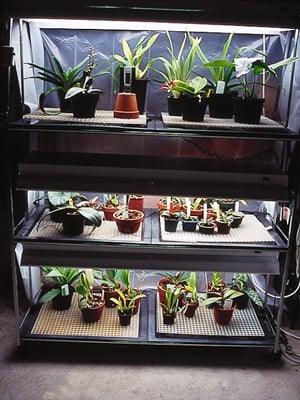
Use a fluorescent light system if your home lacks sufficient bright light for orchids.
When the orchids start to produce their tall orchid spikes, there usually isn't enough head room under most fixed-height light units to accommodate this growing spike. At that point, you can move the orchids to a windowsill or use a light fixture that can be raised as the flower spikes develop.
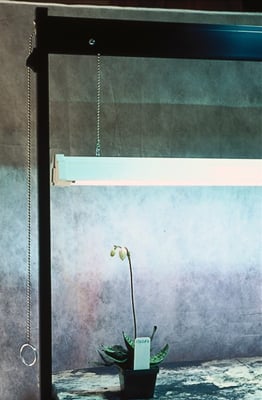
An adjustable light fixture like this one is very handy for accommodating developing flower spikes.
Which bulbs or lamps you should burn in your fixtures is a highly debated topic. Years ago, the only real choice was cool white and warm white tubes. Some people still feel that a 50/50 mix of these tubes is the best option, because they're bright and very inexpensive.
Over 40 years ago, Sylvania started manufacturing Gro-Lux tubes — designed to provide light that more closely reflected the spectrum of light that plants used in photosynthesis, the process that plants use to produce their own food. This started a new race to produce the "best" plant bulb. The evolution of lamps has gone from the Gro-Lux to wide-spectrum bulbs and now to full-spectrum bulbs. The light cast by the full-spectrum lamp is supposed to most closely resemble natural sunlight. Viewed under these lamps, colors of the flowers are rendered more accurately.
High-intensity-discharge lights
Newer to the artificial-light choices are high-intensity-discharge lights. These are very efficient in their production of light and are especially useful where you want to grow orchids requiring higher light intensities than fluorescent lamps can provide and/or where you want a greater working distance between the lights and plants.
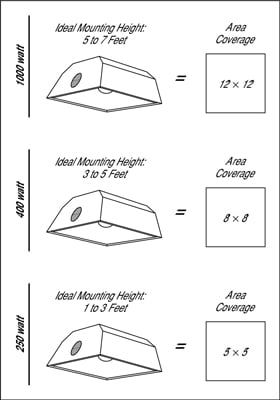
Approximate growing areas for different wattages of high-intensity-discharge lamps.
High-intensity-discharge lights do have the disadvantage of producing quite a bit of heat, so make sure not to get the plants too close to the bulbs.
The two most frequently used lamps for these systems are metal halide (MH) and high-pressure sodium (HPS). HPS is more energy-efficient than MH, but the light it emits is orange-yellow and distorts the color of the flowers and foliage. MH produces blue light that is more pleasing to the eye. Some manufacturers now produce lamps that combine the advantages of both.
Another newer option is the high-intensity compact fluorescent light. The fixtures for these look much like high-intensity-discharge (HID) units. They don't produce quite as much light as HID, but they have the advantage of producing little heat — so there is much less likelihood of orchids being burned.

Gardening Glossary
annuals
Plants that complete their entire life cycle within one growing season. The plant germinates from seed, grows and blooms, and then produces seed and dies.

Gardening Glossary
biennials
A plant that take two growing seasons to complete its life cycle. It germinates and grows leaves and stems in the first year; produces flowers and fruit (seed) in the second, and then dies.

Gardening Glossary
bolt
When a plant flowers or produces seed prematurely.

Gardening Glossary
cold frame
A wooden or concrete block box in which you can grow plants or hold dormant during the cold winter months.

Gardening Glossary
cole crops
A family of vegetables, including broccoli, cabbage, cauliflower, kale, and Brussels sprouts. They thrive in cooler weather.

Gardening Glossary
complete fertilizer
Any fertilizer that contains all three of the primary nutrients, N-P-K (nitrogen, phosphorus, potassium). Phrase is based on regulations governing the fertilizer industry. Does not mean that the fertilizer literally contains everything a plant needs to thrive.

Gardening Glossary
deadheading
The practice of pinching or cutting off spent flowers

Gardening Glossary
evaporative-pad humidifier
A humidifier in which fans blow across a moisture-laden pad that sits in a reservoir of water.

Gardening Glossary
harden off
The process of acclimating plants grown indoors gradually to the brighter light and cooler temperatures of the outside world.

Gardening Glossary
hardiness
The ability of a plant to survive is called its hardiness.

Gardening Glossary
humus
A stable end product of organic-matter decomposition that's believed to increase microbial activity in soil, improve soil structure, and enhance the root development of plants.

Gardening Glossary
Bacillus thuringiensis Bt
An effective bacteria that attacks only the larvae of caterpillar family insects. It is safe to other insects, animals, and humans.

Gardening Glossary
macronutrients
Mineral nutrients that plants need in the largest quantities: nitrogen, phosphorus, potassium, calcium, magnesium, and sulfur.

Gardening Glossary
mulch
Organic or inorganic material placed over the surface of soil, usually directly over the root zone of growing plants. Used to conserve moisture, kill weed seedlings, modify soil temperature, provide attractive covering to garden beds.

Gardening Glossary
organic matter
Once-living stuff like compost, sawdust, animal manure, ground bark, grass clippings, and leaf mold (composted tree leaves). Used to enrich soil and improve soil texture.

Gardening Glossary
perennials
Any plant with a life cycle of three or more years. Herbaceous (non-woody) perennials include flowering plants and herbs, mainly. Woody perennials include trees and shrubs. Longevity depends on the plant and growing conditions.

Gardening Glossary
pH
The measure of soil's acidity. Soil with low pH means it's too acidic; soil with high pH means it's alkaline. Most plants grow best in soil with a pH value between 6.5 and 7.2. Neutral soils measure 7.

Gardening Glossary
photosynthesis
The process through which plants take nutrients from the air and from the water in the soil to produce sugars that fuels the plant's growth.

Gardening Glossary
primary nutrients
Nitrogen, phosphorous, and potassium are the three nutrients plants need in the largest quantities.

Gardening Glossary
root crops
Plants with edible underground roots such as onions, carrots, beets, potatoes, turnips. Most root crops are cold-weather crops.

Gardening Glossary
self-blanching
A type of cauliflower with leaves that naturally curl over the head and exclude light. Requires cool temperatures for leaves to curl effectively.

Gardening Glossary
sets
Small onion bulbs, about 1/2-inch wide, that were started from seed the previous year. Grow onion sets with the pointy end up.

Gardening Glossary
side-dressing
The act of adding a small amount of fertilizer around or "on the side" of plants after they're growing.

Gardening Glossary
succession planting
Planting small, 2-to-4-foot patches of plants every two weeks throughout the growing season so that you can harvest a crop over an extended period of time.

Gardening Glossary
thinning
The act of cutting the least robust seedlings in your garden to give the healthier plants more room to grow.

Gardening Glossary
vining crops
Crops that grow on vines, such as cucumbers, melons, pumpkins, and winter squash. They usually require support (staking, trellising, etc.) to keep them off the ground.