How to Factor the Difference of Two Perfect Cubes
To factor the difference of two perfect cubes, remember this rule: The difference of two perfect cubes equals the difference of their cube roots multiplied by the sum of their squares and the product of their cube roots. The binomial expression looks like: a3 – b3 = (a – b)(a2 + ab + b2).
The results of factoring the difference of perfect cubes are
A binomial factor (a – b) made up of the two cube roots of the perfect cubes separated by a minus sign.
If the cube isn’t there, and the number is smaller than the largest cube on the list, then the number isn’t a perfect cube. For bigger numbers, use a scientific calculator and the cube root button.
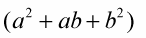
A trinomial factor (a2 + ab + b2) made up of the squares of the two cube roots added to the product of the cube roots in the middle.
The most well-known perfect cubes are those whose roots are integers, not decimals. Becoming familiar with and recognizing these cubes in an algebra problem can save time and improve accuracy. Variable cubes are relatively easy to spot because their exponents are always divisible by 3. When a number is cubed and multiplied out, you can’t always tell it’s a cube unless you memorize a list of the cubes.
Factor the difference between the cubes: 216 – 125.
Use the rule a3 – b3 = (a – b)(a2 + ab + b2) to find the variables.
216 is the a3; 125 is the b3.
The cube root of 216 is 6; the cube root of 125 is 5, so 6 is the a; 5 is the b.
Also, 36 is a2, 25 is b2, and 30 is the product ab.
Substitute the values into a3 – b3 = (a – b)(a2 + ab + b2).
216 – 125 = (6 – 5)(36 + 30 + 25).
Check to see if the equation is true.
The difference between 216 and 125 is 91.
Also, 36 + 30 + 25 = 91, and 6 – 5 = 1; then (1)(91) = 91
Whether the expression is the difference of the two cubes or the factored form, the answer comes out the same.
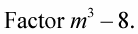
Factor m3 – 8, which has a variable.
Use the rule a3 – b3 = (a – b)(a2 + ab + b2) to find the variables.
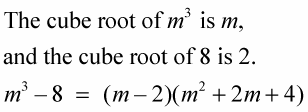
The cube root of m3 is m, and the cube root of 8 is 2.
Substitute the values into a3 – b3 = (a – b)(a2 + ab + b2).
m3 – 8 = (m – 2)(m2 + 2m + 4)
Notice that the sign between the m and the 2 is the same as the sign between the cubes. The square of m is m2 and the square of 2 is 4. The product of the two cube roots is 2m, and the signs in the trinomial are all positive.

Check to see if the equation is true.
(m – 2)(m2 + 2m + 4) =
(m× m2) + (m × 2m) + (m × 4) + (–2 × m2) + (–2 × 2m) + (–2 × 4) =
m3 + 2m2 + 4m + (–2m2) + (–4m) + (–8) =
m3 – 8 . . . You're right back where you started so you factored it correctly!

Algebra Glossary
π
The letter (pi) from the Greek alphabet refers to the ratio of the circumference of a circle to its diameter, which is approximately 3.14 or 22/7.

Algebra Glossary
absolute value
An operation that tells you how far a number is from zero.

Algebra Glossary
additive inverse
Number with the same numerical part but the opposite sign (plus or minus) of the given number. If zero is the sum of two numbers, then these two numbers are additive inverses of one another.

Algebra Glossary
area
Measure of a specified region in a plane.

Algebra Glossary
associative property
Characteristic of addition and multiplication that allows the grouping of terms to change without affecting the result.

Algebra Glossary
base
Value multiplied repeatedly in an exponential expression.

Algebra Glossary
binary operation
Process requiring two values to produce a third value.

Algebra Glossary
binomial
Two terms separated by addition or subtraction.

Algebra Glossary
braces
Grouping symbol that looks like this: { }.

Algebra Glossary
brackets
Grouping symbol that looks like this: [ ].

Algebra Glossary
circumference
Distance around the outside of a circle.

Algebra Glossary
coefficient
1. A number that multiplies a variable and tells how many of the variable. 2. The number preceding a variable.

Algebra Glossary
combinations
Method of counting that tells how many ways a designated number of objects can be selected from a given set.

Algebra Glossary
common denominator
Same value on the bottom of more than one fraction.

Algebra Glossary
commutative property
Characteristic of addition and multiplication that allows the order of the values in an operation to be changed without affecting the result.

Algebra Glossary
composite number
Whole number larger than 1 that isn’t prime.

Algebra Glossary
constant
Variable or number that never changes in value in an expression.

Algebra Glossary
coordinate
Part of an ordered pair that designates a point’s location on a coordinate plane.

Algebra Glossary
coordinate plane
Flat region determined by two intersecting, perpendicular, numbered lines called axes.

Algebra Glossary
cube; perfect cube
1. The third power of a number. 2. The result of multiplying a number by itself three times.

Algebra Glossary
cube root
Number that you can multiply by itself three times to get a given number. For example, the cube root of eight is two because two multiplied by itself three times equals eight.

Algebra Glossary
cubic
Adjective that describes an expression in which the highest power is three.

Algebra Glossary
decimal
Fraction with an unwritten denominator of 10 indicated by the decimal point

Algebra Glossary
degree of an angle
Number of degrees between 1 and 360 that comprise the measure of an angle.

Algebra Glossary
degree of an expression
Highest power occurring in the expression.

Algebra Glossary
denominator
Bottom number of a fraction.

Algebra Glossary
diameter
Longest distance across a circle.

Algebra Glossary
difference
Result of subtraction.

Algebra Glossary
digit
Numerals from zero through nine, so called because they were originally counted on the fingers.

Algebra Glossary
distributive property
Characteristic of multiplication and addition that allows for the multiplication of each individual term in a grouped series by a term outside of the grouping without changing the value of the expression.

Algebra Glossary
dividend
A number to be divided by another number.

Algebra Glossary
divisible
One number can be divided by another with no remainder.

Algebra Glossary
double root
Solution that appears twice when solving an equation because the related factor appears twice in the factored form. For example, in (y – 2)(y – 2) = 0, y = 2 is a double root or solution. In (y – 2)(y – 2)(x + 3) = 0, y = 2 is still a double root or solution.

Algebra Glossary
equation
Mathematical statement with an equal sign showing that two values are equal.

Algebra Glossary
equivalent fractions
Fractions equal to one another, even though they may have different denominators. (Example: 3/4 and 75/100)

Algebra Glossary
even number
A number that can be divided or is divisible by 2.

Algebra Glossary
exponent; power
Value in smaller type found above and to the right of the base that indicates the number of times the base is multiplied by itself.

Algebra Glossary
expression
Combination of values (variables, numbers, and/or constants) and operation(s).

Algebra Glossary
factor
1. (noun) Any of the values involved in a multiplication problem that when multiplied together produces a result. 2. (verb) To rewrite an algebraic expression as a product.

Algebra Glossary
factorial
Operation that multiplies a whole number by every counting number smaller than it.

Algebra Glossary
FOIL
1. Acronym for first, outer, inner, and last — which indicates the order in which two terms (one from each of two binomials) are multiplied together. 2. The process of multiplying two binomials.

Algebra Glossary
fraction
Any quantity expressed as a numerator (the value above the bar) and a denominator (the value below the bar).

Algebra Glossary
fraction line
Line separating the numerator from the denominator.

Algebra Glossary
graph
Plotted figure in a plane.

Algebra Glossary
greatest common factor; GCF
Largest possible value that evenly divides each term of an expression containing two or more terms.

Algebra Glossary
grouping symbol
Parentheses, brackets, and braces that can affect the order of operations. Terms and operations within the grouping symbol take precedence.

Algebra Glossary
groups
Terms and operations within grouping symbols.

Algebra Glossary
hypotenuse
Longest side of right triangle.

Algebra Glossary
improper fraction
A fraction whose numerator is larger than the denominator.

Algebra Glossary
inequality
Relationship between two unequal values.

Algebra Glossary
infinite
Without end; uncountable, as in a repeating decimal

Algebra Glossary
integer
A positive or negative whole number or zero; numbers starting with zero and going up or down in increments of one.

Algebra Glossary
intercept
Point where a graph crosses the x-axis or y-axis.

Algebra Glossary
intersection
Point shared by two lines.

Algebra Glossary
irrational number
Number with no fractional equivalent whose decimal never repeats or terminates.

Algebra Glossary
line
All the points in the coordinate plane that satisfy a linear equation.

Algebra Glossary
linear
Adjective describing expression or equation in which the highest power of any variable is one. Constants can be higher powers. For example, x + y = 4 is linear.

Algebra Glossary
lowest terms
Status of a fraction whose numerator and denominator cannot be divided evenly by the same number. A fraction with a numerator of 12 and a denominator of 25 is in lowest terms.

Algebra Glossary
mixed number
Improper fraction written as a whole number alongside a fraction.

Algebra Glossary
monomial
An expression with only one term.

Algebra Glossary
multiple
A number evenly divisible by a specific factor. Example, 14 and 21 are multiples of 7.

Algebra Glossary
multiplication property of zero (MPZ)
Rule stating if the product of two numbers is zero, then one of the numbers must be zero.

Algebra Glossary
multiplier
An integer multiplied with both the numerator and denominator of a fraction.

Algebra Glossary
natural numbers; counting numbers
Values starting with 1 and increasing by 1.

Algebra Glossary
negative number
Any quantity that is less than zero; usually preceded by a minus sign.

Algebra Glossary
negative reciprocals
Two numbers, one positive and one negative, whose product is negative one.

Algebra Glossary
nested
When two or more grouping symbols are inside one another, such as {32[4 × 2(2 + 5)]}.

Algebra Glossary
number system
A set of numbers.

Algebra Glossary
numerator
The top number in a fraction.

Algebra Glossary
odd number
A whole number that is not evenly divided by 2.

Algebra Glossary
operation
Mathematical process, such as addition, subtraction, multiplication, and division, performed on one or more quantities.

Algebra Glossary
ordered pair
Two values inside parentheses and separated by a comma that indicate the position of a point in the coordinate plane.

Algebra Glossary
origin
Point of intersection of the x-axis and y-axis in a coordinate plane.

Algebra Glossary
parallel lines
Lines that never intersect and are always the same distance apart.

Algebra Glossary
percent
Fractions with a denominator of 100. The percentage is the numerator of the fraction — how many out of 100.

Algebra Glossary
perimeter
Total distance around the outside of a region or area.

Algebra Glossary
permutation
Counting method that determines the number of ordered arrangements there are when a certain number of objects are selected from a given set.

Algebra Glossary
perpendicular lines
Lines that form a 90-degree angle at their intersection.

Algebra Glossary
pi
The letter (π) from the Greek alphabet refers to the ratio of the circumference of a circle to its diameter, which is approximately 3.14 or 22/7.

Algebra Glossary
polynomial
Expression with one or more terms.

Algebra Glossary
positive number
Any quantity greater than zero.

Algebra Glossary
power of zero
Any number raised to the power of zero equals 1 as long as the base number isn’t zero.

Algebra Glossary
prime factor
A prime number that evenly divides the number you’re working on.

Algebra Glossary
prime factorization
Process of finding the prime numbers that, when multiplied together, produce a given composite number.

Algebra Glossary
prime number
Whole number larger than the number 1 that can be divided evenly only by itself and 1.

Algebra Glossary
principal square root
Positive number that when multiplied by itself produces a given positive number. For example, the square roots of 25 are 5 and −5, but the principal square root of 25 is only 5.

Algebra Glossary
product
The result of multiplication.

Algebra Glossary
proper fraction
Fraction whose value is less than 1. The numerator is always smaller than the denominator.

Algebra Glossary
proportion
Equation showing that two ratios are equal to one another.

Algebra Glossary
Pythagorean theorem
Formula specific to right triangles stating that the hypotenuse (c) squared is equal to the sum of the squares of the remaining sides (a and b): a2 + b2 = c2.

Algebra Glossary
quadrant
One of four regions in a coordinate plane defined by the x-axis and the y-axis.

Algebra Glossary
quadratic
Also known as second degree, expression or equation in which the highest power is 2. The degree is 2.

Algebra Glossary
quotient
Result of division.

Algebra Glossary
radical
Symbol for the operation to find a square root.

Algebra Glossary
radius
Distance from the center of a circle to its outer edge; half its diameter.

Algebra Glossary
raised to the power of
Multiplying a base number the number of times indicated by the exponent. For example, 5 is being raised to the power of 3 in expression 53.

Algebra Glossary
rational number
Quantity, positive or negative, that can be written as a fraction; its decimal equivalent terminates or repeats.

Algebra Glossary
real number
Any rational or irrational number.

Algebra Glossary
reciprocal; multiplicative inverse
1. Two numbers whose product is always 1, such as 3 × 1/3 and 0.25 × 4. 2. Either one of the two numbers in a reciprocal. Example: 3 is the reciprocal of 1/3; and 1/3 is the reciprocal of 3.

Algebra Glossary
rectangle
Four-sided plane figure with all right angles; its opposite sides are equal to one another in length.

Algebra Glossary
reduce
Process in which a common factor of the numerator and denominator of a fraction is divided out, leaving an equivalent fraction.

Algebra Glossary
relatively prime
Two numbers that have no factors in common other than the number 1.

Algebra Glossary
remainder
Value that is left over when one number is divided by another.

Algebra Glossary
repeating decimal; recurring decimal
A decimal in which beyond a certain point a digit or set of digits repeats indefinitely. (Example: 3.3333
and 3.1787878
) Rounding off results in an estimated or approximate value.

Algebra Glossary
right angle
90-degree angle.

Algebra Glossary
right triangle
Three-sided plane figure with a 90-degree angle (right angle).

Algebra Glossary
root
Value that multiplied by itself a number of times results in the value or number wanted, such as 2 is the root of 4, because 2 multiplied by itself produces 4.

Algebra Glossary
rounding off
Approximating the value to the nearest digit or decimal place, such as rounding 14.9 up to 15.

Algebra Glossary
scientific notation
A standard way of writing very large and very small numbers as the product of two values — a number between 1 and 19 and a power of 10. Scientific notation follows the form N × 10a where N is a number from 1 up to 10, but not 10 itself, and a is an integer (positive or negative number).

Algebra Glossary
semiperimeter
Half the perimeter.

Algebra Glossary
sign
Symbol indicating whether a value is positive (+) or negative (−).

Algebra Glossary
simple fraction
A fraction in which both the numerator and the denominator are whole numbers.

Algebra Glossary
simplify
To combine all that can be combined and put an expression in its most easily understandable form.

Algebra Glossary
slope
Number indicating the measure of a line’s steepness or slant and whether it rises or falls.

Algebra Glossary
solution of equation
Value(s) of the variable that make the equation a true statement.

Algebra Glossary
solve
Find the answer or what number the variable stands for.

Algebra Glossary
square; perfect square
1. Product of another number times itself. 2. Value with an exponent of 2.

Algebra Glossary
square root
Value resulting in a given value when multiplied by itself. For example, the square root of 4 is 2, because 2 ×2 = 4, which is a perfect square.

Algebra Glossary
substitution
Method of replacing a value with its equivalent.

Algebra Glossary

Algebra Glossary
symmetric property
Characteristic of equations that allows for the exchange of the value(s) on one side of the equal sign with the value(s) on the other side (quantities on the right go to the left; quantities on the left go to the right) without changing the truth of the equation: If x = y, then y = x.

Algebra Glossary
synthetic division
Short-cut division process in which only the coefficients of the terms in an expression are used. The answer is obtained by multiplying and adding.

Algebra Glossary
term
Group of number(s) and/or variable(s) connected to one another by multiplication or division and separated from other terms by addition or subtraction.

Algebra Glossary
trinomial
Expression with three terms. Each term is separated from the others by addition or subtraction.

Algebra Glossary
unFOIL
To factor a trinomial into two binomials

Algebra Glossary
value
A numeric equivalence or worth of an expression or variable.

Algebra Glossary
variable
Letter representing an unknown number or what you’re solving for in an algebra problem.

Algebra Glossary
vertex
Corner of a figure; where two sides intersect to form an angle.

Algebra Glossary
volume
Measurement of the amount of space within a three-dimensional solid figure.

Algebra Glossary
whole numbers
All natural numbers plus zero. Start with zero and add one repeatedly to find the whole number spectrum (0, 1, 2, 3 . . . ).
Comments (0)
Leave a Reply