
How to Express Superlatives and Make Comparisons with American Sign Language
In English, you sometimes form words that compare by adding endings, such as est or er. In American Sign Language (ASL), you can't really sign comparatives and superlatives. For example, greatest is signed simply as GREAT, and happier is signed HAPPY.
However, you can compare objects another way, using sign. After you decide which base word you want to use, sign it and then add one of the words from this table — whichever one is the most appropriate.
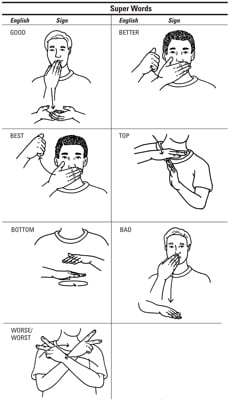
These sentences provide examples of signing superlatives:
English: His coat is the warmest.
Sign: HIS COAT — WARM — TOP
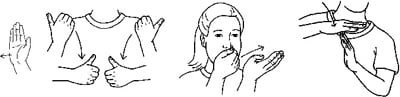
English: Your shoes are the ugliest.
Sign: YOUR SHOES — UGLY — WORST
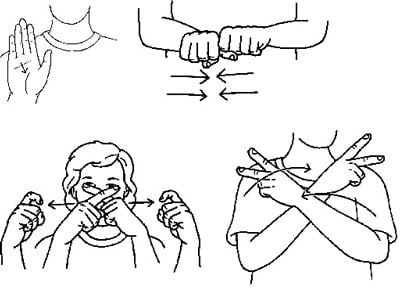
Comparing costs is a pretty common thing to do. Here’s how to sign the better bargain:
If you’re at the store, you can always point to what you’re referring to; this way, you can avoid fingerspelling.
To sign that you found the cheapest or most expensive item, simply sign CHEAP or EXPENSIVE, and then sign the word TOP. You can also sign CHEAP or EXPENSIVE, and then sign BETTER.

Language Phrases Glossary
accusative case
When noun or pronoun is the direct object of the verb of the sentence, you are required to switch to the accusative case ending.

Language Phrases Glossary
dative case
When noun or pronoun is the indirect object of the verb of the sentence, you are required to switch to the dative case ending.

Language Phrases Glossary
genitive case
When the noun or pronoun indicates possession, you are required switch to the genitive case ending.

Language Phrases Glossary
instrumental case
A Russian grammatical term that indicates that the noun or pronoun assist in the carrying out of an action, you are required to switch to the accusative case ending.

Language Phrases Glossary
interrogative
Words used to ask questions, such as who, what, when, where, and why.

Language Phrases Glossary
macron
A small, horizontal mark above the vowel that indicates a long vowel sound. Make the vowel sound like its name.

Language Phrases Glossary
nominative case
When noun or pronoun is the subject of the sentence, you are required to switch to the nominative case ending.

Language Phrases Glossary
prepositional case
A grammatical case that indicates that the noun or pronoun is the object of a preposition, you are required to switch to the accusative case ending. Used with the Russian prepositions: v (v; in), na (nah; on), o (oh; about), and ob (ohb; about).