How to Discuss Articles of Clothing in American Sign Language
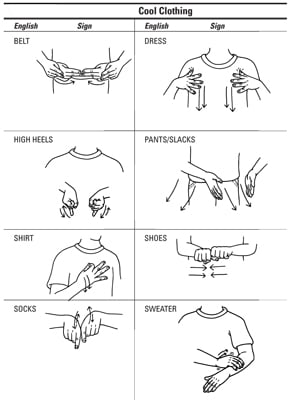
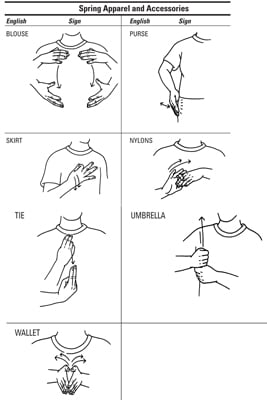
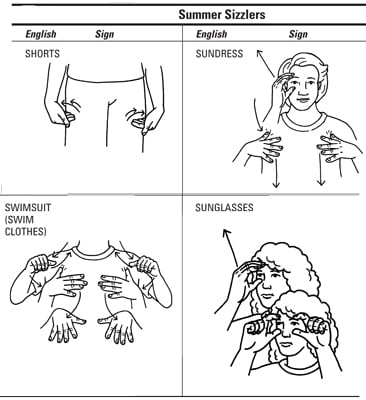
Whether you're signing about doing laundry or buying new clothes, you may need to know how to identify items of clothing in American Sign Language (ASL). These signs show you how to refer to clothing in any season.
Signs for underwear
It’s time to go under cover. Most of these signs are signed to look like what they represent. Anything slinky or kinky is fingerspelled. Take a look at this table for how to sign about your underwear.
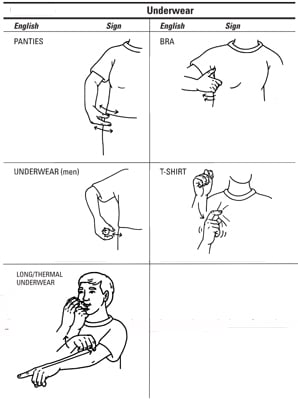
Men’s briefs can be signed like panties; men’s boxers can be, too.
Signing about all kinds of garments
Regardless of the season, you can use these signs to describe what you're wearing (or what someone else is wearing).
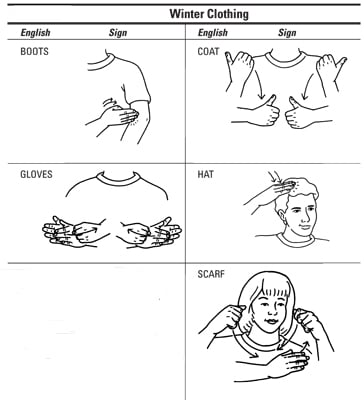
There are a variety of signs for gloves because there are different kinds of gloves. Either way, mimic putting on a pair of gloves. Mittens can be signed by making an outline of your thumb and four fingers with the index finger of your passive hand. Mittens are not as common as gloves, so if people don’t understand you, you can always rely on fingerspelling.
A two-piece swimsuit for women is signed like bra and panties; a one-piece swimsuit is signed one piece. Men’s swimming trunks are fingerspelled, or you can sign shorts. But if you’re talking Speedos, sign it like panties.

Language Phrases Glossary
accusative case
When noun or pronoun is the direct object of the verb of the sentence, you are required to switch to the accusative case ending.

Language Phrases Glossary
dative case
When noun or pronoun is the indirect object of the verb of the sentence, you are required to switch to the dative case ending.

Language Phrases Glossary
genitive case
When the noun or pronoun indicates possession, you are required switch to the genitive case ending.

Language Phrases Glossary
instrumental case
A Russian grammatical term that indicates that the noun or pronoun assist in the carrying out of an action, you are required to switch to the accusative case ending.

Language Phrases Glossary
interrogative
Words used to ask questions, such as who, what, when, where, and why.

Language Phrases Glossary
macron
A small, horizontal mark above the vowel that indicates a long vowel sound. Make the vowel sound like its name.

Language Phrases Glossary
nominative case
When noun or pronoun is the subject of the sentence, you are required to switch to the nominative case ending.

Language Phrases Glossary
prepositional case
A grammatical case that indicates that the noun or pronoun is the object of a preposition, you are required to switch to the accusative case ending. Used with the Russian prepositions: v (v; in), na (nah; on), o (oh; about), and ob (ohb; about).