

How to Change the Look of Images in Word for Mac Documents
Microsoft Word 2008 for Mac is, of course, a word processor, but it also offers you some control over how you can make images look in your documents. Using Word’s basic tools, you can change the size and appearance of images you insert into your documents.
1
To modify an image in your document, click the image in your document to select it.
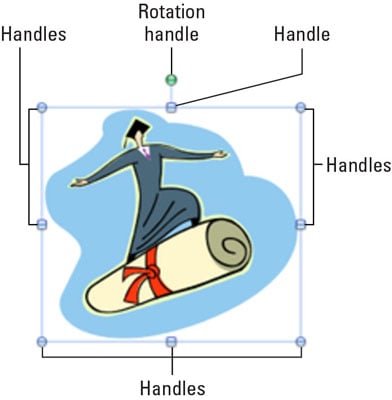
When an image is selected, it displays handles on each corner and in the middle of each side. It also displays a green rotation handle that extends from the middle handle on the top side.
2
Click and drag any of the handles to stretch or shrink your image.
If you drag a corner handle, the aspect ratio remains the same, and the height and width change simultaneously. If you drag one of the handles in the middle of a side, the image stretches or shrinks in that direction only. You can make additional image modifications in the Format Picture dialog.
3
With the image you want to modify still selected, choose Format→Picture.
Or you can double-click the image to open it. Either way, the Format Picture dialog appears.
4
Select your image and click the screen you want from the list on the left.
The Format Picture dialog offers 11 different screens: Fill, Line, Shadow, Glow & Soft Edges, Reflection, 3-D Format, 3-D Rotation, Picture, Text Box, Size, and Layout. Not all of these screens are appropriate for all pictures. So, don’t be alarmed if some of them don’t appear to do anything to your image.
5
Continue making your changes until you’re finished and then click OK.
The changes made in the Format Picture dialog are displayed immediately.

Macs and OS X Glossary
Address Book
The place for addresses, phone numbers, and e-mail addresses on the Mac. You can also add a picture and note about the person.

Macs and OS X Glossary
Bluetooth
A short-range wireless technology that lets your Mac communicate with other compatible gadgets, from up to 30 feet away.

Macs and OS X Glossary
ColorSync
A printer setting that lets you add black and white, blue tone, sepia, or other filters.

Macs and OS X Glossary
Dashboard
A translucent screen that lays on top of your desktop and houses clever little applications called widgets.

Macs and OS X Glossary
desktop
The whole of your Mac’s computer screen. Also called the Finder.

Macs and OS X Glossary
Discoverable mode
Helps other Bluetooth devices find your Mac.

Macs and OS X Glossary
Dock
The colorful bar on the bottom of the Mac screen. It’s a rough cross between the Windows taskbar and the Start menu.

Macs and OS X Glossary
double-clicking
Left-clicking twice in rapid succession while keeping the cursor in the same location.

Macs and OS X Glossary
dragging
Positioning the cursor on top of a symbol or icon and then holding down the mouse button and rolling the mouse across your desk, which moves the symbol or icon to a new location.

Macs and OS X Glossary
Exposé
A Mac feature that, with a click of a button, organizes your Mac desktop.

Macs and OS X Glossary
FileVault
A Mac feature that automatically scrambles, or encrypts, the data in your Home folder.

Macs and OS X Glossary
FireWire
A speedy connector often used with digital cameras.

Macs and OS X Glossary
function keys
Housed on the top row of the Mac keyboard, the keys with the letter F followed by a number.

Macs and OS X Glossary
iCal
The Mac’s built-in calendar.

Macs and OS X Glossary
iDVD
The application that lets you burn movies onto a disk.

Macs and OS X Glossary
iMac
A Mac desktop computer.

Macs and OS X Glossary
iPhoto
The application where you store and touch up digital images.

Macs and OS X Glossary
iSync
The application that keeps your calendar, Address Book, and Internet bookmarks synchronized across multiple devices.

Macs and OS X Glossary
iTunes
Apple’s renowned musical jukebox.

Macs and OS X Glossary
iWeb
The tool that lets you create personal Web sites, blogs, and podcasts.

Macs and OS X Glossary
Mac Mini
Apple’s budget desktop computer. Weighing less than 3 pounds, it’s portable, but not in the same sense as a notebook.

Macs and OS X Glossary
Mac OSx
The operating system that Apple included with all new Mac computer systems since 2002.

Macs and OS X Glossary
Mac Pro
A Mac desktop intended for professionals facing demanding graphics and other computing tasks. Its arrival completed the transition of the Mac line to Intel processors.

Macs and OS X Glossary
MacBook Air
Apple’s super-thin Mac. Encased in aluminum with a 13.3-inch display, Air measures just 0.16 inches at its skinniest point and just 0.75 inches at its thickest. But it still boasts a full-size keyboard and very good battery life.

Macs and OS X Glossary
MacBook, MacBook Pro
Apple’s successor to the PowerBook.

Macs and OS X Glossary
Mail
Apple’s built-in calendar.

Macs and OS X Glossary
MobileMe
The application that keeps your e-mail, contacts, and calendar synchronized, no matter what device you’re using.

Macs and OS X Glossary
operating software
The software that makes a Mac work.

Macs and OS X Glossary
parental controls
Safety features that let you place limitations on your child’s computer use.

Macs and OS X Glossary
phishing
A form of Internet fraud where identity thieves, posing as a respectable financial or Internet company, tries to dupe you into clicking phony links to verify personal or account information.

Macs and OS X Glossary
Safari
The Mac’s Web browser.

Macs and OS X Glossary
Smart Groups
A way to group contacts in your Address Book.

Macs and OS X Glossary
Smart Mailboxes
Searches for e-mail that matches specific search criteria.

Macs and OS X Glossary
Spotlight
The Mac’s search technology.

Macs and OS X Glossary
trackpad
The smooth surface below your Mac keyboard that’s your laptop’s answer to using a mouse.

Macs and OS X Glossary
USB port
The place on your Mac where you plug in devices you want to connect, such as printers, scanners, digital cameras, and more.

Macs and OS X Glossary
Voiceover
A screen reader designed to make using a Mac easier by speaking the contents of the screen.

Macs and OS X Glossary
wireless network
A network that isn’t connected by wires but uses radio waves, instead.
Comments (0)
Leave a Reply