
How to Change Mac’s Keyboard and Mouse Preferences
Mac OS X Snow Leopard gives you control over your keyboard preferences and how your mouse functions. Setting these preferences can help you get your system working just right for you. You Access these preferences via the system Preferences icon on the Dock.
The Keyboard preferences panel has two tabs:
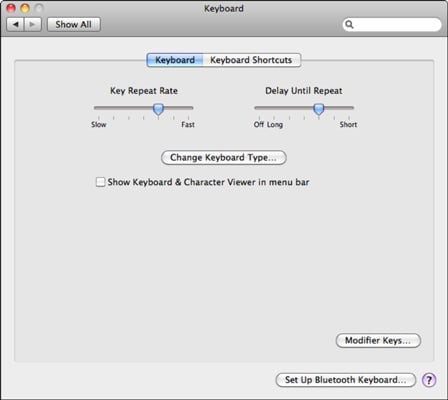
Keyboard: Move the Key Repeat Rate slider to alter the rate at which a keystroke repeats. You can also adjust the Delay until Repeat slider to alter how long a key must be held down before it repeats. If you change your keyboard, you can always run the Keyboard Setup Assistant by clicking the Change Keyboard Type button; you can also set up a wireless Bluetooth keyboard from this pane.
Laptop owners (as well as Mac owners with newer Apple keyboards) can set the F1–F12 keys for applications by enabling the Use the F1–F12 Keys to Control Software Features check box. If you enable this feature, you have to hold down the Function (or Fn) key while pressing the F1 through F12 keys to use the regular hardware keys.
If you have a MacBook Pro, you can choose to turn the ambient keyboard lighting on and off from this pane, or turn off keyboard lighting after an inactivity delay that you set.
Keyboard Shortcuts: If you’re a power user who appreciates the lure of the keyboard shortcut, you can edit your shortcuts here.
Looking for even more keyboard customizing possibilities? Select the All Controls radio button on the Keyboard Shortcuts pane to see additional keys to use.
The Mouse preferences pane has three tabs:
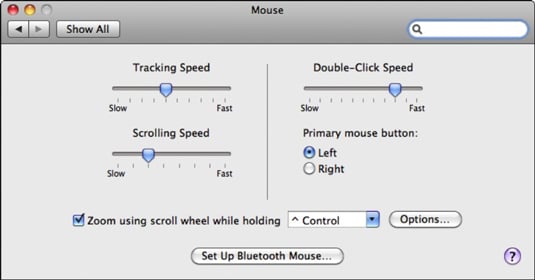
Mouse: Drag the Tracking Speed slider to determine how fast the mouse tracks across your Desktop. You can also drag the Double-Click Speed slider to determine how fast you must click your mouse to cause a double-click. Drag the Scrolling Speed slider to specify the rate at which the contents of windows will scroll.
Lefties might want to change the primary mouse button for aftermarket pointing devices. You can also zoom the display with your Mighty Mouse scroll ball while holding down the key of your choice — a great option for image editing. To install a wireless Bluetooth mouse, click the Set Up Bluetooth Mouse button, which runs the Bluetooth device Set Up assistant.
(Optional) Trackpad: This tab is available only to Mac laptop owners, allowing this elite crowd to customize the tracking speed and double-click speed for their trackpads. You can also set your MacBook’s trackpad for two-fingered scrolling (vertical and horizontal) and two-fingered zooming. You can also enable clicking and right-clicking by using the trackpad.
Leaving the Ignore Accidental Trackpad Input check box enabled prevents spurious movements and clicks and, if you use a mouse with your laptop, you can elect to disable the trackpad while the mouse is connected. This helps to prevent accidental copies or moves within a Finder window!
(Optional) Bluetooth: If you’re using a wireless Bluetooth mouse or keyboard, you can check the battery level on these devices from this panel. You can also specify whether your Bluetooth keyboard or mouse wakes your Mac from sleep mode. If you don’t have a Bluetooth card or external adapter, this tab doesn’t appear.

Macs and OS X Glossary
802.11x wireless
A protocol for connections to your Ethernet network and your Apple TV unit.

Macs and OS X Glossary
Address Book
The place for addresses, phone numbers, and e-mail addresses on the Mac. You can also add a picture and note about the person.

Macs and OS X Glossary
alias
A pointer to another application of folder.

Macs and OS X Glossary
Bluetooth
A short-range wireless technology that lets your Mac communicate with other compatible gadgets, from up to 30 feet away.

Macs and OS X Glossary
ColorSync
A printer setting that lets you add black and white, blue tone, sepia, or other filters.

Macs and OS X Glossary
cookie
A small file that a web site automatically saves on your hard drive. It contains information that the site will use on your future visits. For example, a site might save a cookie to preserve your site preferences for the next time or ¯ in the case of a site such as Amazon.com ¯ to identify you automatically and help customize the offerings that you see.

Macs and OS X Glossary
Dashboard
A translucent screen that lays on top of your desktop and houses clever little applications called widgets.

Macs and OS X Glossary
desktop
The whole of your Mac’s computer screen. Also called the Finder.

Macs and OS X Glossary
Discoverable mode
Helps other Bluetooth devices find your Mac.

Macs and OS X Glossary
Dock
The colorful bar on the bottom of the Mac screen. It’s a rough cross between the Windows taskbar and the Start menu.

Macs and OS X Glossary
double-clicking
Left-clicking twice in rapid succession while keeping the cursor in the same location.

Macs and OS X Glossary
dragging
Positioning the cursor on top of a symbol or icon and then holding down the mouse button and rolling the mouse across your desk, which moves the symbol or icon to a new location.

Macs and OS X Glossary
driver
A software program provided by the printer manufacturer that tells Mac OS X how to communicate with your printer.

Macs and OS X Glossary
Dynamic Host Configuration Protocol; DHCP
A protocol that enables a computer to automatically get connection information for communicating with a network or your ISP.

Macs and OS X Glossary
Exposé
A Mac feature that, with a click of a button, organizes your Mac desktop.

Macs and OS X Glossary
FileVault
A Mac feature that automatically scrambles, or encrypts, the data in your Home folder.

Macs and OS X Glossary
Finder
The application that Mac OS X runs to display the operating system’s menus and windows.

Macs and OS X Glossary
FireWire
A speedy connector often used with digital cameras.

Macs and OS X Glossary
FTP
Part of the TCP/IP protocol suite; (the hoary acronym FTP stands for File Transfer Protocol. FTP is one of the oldest methods for sharing files between computers

Macs and OS X Glossary
function keys
Housed on the top row of the Mac keyboard, the keys with the letter F followed by a number.

Macs and OS X Glossary
iCal
The Mac’s built-in calendar.

Macs and OS X Glossary
iDVD
The application that lets you burn movies onto a disk.

Macs and OS X Glossary
iMac
A Mac desktop computer.

Macs and OS X Glossary
iPhoto
The application where you store and touch up digital images.

Macs and OS X Glossary
iSync
The application that keeps your calendar, Address Book, and Internet bookmarks synchronized across multiple devices.

Macs and OS X Glossary
iTunes
Apple’s renowned musical jukebox.

Macs and OS X Glossary
iWeb
The tool that lets you create personal Web sites, blogs, and podcasts.

Macs and OS X Glossary
Lightweight Directory Access Protocol; LDAP
With LDAP, you can search a central company directory from anywhere in the world as long as you have an Internet connection.

Macs and OS X Glossary
Lightweight Extensible Authentication Protocol
An encryption protocol developed by Cisco Systems for superior security in the business world.

Macs and OS X Glossary
Mac Mini
Apple’s budget desktop computer. Weighing less than 3 pounds, it’s portable, but not in the same sense as a notebook.

Macs and OS X Glossary
Mac OSx
The operating system that Apple included with all new Mac computer systems since 2002.

Macs and OS X Glossary
Mac Pro
A Mac desktop intended for professionals facing demanding graphics and other computing tasks. Its arrival completed the transition of the Mac line to Intel processors.

Macs and OS X Glossary
MacBook Air
Apple’s super-thin Mac. Encased in aluminum with a 13.3-inch display, Air measures just 0.16 inches at its skinniest point and just 0.75 inches at its thickest. But it still boasts a full-size keyboard and very good battery life.

Macs and OS X Glossary
MacBook, MacBook Pro
Apple’s successor to the PowerBook.

Macs and OS X Glossary
Mail
Apple’s built-in calendar.

Macs and OS X Glossary
MobileMe
The application that keeps your e-mail, contacts, and calendar synchronized, no matter what device you’re using.

Macs and OS X Glossary
Network interface card
A hardware device that your computer uses to talk to the rest of the network.

Macs and OS X Glossary
operating software
The software that makes a Mac work.

Macs and OS X Glossary
parental controls
Safety features that let you place limitations on your child’s computer use.

Macs and OS X Glossary
partition
A formatted section of a disk that contains data.

Macs and OS X Glossary
PDF
A special document display format developed by Adobe; they display like a printed document but take up minimal space.

Macs and OS X Glossary
phishing
A form of Internet fraud where identity thieves, posing as a respectable financial or Internet company, tries to dupe you into clicking phony links to verify personal or account information.

Macs and OS X Glossary
RAID set
A group of multiple separate disks, working together as a team.

Macs and OS X Glossary
Safari
The Mac’s Web browser.

Macs and OS X Glossary
Smart Groups
A way to group contacts in your Address Book.

Macs and OS X Glossary
Smart Mailboxes
Searches for e-mail that matches specific search criteria.

Macs and OS X Glossary
Spotlight
The Mac’s search technology.

Macs and OS X Glossary
start-up disk
The boot drive that contains the Mac OS X system you’re using at the moment

Macs and OS X Glossary
thread
Contains an original message and all related replies, which makes it easy to follow the flow of an e-mail discussion without bouncing around within your Inbox, searching for the next message in the conversation.

Macs and OS X Glossary
trackpad
The smooth surface below your Mac keyboard that’s your laptop’s answer to using a mouse.

Macs and OS X Glossary
USB port
The place on your Mac where you plug in devices you want to connect, such as printers, scanners, digital cameras, and more.

Macs and OS X Glossary
Voiceover
A screen reader designed to make using a Mac easier by speaking the contents of the screen.

Macs and OS X Glossary
wireless network
A network that isn’t connected by wires but uses radio waves, instead.