How to Ask Questions in Japanese
As you travel in Japan and speak Japanese to everyone you meet, you need to ask questions. The standard who, what, when, where and why are in the following list along with a few other useful questions in Japanese.
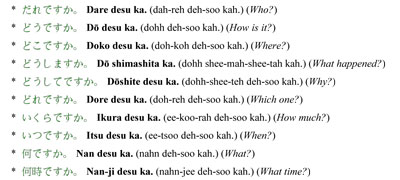
How? Dō desu ka? (dohh deh-soo kah)
Howmuch? Ikura desu ka? (ee-koo-rah deh-soo kah)
What? Nan desu ka? (nahn deh-soo kah)
What happened? Dō shimashita ka? (dohh shee-mah-shee-tah kah)
Whattime? Nan-ji desu ka? (nahn-jee deh-soo kah)
When? Itsu desu ka? (ee-tsoo deh-soo kah)
Where? Doko desu ka? (doh-koh deh-soo kah)
Whichone? Dore desu ka? (doh-reh deh-soo kah)
Who? Dare desu ka? (dah-reh deh-soo kah)
Why? Dōshite desu ka? (dohh-shee-teh deh-soo kah)

Language Phrases Glossary
accusative case
When noun or pronoun is the direct object of the verb of the sentence, you are required to switch to the accusative case ending.

Language Phrases Glossary
dative case
When noun or pronoun is the indirect object of the verb of the sentence, you are required to switch to the dative case ending.

Language Phrases Glossary
genitive case
When the noun or pronoun indicates possession, you are required switch to the genitive case ending.

Language Phrases Glossary
instrumental case
A Russian grammatical term that indicates that the noun or pronoun assist in the carrying out of an action, you are required to switch to the accusative case ending.

Language Phrases Glossary
interrogative
Words used to ask questions, such as who, what, when, where, and why.

Language Phrases Glossary
macron
A small, horizontal mark above the vowel that indicates a long vowel sound. Make the vowel sound like its name.

Language Phrases Glossary
nominative case
When noun or pronoun is the subject of the sentence, you are required to switch to the nominative case ending.

Language Phrases Glossary
prepositional case
A grammatical case that indicates that the noun or pronoun is the object of a preposition, you are required to switch to the accusative case ending. Used with the Russian prepositions: v (v; in), na (nah; on), o (oh; about), and ob (ohb; about).
Comments (0)
Leave a Reply