
Growing Vegetables on Hills, Rows, or Raised Beds
After you determine the best spot for your vegetable garden, sketch a plan and decide the planting method: rows, hills or raised garden beds. These basic garden layouts have different advantages and uses:
In rows: Any vegetable can be planted in straight rows, but this arrangement works best with types that need quite a bit of room, such as tomatoes, beans, cabbages, corn, potatoes, peppers, and summer squash.
In hills: Hills are typically used for vining crops. Create a 1-foot-wide, flat-topped mound (or a circle at ground level for sandy soil). Surround the soil with a moatlike ring. Grow two or three evenly spaced plants on each hill.
In raised beds: Make your bed at least 2 feet wide and raised at least 6 inches high. Almost any vegetable benefits from a raised bed, but smaller vegetables and root crops, such as lettuce, beets, carrots, onions, spinach, and radishes, really thrive with this type planting.
A raised bed can be a temporary bed with the soil piled 5 or 6 inches high. Or you can build a permanent raised bed.
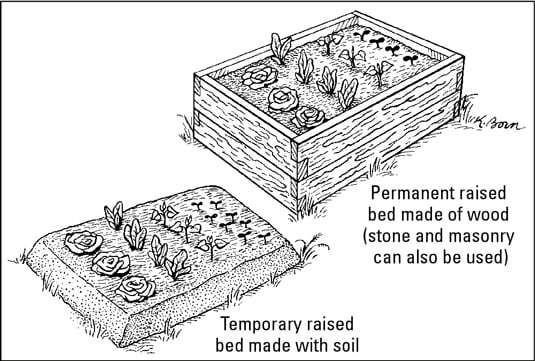
Make raised beds with soil, or wood, stone, or masonry sides.
Raised beds have several advantages, including the following:
They solve soil problems: If you have bad soil or poor drainage, you can amend the garden soil in the raised bed with compost. And because you don't step on the beds as you work, the soil stays light and fluffy, providing the perfect conditions for root growth — especially for root crops such as carrots and beets.
They warm up quickly: Because more of the soil in raised beds is exposed to the sun, the soil warms faster, allowing for early planting.
If you're in a hot climate and have sandy soil, raised beds may dry out and heat up too much.
They reduce your work: By growing your vegetables in raised beds, you can maximize your fertilizing and watering so that more nutrients and water are actually used by the plants rather than wasted in the pathways.
They're easy on your back and knees: If you design beds 18 to 24 inches high and no wider than 4 feet, you can sit on the edge and reach into the bed to weed or harvest.
They're attractive: You can make raised beds in almost any shape you like — rectangle, square, triangle, circle. Your garden can take on a whimsical design with a little creativity.
Wooden raised beds should be made of rot-resistant woods, such as redwood or cedar, or recycled plastic timbers. Some gardeners use pressure-treated wood or creosote-treated railroad ties to construct raised beds. Although these materials last a long time, these chemicals leach into the soil and can adversely affect your plants.

Gardening Glossary
annuals
Plants that complete their entire life cycle within one growing season. The plant germinates from seed, grows and blooms, and then produces seed and dies.

Gardening Glossary
biennials
A plant that take two growing seasons to complete its life cycle. It germinates and grows leaves and stems in the first year; produces flowers and fruit (seed) in the second, and then dies.

Gardening Glossary
bolt
When a plant flowers or produces seed prematurely.

Gardening Glossary
cold frame
A wooden or concrete block box in which you can grow plants or hold dormant during the cold winter months.

Gardening Glossary
cole crops
A family of vegetables, including broccoli, cabbage, cauliflower, kale, and Brussels sprouts. They thrive in cooler weather.

Gardening Glossary
complete fertilizer
Any fertilizer that contains all three of the primary nutrients, N-P-K (nitrogen, phosphorus, potassium). Phrase is based on regulations governing the fertilizer industry. Does not mean that the fertilizer literally contains everything a plant needs to thrive.

Gardening Glossary
deadheading
The practice of pinching or cutting off spent flowers

Gardening Glossary
evaporative-pad humidifier
A humidifier in which fans blow across a moisture-laden pad that sits in a reservoir of water.

Gardening Glossary
harden off
The process of acclimating plants grown indoors gradually to the brighter light and cooler temperatures of the outside world.

Gardening Glossary
hardiness
The ability of a plant to survive is called its hardiness.

Gardening Glossary
humus
A stable end product of organic-matter decomposition that's believed to increase microbial activity in soil, improve soil structure, and enhance the root development of plants.

Gardening Glossary
Bacillus thuringiensis Bt
An effective bacteria that attacks only the larvae of caterpillar family insects. It is safe to other insects, animals, and humans.

Gardening Glossary
macronutrients
Mineral nutrients that plants need in the largest quantities: nitrogen, phosphorus, potassium, calcium, magnesium, and sulfur.

Gardening Glossary
mulch
Organic or inorganic material placed over the surface of soil, usually directly over the root zone of growing plants. Used to conserve moisture, kill weed seedlings, modify soil temperature, provide attractive covering to garden beds.

Gardening Glossary
organic matter
Once-living stuff like compost, sawdust, animal manure, ground bark, grass clippings, and leaf mold (composted tree leaves). Used to enrich soil and improve soil texture.

Gardening Glossary
perennials
Any plant with a life cycle of three or more years. Herbaceous (non-woody) perennials include flowering plants and herbs, mainly. Woody perennials include trees and shrubs. Longevity depends on the plant and growing conditions.

Gardening Glossary
pH
The measure of soil's acidity. Soil with low pH means it's too acidic; soil with high pH means it's alkaline. Most plants grow best in soil with a pH value between 6.5 and 7.2. Neutral soils measure 7.

Gardening Glossary
photosynthesis
The process through which plants take nutrients from the air and from the water in the soil to produce sugars that fuels the plant's growth.

Gardening Glossary
primary nutrients
Nitrogen, phosphorous, and potassium are the three nutrients plants need in the largest quantities.

Gardening Glossary
root crops
Plants with edible underground roots such as onions, carrots, beets, potatoes, turnips. Most root crops are cold-weather crops.

Gardening Glossary
self-blanching
A type of cauliflower with leaves that naturally curl over the head and exclude light. Requires cool temperatures for leaves to curl effectively.

Gardening Glossary
sets
Small onion bulbs, about 1/2-inch wide, that were started from seed the previous year. Grow onion sets with the pointy end up.

Gardening Glossary
side-dressing
The act of adding a small amount of fertilizer around or "on the side" of plants after they're growing.

Gardening Glossary
succession planting
Planting small, 2-to-4-foot patches of plants every two weeks throughout the growing season so that you can harvest a crop over an extended period of time.

Gardening Glossary
thinning
The act of cutting the least robust seedlings in your garden to give the healthier plants more room to grow.

Gardening Glossary
vining crops
Crops that grow on vines, such as cucumbers, melons, pumpkins, and winter squash. They usually require support (staking, trellising, etc.) to keep them off the ground.